An end-to-end voice communication node addressing method based on two-layer structure

A two-layer structure, voice communication technology, applied in digital transmission systems, electrical components, transmission systems, etc., can solve the problems of uneven distribution of logical network nodes, uneven resource search efficiency, and violation of end-to-end network design. Achieve good access search efficiency, improve addressing efficiency, and improve the effect of quick positioning

CN103401953BInactive Publication Date: 2016-07-06SOUTHEAST UNIV
2 Cites 0 Cited by

Patent Information

Authority / Receiving Office
CN · China
Patent Type
Patents(China)
Current Assignee / Owner
Publication Date
2016-07-06
Estimated Expiration
Not applicable · inactive patent

Smart Images

  • Figure 1
    Figure 1
  • Figure 2
    Figure 2
  • Figure 3
    Figure 3
Patent Text Reader

Abstract

The invention discloses an end-to-end voice communication node addressing method based on a double-layer structure. When each node participating in the communication is connected to the network, it is logically divided into two layers, and the upper layer is composed of a super node through a distributed hash table mechanism. To connect, the lower ordinary node selects a super node of the upper layer as the host node, and this super node implements the distributed hash table mechanism publishing and searching of ordinary node information. When a node accesses, it will distinguish super nodes, backup super nodes and ordinary nodes according to their own network address properties, network bandwidth capabilities, computing processing capabilities, and storage capabilities. The distributed hash table mechanism adopted applies the improved K-bucket structure, adding the IP address and port number information of the connected super node. In the process of node joining and addressing, super nodes and ordinary nodes will be implemented according to different steps. The invention can effectively improve the addressing efficiency of the voice communication node.
Need to check novelty before this filing date? Find Prior Art

Description

technical field

[0001] The invention relates to the field of voice communication, in particular to an end-to-end voice communication node addressing method based on a double-layer structure. Background technique

[0002] Traditional network voice communication requires the help of a central addressing server to address and locate the destination terminal. For example, users in the SIP voice communication protocol need to register their own information on the SIP server first. When the user makes a call, he needs to query the address information of the target user through the SIP server, and then through the corresponding signaling interaction, the streaming media communication channel can be established. . It can be seen from this that in the client / server mode, the server is responsible for the registration, query and maintenance functions of all end users, and the performance of the server directly affects the reliability and stability of the entire system. The server ha...

Examples

Embodiment Construction

[0032] A two-layer structure-based end-to-end voice node addressing method of the present invention will be further explained below in combination with specific embodiments.

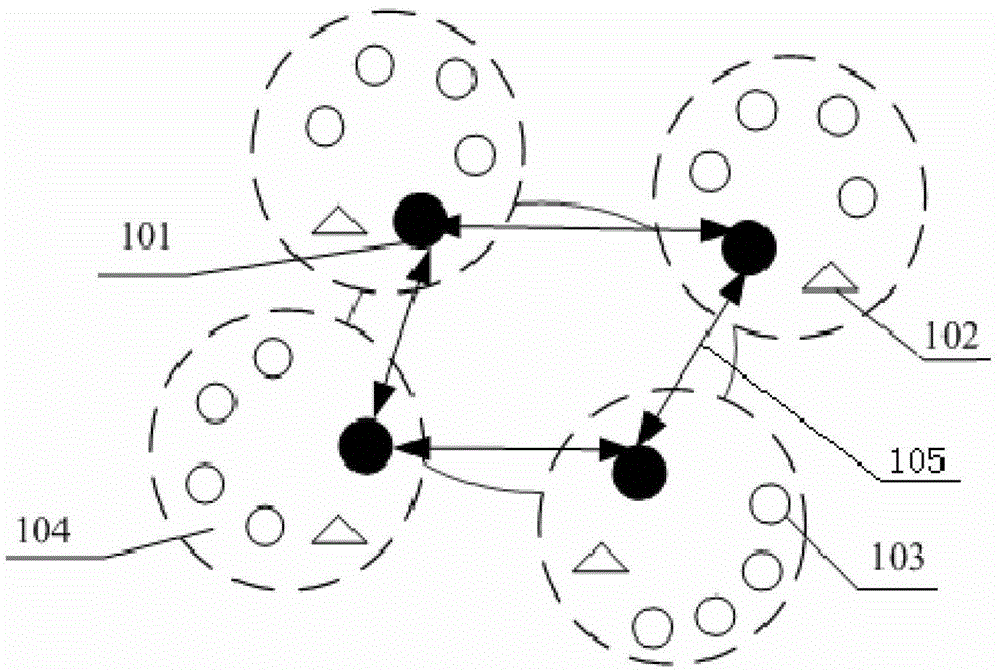
[0033] existfigure 1 In the present invention, the nodes accessing the network are divided into super nodes 101, backup super nodes 102 and ordinary nodes 103. The nodes are logically divided into two layers. The upper layer network 105 is connected by the super node 101 through the distributed hash table mechanism, while the lower layer includes the backup super node 102 and the ordinary node 104. Their call addressing process will be connected by the super node The node's distributed hash table mechanism is used to assist in the completion.

[0034] figure 1 The ordinary nodes and standby supernodes connected under each supernode form a subnetwork domain 104. This subnetwork domain 104 is only a logical subnetwork, but it is composed of ordinary nodes or standby supernodes that are physically close to...