Case hardening steel and carburized component obtained therefrom

A technology for hardening steel and parts, applied in the direction of coating, metal material coating process, solid diffusion coating, etc., can solve technical difficulties and other problems, and achieve the effect of improving hardenability and excellent cold forgeability

CN106062227AActive Publication Date: 2016-10-26DAIDO STEEL CO LTD
9 Cites 0 Cited by

Patent Information

Authority / Receiving Office
CN · China
Patent Type
Applications(China)
Current Assignee / Owner
Publication Date
2016-10-26

Smart Images

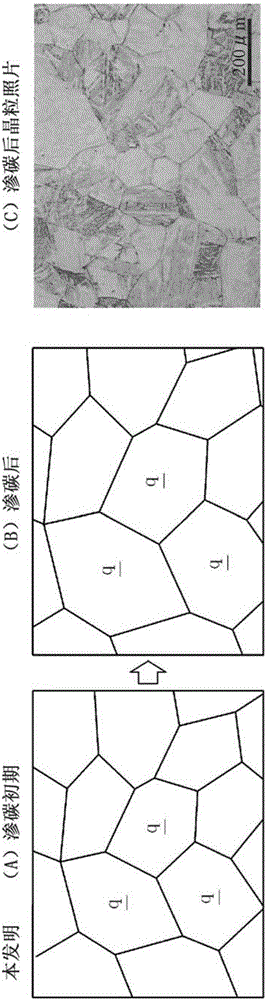
  • Figure 1
    Figure 1
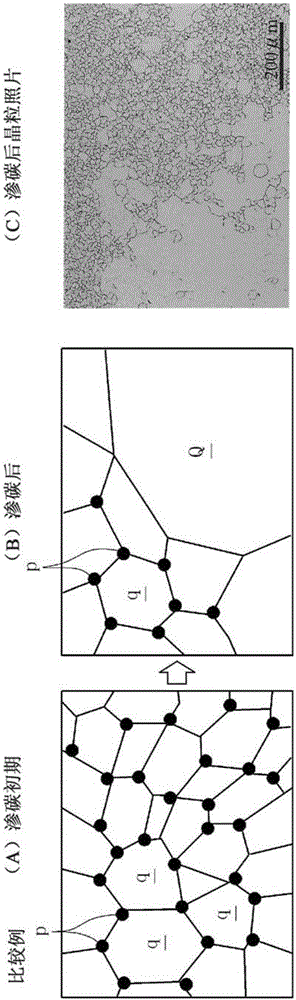
  • Figure 2
    Figure 2
  • Figure 3
    Figure 3
Patent Text Reader

Abstract

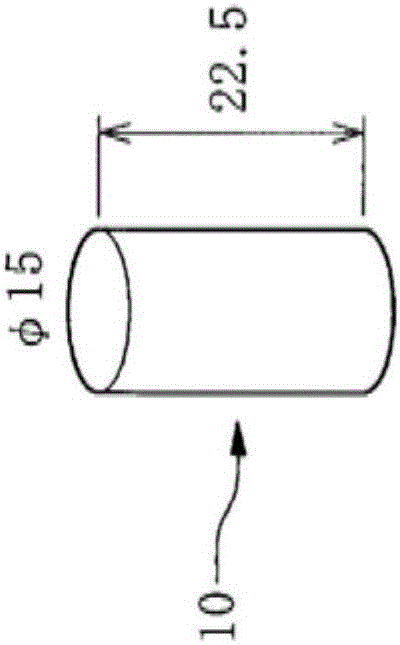
The present invention addresses the problem of providing a case hardening steel excellent in terms of cold forgeability and hardenability and a carburized component obtained therefrom. The case hardening steel satisfies the following relationship (1): sigma MAX<12.8*DI+745 relationship (1) where DI is a value determined by a Jominy quench test and sigma MAX (MPa) is the maximum deformation resistance determined in such a manner that test pieces having dimensions of 15 mm (diameter) *22.5 mm are cut out of the material which has undergone spheroidization annealing and are deformed by cold compression at a draft of 70% while keeping the end surfaces of each test piece restrained. The carburized component is obtained by carburizing and hardening the case hardening steel.
Need to check novelty before this filing date? Find Prior Art

Description

technical field

[0001] The present invention relates to a case-hardened steel having excellent cold forgeability and hardenability, and to a carburized part obtained using the same. Background technique

[0002] As a method of processing steel into the shape of gears and other parts, hot forging, which forges steel at high temperatures, is widely used.

[0003] However, in hot forging, the material to be forged needs to be heated under high temperature conditions, and the mold needs to be heated. Therefore, there is a problem that the required cost increases because a large amount of heat energy is consumed and the number of processing steps increases.

[0004] The processing method has been changed from hot forging to cold forging. In cold forging, no heating is required and the number of processing steps is reduced. Therefore, it is possible to reduce the required cost.

[0005] However, compared with hot forging, the deformation resistance of the forged material incre...

Examples

Embodiment

[0187] Each steel material having the chemical composition shown in Table 1 was melted, kept under heating at 1,250°C for 4 hours, and then hot rolled at a temperature above 950°C, whereby the steel material was made into a cylindrical test piece and diameter A steel bar with a φ of 30 mm is used for the Jominy end hardenability test defined in JIS G 0561 (2011).

[0188] Each test piece for the Jominy end hardenability test was used and the Jominy end hardenability test was performed to obtain the DI value.

[0189] In addition, various steel bars having a diameter φ of 30 mm were used and various tests described below including a forging test were performed.

[0190] Usually, since the parts to be cold forged are subjected to softening heat treatment before forging, the steel bar is kept at 760°C for 4 hours, and then the temperature is lowered to 650°C at a rate of 15°C / h and carried out in air. Cooling softening treatment, measuring the hardness after softening treatment ...