
J-wave detection and classification method based on Q-modulated wavelet transform and high-order cumulants
A high-order cumulant and wavelet transform technology, applied in character and pattern recognition, pattern recognition in signals, instruments, etc., can solve the problem of low detection accuracy of J-wave signals
- Summary
- Abstract
- Description
- Claims
- Application Information
AI Technical Summary
Problems solved by technology
Method used
Image



Examples
Embodiment Construction
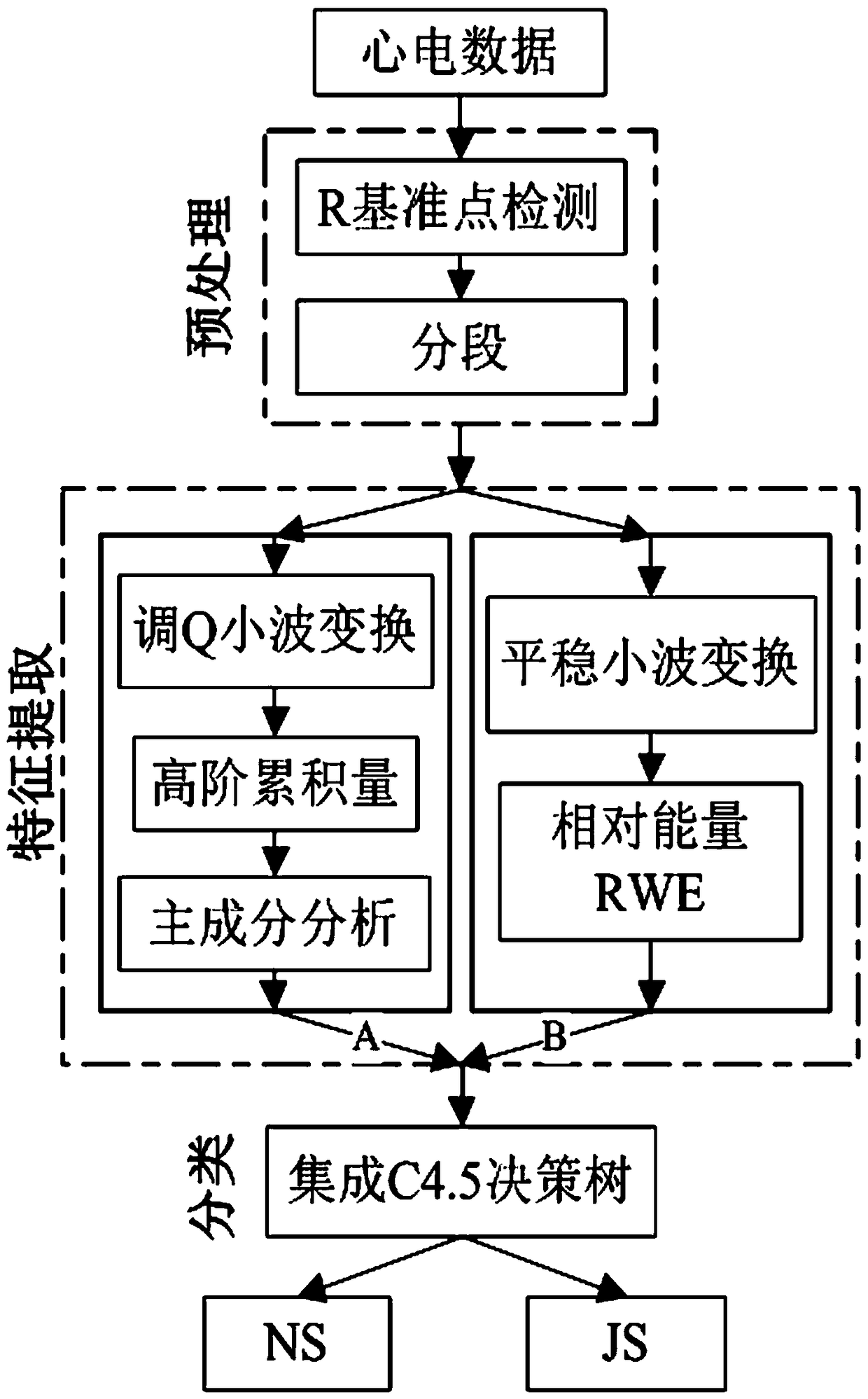
[0018] The J-wave detection and classification method based on Q-switched wavelet transform and high-order cumulant comprises the following steps:
[0019] (1) Obtain the required ECG signals through the electrocardiograph, including normal signal (NS) and J wave signal (JS). Because the electrocardiograph has a noise filtering module, it can directly obtain the ECG signal after the noise is removed.
[0020] (2) Since the J wave is mainly prominent in the ST segment of the ECG, and sometimes also appears in the descending branch of the QRS, in order to improve the detection efficiency and reduce the computational complexity, the stationary wavelet transform is used to detect the R peak point of the ECG signal, and the R peak point is intercepted. The 128 sample points after the peak point are used as initial data samples.
[0021] (3) Apply stationary wavelet transform and Q-switched wavelet transform to the initial data samples for 4-layer decomposition, and extract the fol...
PUM
 Login to View More
 Abstract
Description
Claims
Application Information
 Login to View More