Distribution network differential planning method with consideration of composite fault risk

A technology for complex faults and distribution network, applied in the direction of instruments, data processing applications, information technology support systems, etc., can solve the problems of lack of evaluation and planning methods, inability to reflect the actual situation of disaster response capabilities from multiple aspects, and weak research.

CN106875105AActive Publication Date: 2017-06-20NORTHEASTERN UNIV
5 Cites 16 Cited by

Patent Information

Authority / Receiving Office
CN · China
Patent Type
Applications(China)
Current Assignee / Owner
Publication Date
2017-06-20

Smart Images

  • Figure 1
    Figure 1
  • Figure 2
    Figure 2
  • Figure 3
    Figure 3
Patent Text Reader

Abstract

The invention, which belongs to the technical field of power system planning, provides a distribution network differential planning method with consideration of a composite fault risk. The method comprises: according to a climatic condition of a region where a distribution network is located, meteorological protection levels of the region are set; historical failure rates of all lines under all meteorological protection levels are calculated; according to the historical failure rates, composite line failure rate prediction values are planned; candidate distribution network differential planning schemes are formulated; and a comprehensive evaluation system is constructed, all candidate distribution network differential planning schemes are evaluated, and then an candidate distribution network differential planning schemes is selected. According to the distribution network differential planning method, with consideration of influences on the distribution network by composite meteorological disasters, the comprehensive disaster handling capability of the distribution network is enhanced and security operation of the distribution network is guaranteed; on the basis of the composite failure rate economic risk evaluation, a cost and a failure disaster risk are balanced; the planning scheme is evaluated in terms of the failure recovery capability, so that the method has an important practical significance in promoting application and perfection of distribution network planning work; and the distribution network planning efficiency and planning quality can be improved.
Need to check novelty before this filing date? Find Prior Art

Description

technical field

[0001] The invention belongs to the technical field of electric power system planning, and in particular relates to a differential planning method for a distribution network considering compound fault risks. Background technique

[0002] With the continuous expansion of power grid scale, people have higher and higher requirements for power quality. In recent years, extreme weather disasters have occurred frequently, and the probability of line failure has increased significantly. When a major disaster occurs, it is very important to ensure the safe and stable operation of the distribution network and the continuous power supply of important loads. Traditional distribution network planning determines the optimal planning scheme through load forecasting during the planning period and analysis of the existing grid structure. On the premise of meeting the load requirements and safe and reliable power supply, the construction and operation costs of the distributio...

Examples

Embodiment Construction

[0058] An embodiment of the present invention will be described in detail below in conjunction with the accompanying drawings.

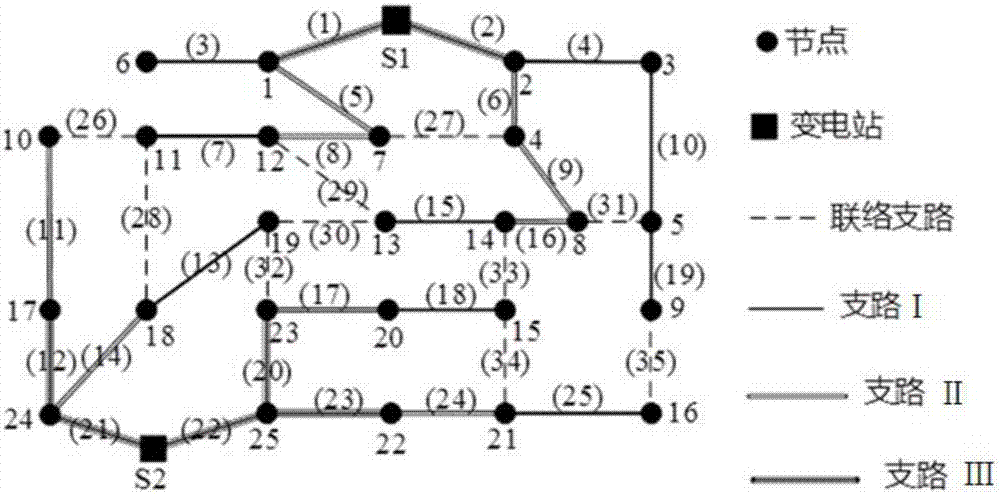
[0059] The distribution network differentiation planning method considering the compound fault risk in this embodiment is the planning for the 10kV distribution network in area A. Such as figure 1 As shown, the distribution network has 25 load nodes, 2 substations, each with 2 feeders, 27 existing branches and 8 contact branches.

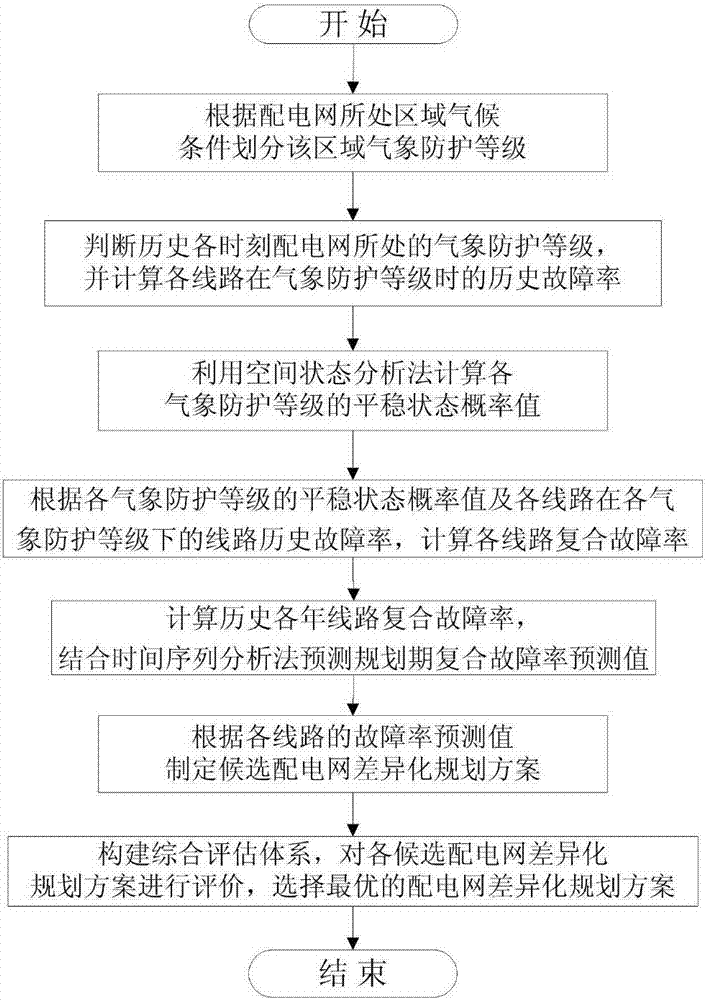
[0060] Such as figure 2 As shown, a distribution network differentiation planning method considering the composite fault risk includes the following steps:

[0061] Step 1: Divide the weather protection level of the area according to the regional climate conditions of the distribution network:

[0062] Step 1-1: Formulate the scoring rules for each real-time weather information in the current period of the area where the distribution network is located. The weather information includes: temperature, air pressure, humid...