
Multi-manufacturer OTN business configuration end-to-end intercommunication systems and methods based on SDN (Software Defined Network)
A technology for service configuration and intercommunication system, applied in the field of multi-vendor OTN service configuration end-to-end intercommunication system, which can solve the problems of inability to configure end-to-end services and cumbersome operations, and save the manual operation process.
- Summary
- Abstract
- Description
- Claims
- Application Information
AI Technical Summary
Problems solved by technology
Method used
Image

Examples
Embodiment 1
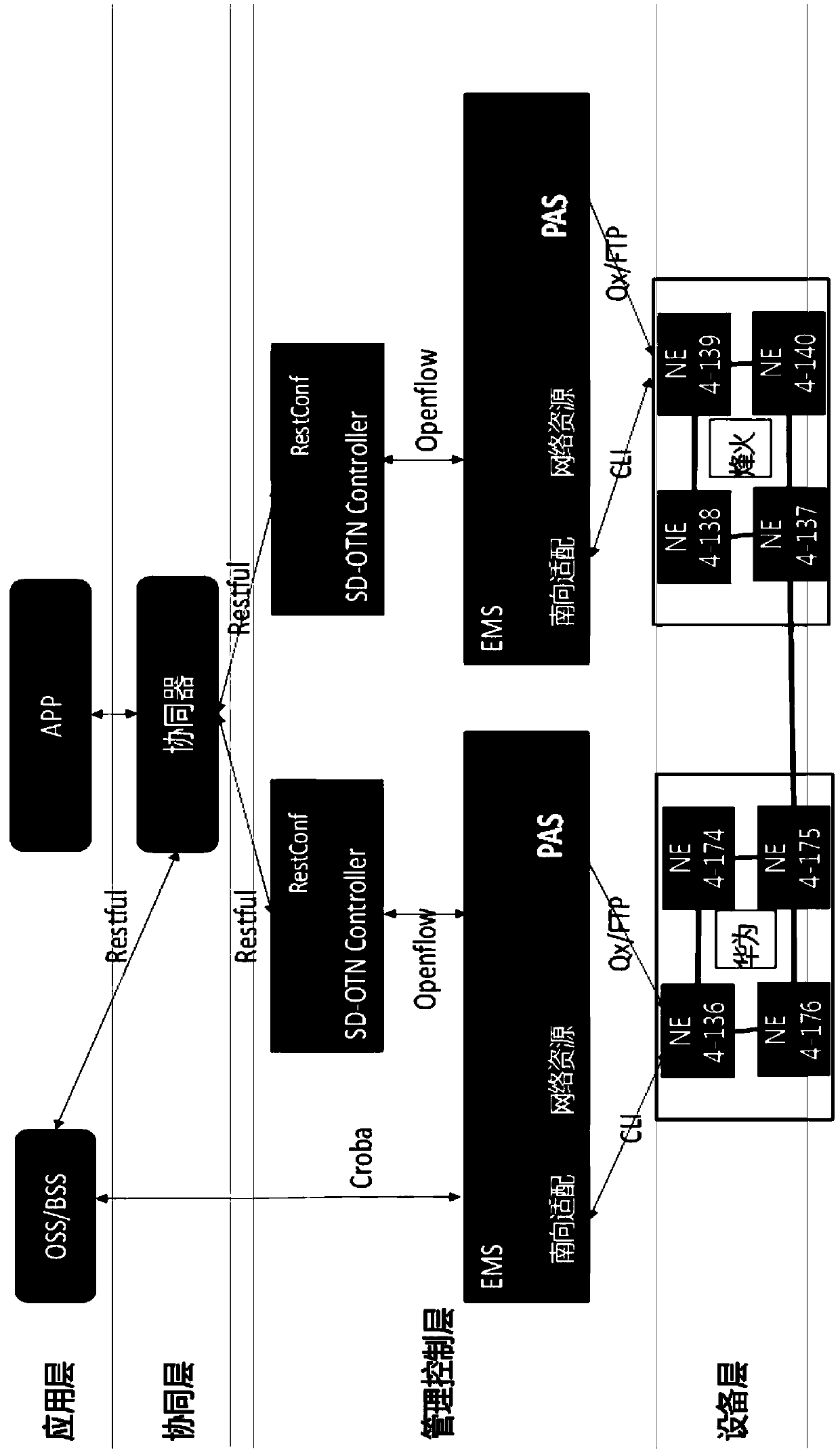
[0033] One of the implementation modes of the present invention is an SDN-based multi-vendor OTN service configuration end-to-end interworking system and method, an SDN-based multi-vendor OTN service configuration end-to-end interworking system, such as Figure 1 As shown, it includes: application layer, coordination layer, management control layer and equipment layer; the equipment layer includes each network element (NE) in the OTN network, and the management control layer includes several network element controllers (ie figure 1 SD-OTN controller in SD-OTN controller) and several EMS; the coordination layer includes network synergists; the application layer includes OSS / BSS (OSS, Operation Support System, operation support system; BSS, Business Support System, business support system; OSS / BSS is a telecom The support system for the integration of operators and information resource sharing, which is mainly composed of network management, system management, billing, business, ...
Embodiment 2
[0050] One of the implementation modes of an SDN-based multi-vendor OTN service configuration end-to-end interworking system and method of the present utility model, the main technical solution of this embodiment is basically the same as that of Embodiment 1, and there are no explanations in this embodiment Features, use the explanation in Embodiment 1, and will not repeat them here. The difference between this embodiment and Embodiment 1 is that an SDN-based multi-vendor OTN service configuration end-to-end interworking method includes the following steps:
[0051] Sa': Enter the intercommunication business order through OSS / BSS.
[0052] S1: OSS / BSS generates intercommunication service application information according to the entered intercommunication service order, and sends it to the network coordinator;
[0053] S2: The network coordinator retrieves the corresponding service start network element and service end network element in the OTN network topology according to t...
Embodiment 3
[0058] One of the implementation modes of an SDN-based multi-vendor OTN service configuration end-to-end interworking system and method of the present utility model, the main technical solution of this embodiment is basically the same as that of Embodiment 1, and there are no explanations in this embodiment Features, use the explanation in Embodiment 1, and will not repeat them here. The difference between this embodiment and Embodiment 1 is that an SDN-based multi-vendor OTN service configuration end-to-end interworking method includes the following steps:
[0059] Sa: Enter the user account information through the user APP and send it to the network coordinator, the network coordinator sends the user account information to the OSS / BSS, and the OSS / BSS matches the received user account information with the stored user account information, and judges Whether the entered user account information is valid, if valid, enter step Sb, if invalid, OSS / BSS generates login failure info...
PUM
 Login to View More
 Abstract
Description
Claims
Application Information
 Login to View More