
Communications device, communications apparatus operating as a relay node, infrastructure equipment and methods
a communication device and relay node technology, applied in the field of communication devices and methods, can solve the problems of reducing transmission power capability compared with more conventional devices, presenting disadvantages and challenges to successful deployment, and requiring more complex and expensive radio transceivers to implemen
- Summary
- Abstract
- Description
- Claims
- Application Information
AI Technical Summary
Benefits of technology
Problems solved by technology
Method used
Image

Examples
example embodiment
Node Discovery
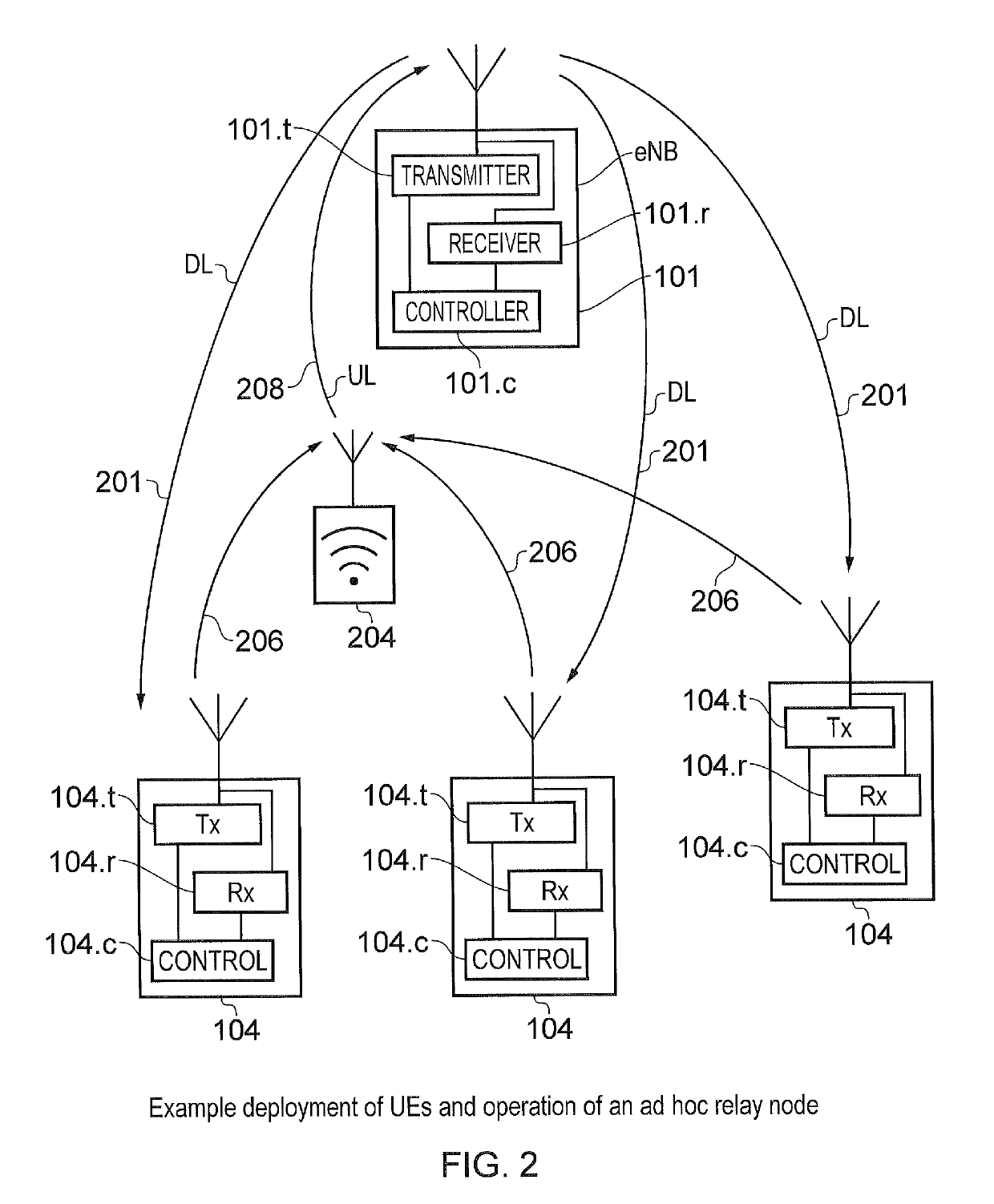
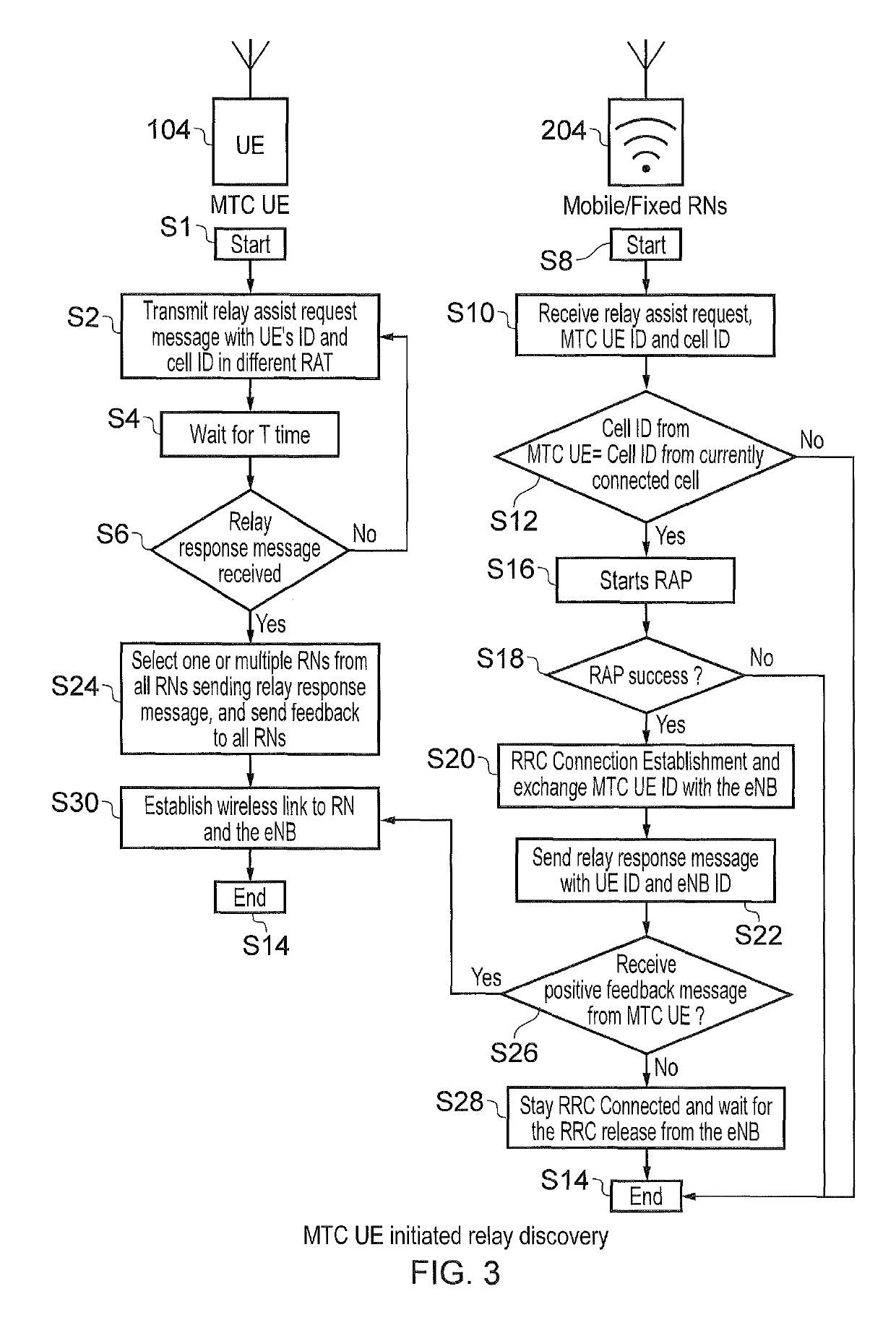
[0056]When a UE receives a paging message or some data enters its own transmit buffer for transmission on the Up-Link, it conducts Random Access Procedure (RAP). It is likely that the RAP will fail because of the coverage problem, in that signals transmitted by the UE on the Up-Link are not received with sufficient strength by the nearest eNode. As this point a relay node discovery procedure can be initiated by the UE. From the UE's perspective, the fixed relay nodes and the ad hoc relay nodes are similar and accordingly there is no need to differentiate these two categories in the relay discovery procedure.
[0057]An example embodiment of the present technique is illustrated by the flow diagram shown in FIG. 3, which provides an example operation of a UE 104 and a relay node 204. According to this example it is assumed that the fixed / mobile relay node 204 has already obtained a currently connected cell ID based on primary and secondary synchronisation signals. According...
PUM
 Login to View More
 Abstract
Description
Claims
Application Information
 Login to View More