Reduction of self-interference for a high symbol rate non-orthogonal matrix modulation

a non-orthogonal matrix, high symbol rate technology, applied in the direction of error prevention, digital transmission, diversity/multi-antenna systems, etc., can solve the problem of not achieving an increase in bit rate, and achieve the effect of reducing self-interferen

a non-orthogonal matrix, high symbol rate technology, applied in the direction of error prevention, digital transmission, diversity/multi-antenna systems, etc., can solve the problem of not achieving an increase in bit rate, and achieve the effect of reducing self-interferen

US20060008021A1Inactive Publication Date: 2006-01-12NOKIA CORP

Image

Smart Image Click on the blue labels to locate them in the text.
Viewing Examples
Smart Image
  • Reduction of self-interference for a high symbol rate non-orthogonal matrix modulation
  • Reduction of self-interference for a high symbol rate non-orthogonal matrix modulation
  • Reduction of self-interference for a high symbol rate non-orthogonal matrix modulation

Examples

Experimental program
Comparison scheme
Effect test

Embodiment Construction

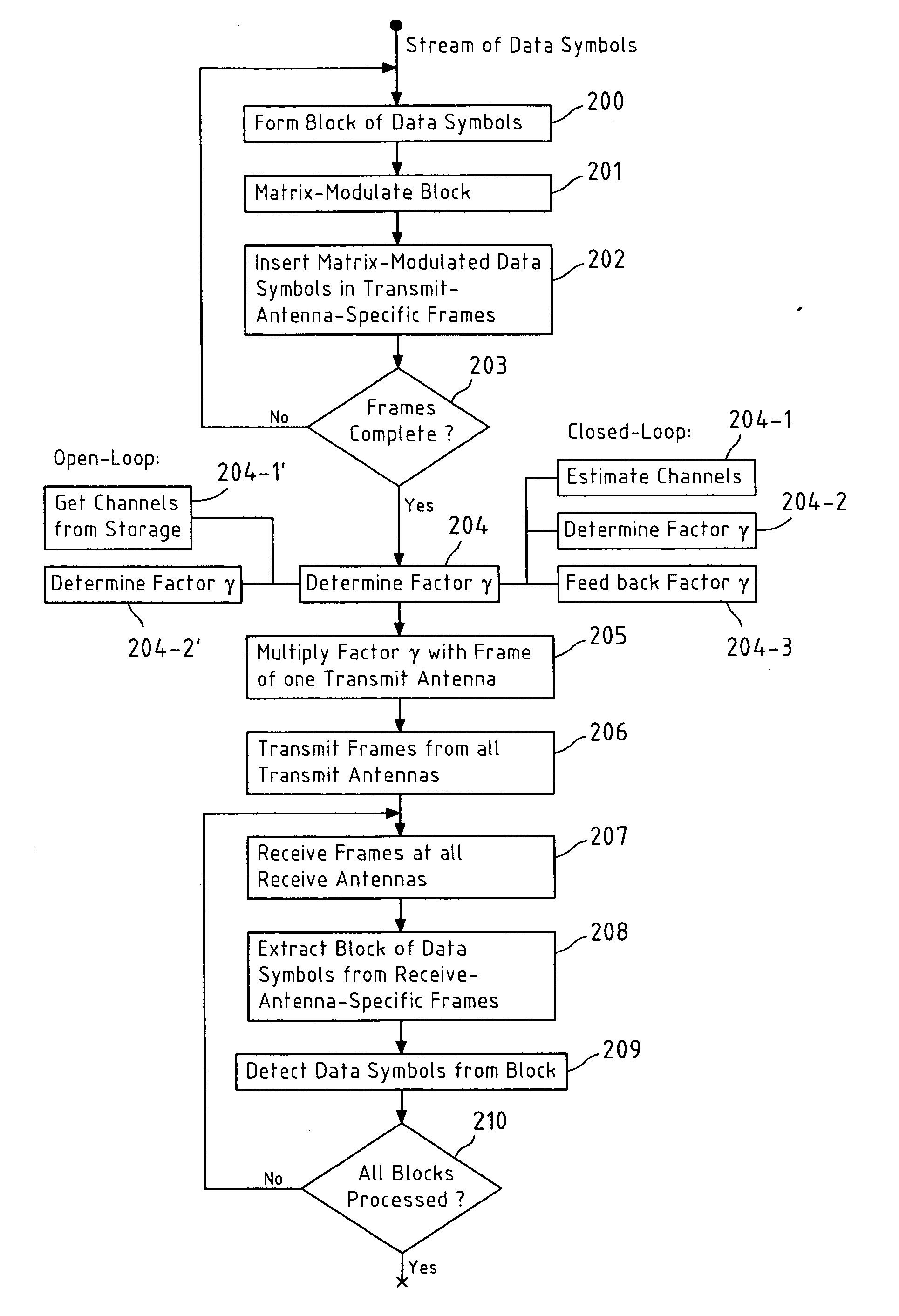
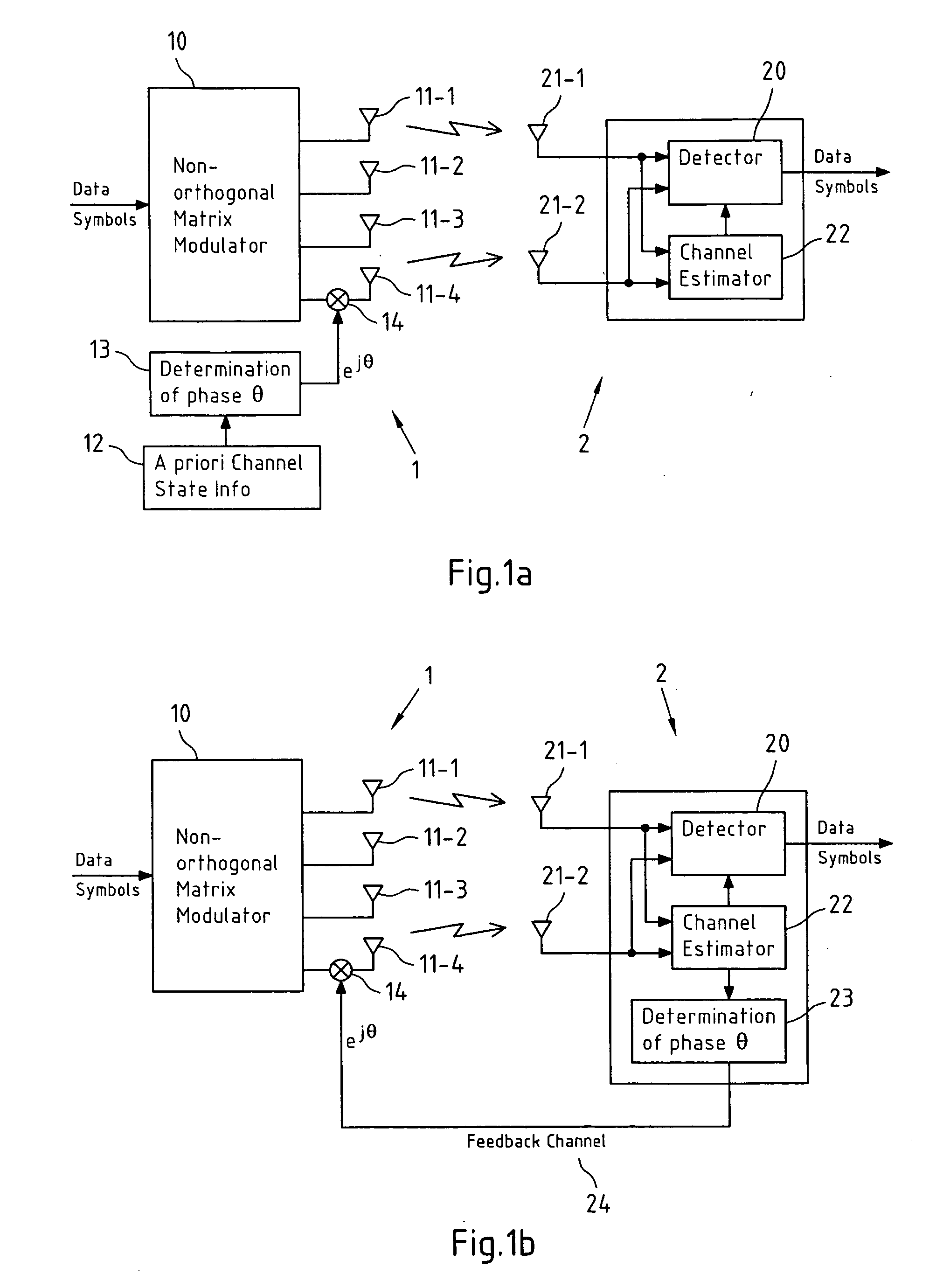
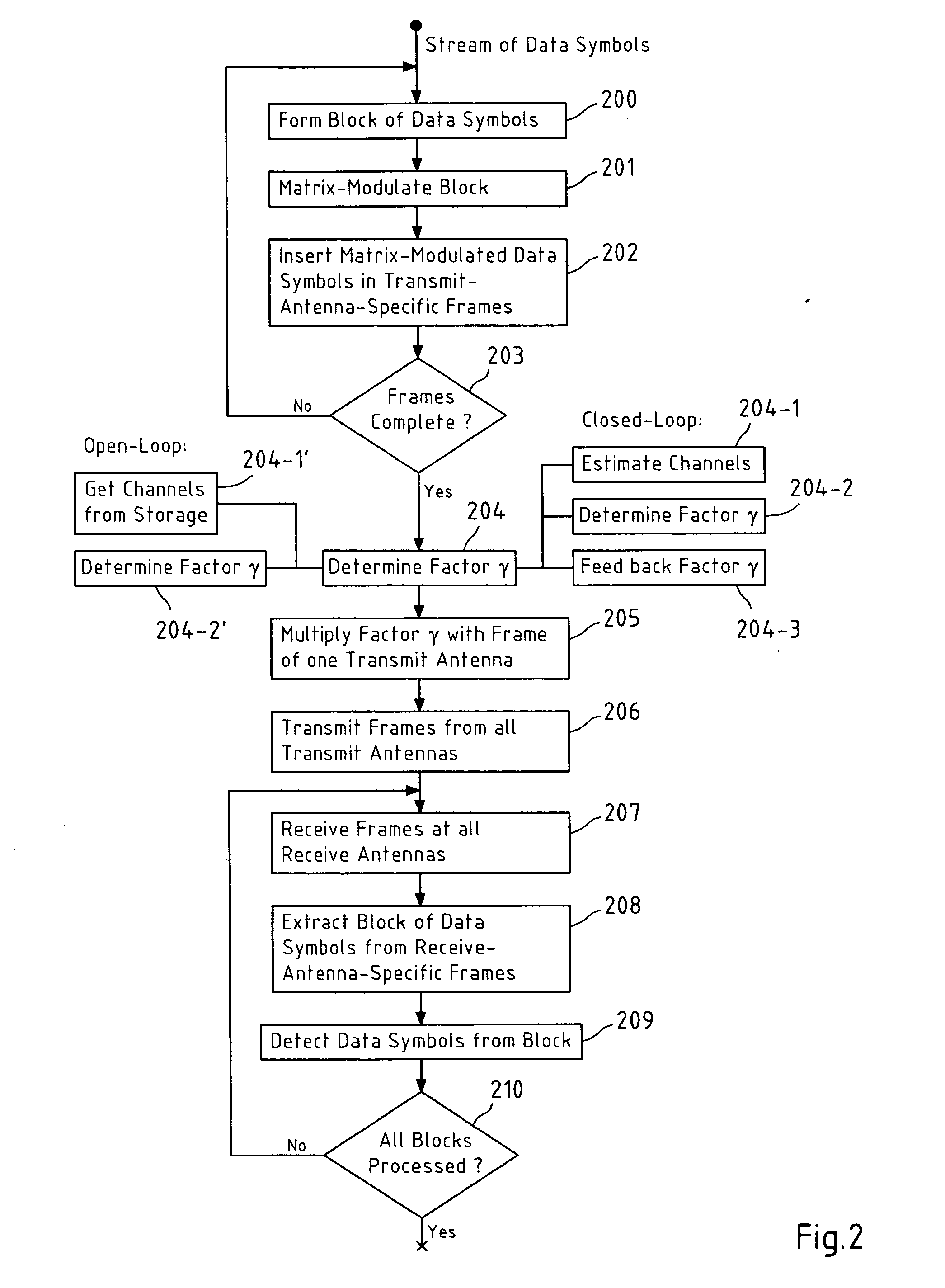
[0064] The present invention proposes to reduce the self-interference encountered in non-orthogonal matrix modulation with at least four transmit antennas and symbol rates equal to or larger than 2 symbols / time period by multiplying the data symbols mapped to one of said at least four transmit antennas by a factor γ that is properly determined to achieve this self-interference reduction. In the following, for illustrative purposes, the presentation will concentrate on closed-loop space-time matrix modulation. It should however be noted that the present invention lends itself for deployment in the context of all other orthogonal transmission resources such as frequency, polarization, codes or eigenmodes of a channel, and may equally well be applied in open-loop systems in which the factor γ is determined at the transmitter site.

[0065] As an example for the application of the present invention, the non-orthogonal DSTTD block code as defined in equation (9) will be considered. The equ...

the structure of the environmentally friendly knitted fabric provided by the present invention; figure 2 Flow chart of the yarn wrapping machine for environmentally friendly knitted fabrics and storage devices; image 3 Is the parameter map of the yarn covering machine
Login to View More

PUM

No PUM Login to View More

Abstract

A method for reducing self-interference between at least four data symbols that are modulated via a non-orthogonal matrix modulation and transmitted from at least four transmit antennas to at least one receive antenna comprises mapping the at least four data symbols onto the at least four transmit antennas and two orthogonal transmission resources via the non-orthogonal matrix modulation, multiplying data symbols mapped to one of the at least four transmit antennas with a factor γ, wherein γ is determined at least in dependence on the transmission channel characteristics from the at least four transmit antennas to the at least one receive antenna to reduce a self-interference between the at least four data symbols, and transmitting the mapped data symbols and the mapped and multiplied data symbols from the at least four transmit antennas to at least one receive antenna in the two orthogonal transmission resources.

Description

FIELD OF THE INVENTION [0001] This invention relates to a method for reducing self-interference between at least four data symbols that are modulated via a non-orthogonal matrix modulation and transmitted from at least four transmit antennas to at least one receive antenna. BACKGROUND OF THE INVENTION [0002] Conveying information over a multiple input multiple output (MIMO) system with multiple antennas at both the transmitter and receiver site of the transmission channel benefits from a significant enhancement of the channel capacity. This crucial fact has motivated a wide area of research over the past decade in order to better exploit multi-antenna systems. [0003] However, the existence of various transmission sub-channels due to the spatial diversity used at the transmitter and / or at the receiver site has a harmful outcome, namely the interference caused by the simultaneous transmission of different signals between the receiver and the transmitter. In the remainder of this speci...

Claims

the structure of the environmentally friendly knitted fabric provided by the present invention; figure 2 Flow chart of the yarn wrapping machine for environmentally friendly knitted fabrics and storage devices; image 3 Is the parameter map of the yarn covering machine
Login to View More

Application Information

Patent Timeline
12 Jan 2006
Publication
US20060008021A1
IPC
H04B7/02; H04L1/06
CPC
H04L1/0618
Inventors
BONNET, JEROME