Battery receptacle

a battery receptacle and battery technology, applied in the field of battery receptacles, can solve the problems of incorrect insertion or jamming of batteries into the battery receptacle, blood clot formation in the circulatory system of patients or blood pumps, and patients forgetting the proper handling procedures of batteries

US20070052389A1Inactive Publication Date: 2007-03-08VENTRACOR
4 Cites 5 Cited by

Patent Information

Authority / Receiving Office
US · United States
Patent Type
Applications(United States)
Current Assignee / Owner
Publication Date
2007-03-08
Estimated Expiration
Not applicable · inactive patent

Smart Images

  • Figure 1
    Figure 1
  • Figure 2
    Figure 2
  • Figure 3
    Figure 3
Patent Text Reader

Abstract

A battery receptacle for use with a medical device, said receptacle comprising at least one cavity accessed via a respective door, said cavity adapted to slidably receive at least one non-cylindrical battery to engage with electrical contacts in a single predetermined orientation, said receptacle and said battery each being provided with complementary slidable engagement means that must be engaged with each other when inserting said battery into said cavity, thereby only allowing said battery to engage said contacts in said single predetermined configuration, and wherein said receptacle further comprising at least one portion that allows said battery to be visible when said battery is inserted in said cavity and said door is closed.
Need to check novelty before this filing date? Find Prior Art

Description

FIELD OF THE INVENTION

[0001] The present invention relates to improvements in battery receptacles for use with battery-powered devices, and in particular with battery-powered medical devices including implantable blood pumps and left ventricle assist devices. BACKGROUND OF THE INVENTION

[0002] Implantable blood pumps may typically rely on power sources external to the patients to provide power to drive the blood pumps. One known power source has been by batteries housed within battery receptacles.

[0003] The known battery receptacles typically comprise a housing adapted to house a primary battery and a reserve battery within a housing. These two batteries function to sequentially supply power to battery-powered devices such as implantable blood pumps, and are typically charged by connection to wall sockets or chargers. Implantable blood pumps have very specific power requirements and these requirements include the need for a continuous power source. If the blood pump is stopped, ev...

Examples

Embodiment Construction

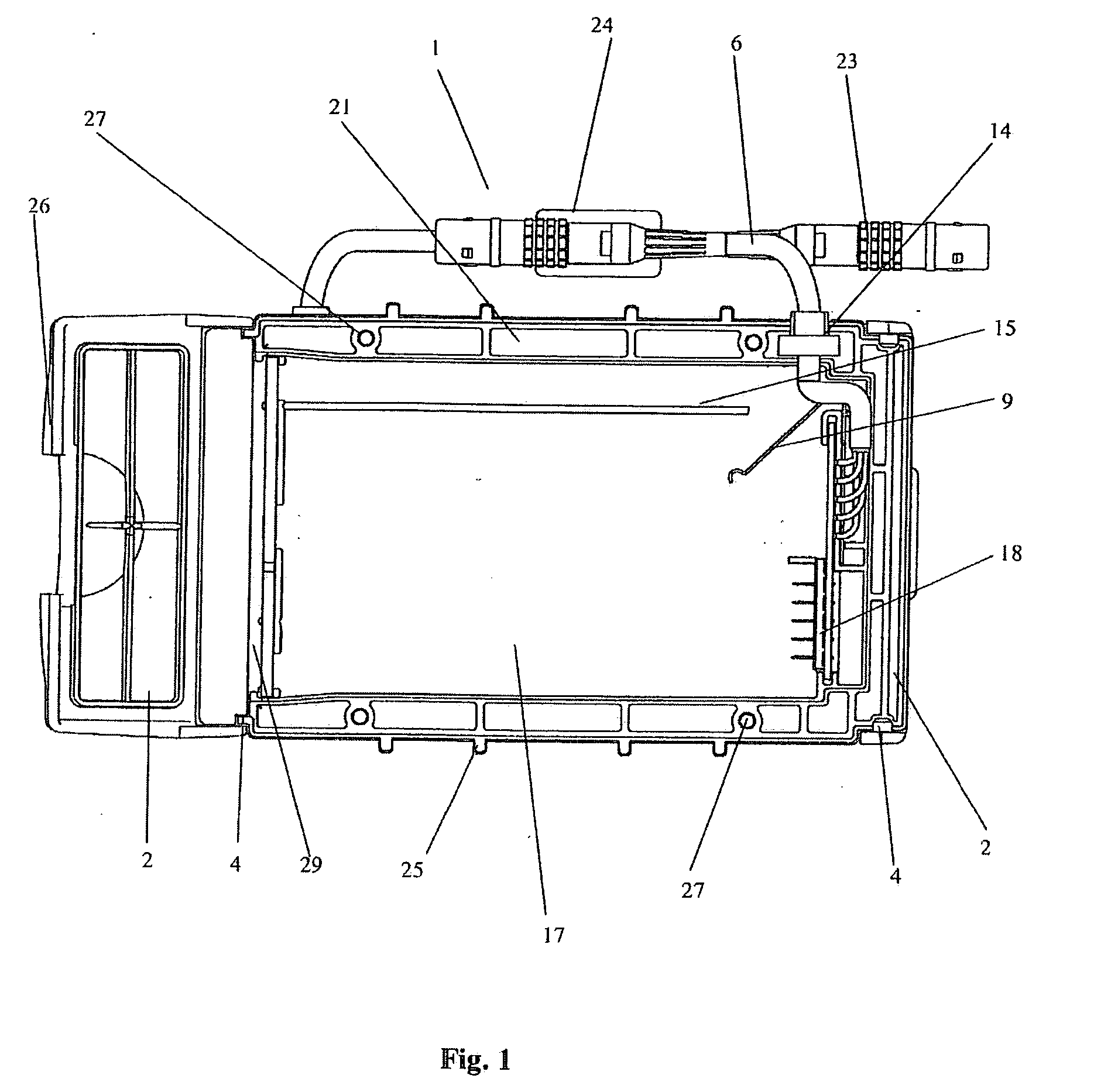
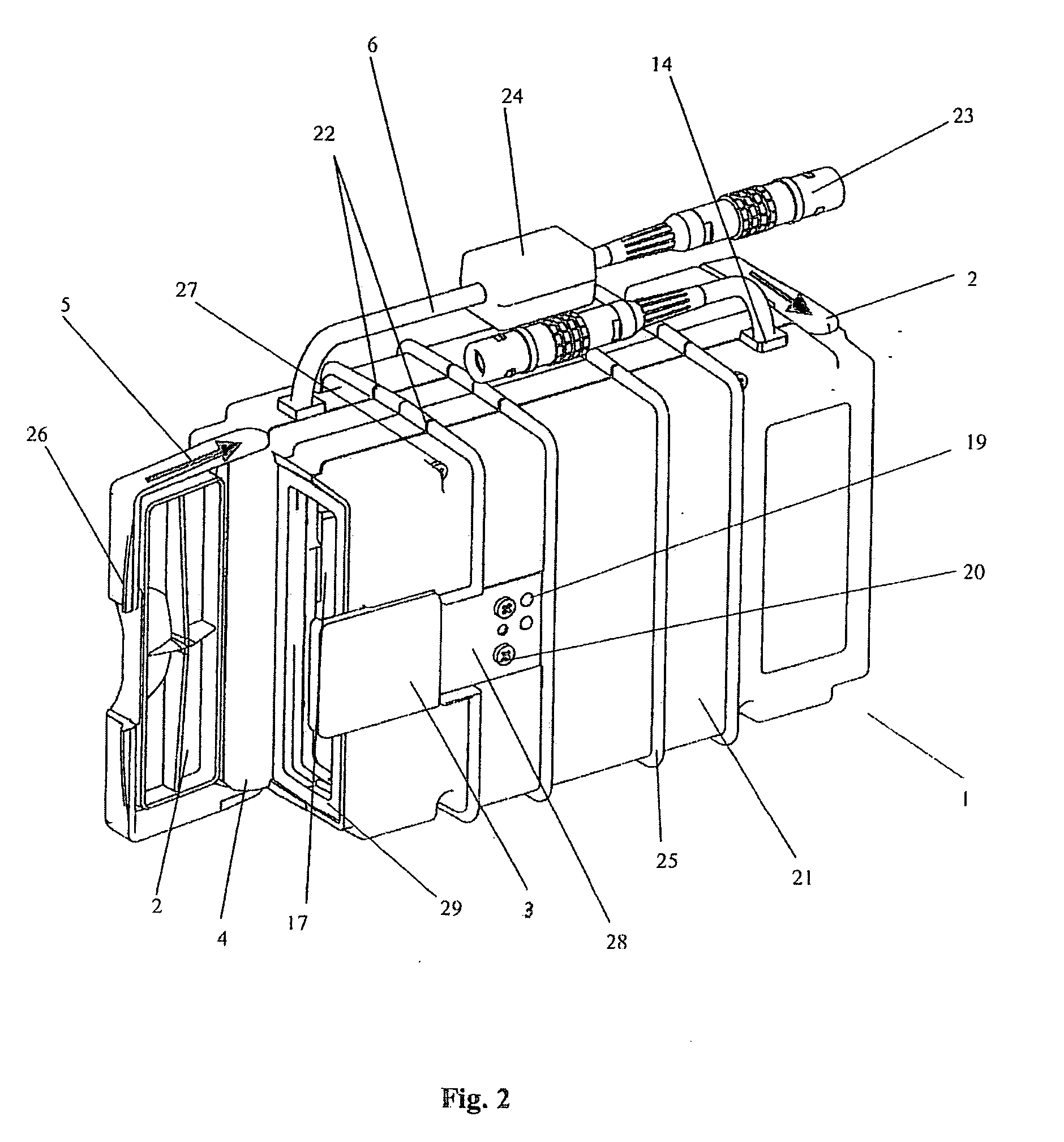
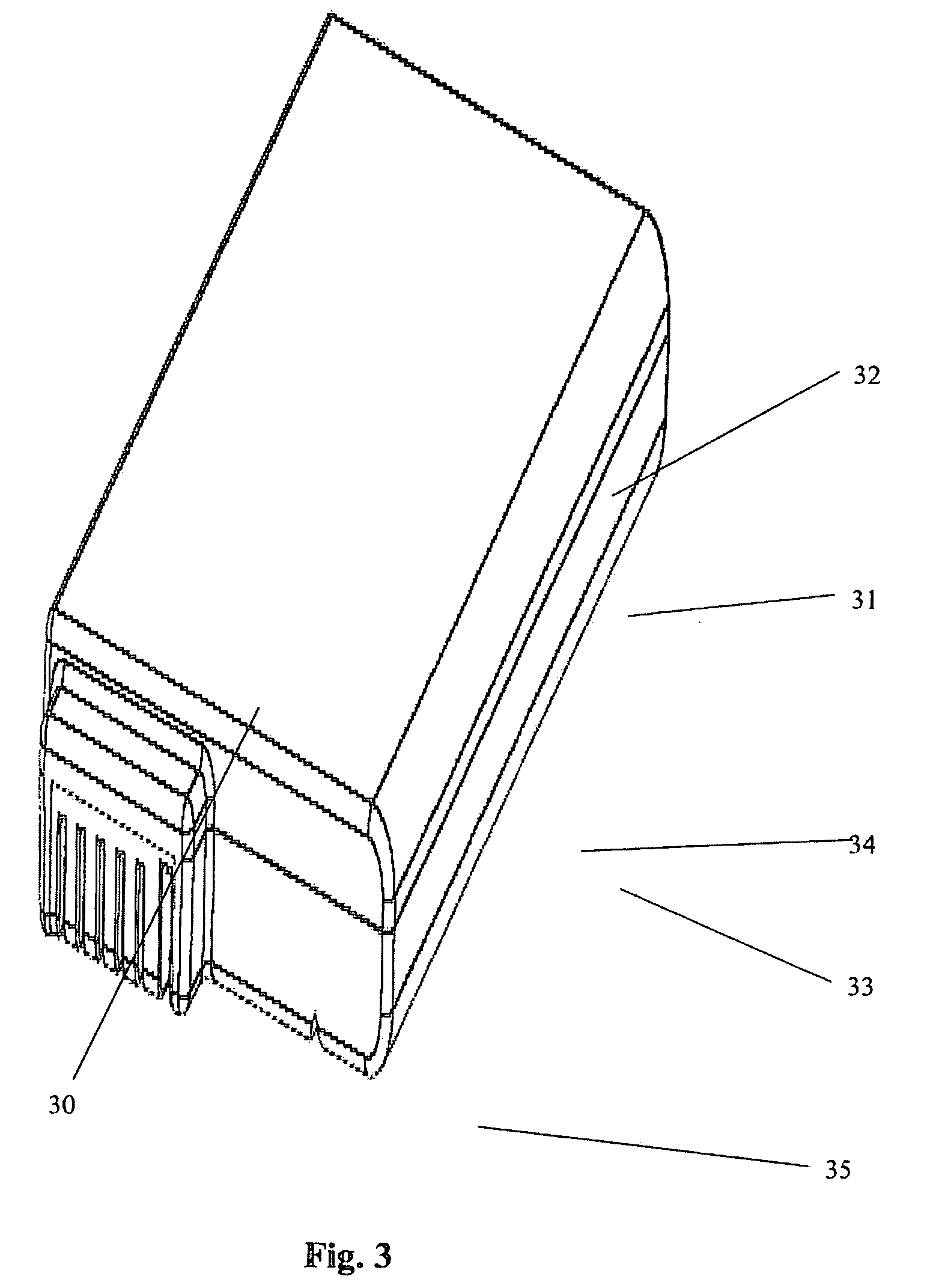
[0020] In a first preferred embodiment of the present invention, depicted in FIGS. 1 and 2, there is provided a battery receptacle 1 for receiving a number of batteries. In this first embodiment, the battery receptacle 1 is adapted to receive two batteries being primary and reserve batteries 30, as shown in FIG. 3.

[0021] When in use, the primary and reserve batteries 30 may be used in conjunction with the first embodiment and may be received within respective slots 17 or cavities in the battery receptacle 1. The batteries 30 connect with electrical contacts 18 preferably mounted at the end of the slot 17 in a manner so as to allow the batteries to be easily inserted and removed, when desired. Spring mechanism 9 is mounted in the end of the slot 17 and this spring mechanism 9 may provide sufficient force against the respective batteries so as to allow it to be automatically ejected when either the primary or reserve battery 30 is not secured.

[0022] In this embodiment, the batteries...