
Methods for predicting the efficacy or outcome of hcv therapy
a technology of hcv and efficacy, applied in the field of methods for predicting the efficacy or outcome of hcv therapy, can solve the problems of hampered definitive demonstration of causal relationships, difficult to imagine that the cellular immune response would play no role in hc-v control, and inability to meet the needs of patients,
- Summary
- Abstract
- Description
- Claims
- Application Information
AI Technical Summary
Benefits of technology
Problems solved by technology
Method used
Image

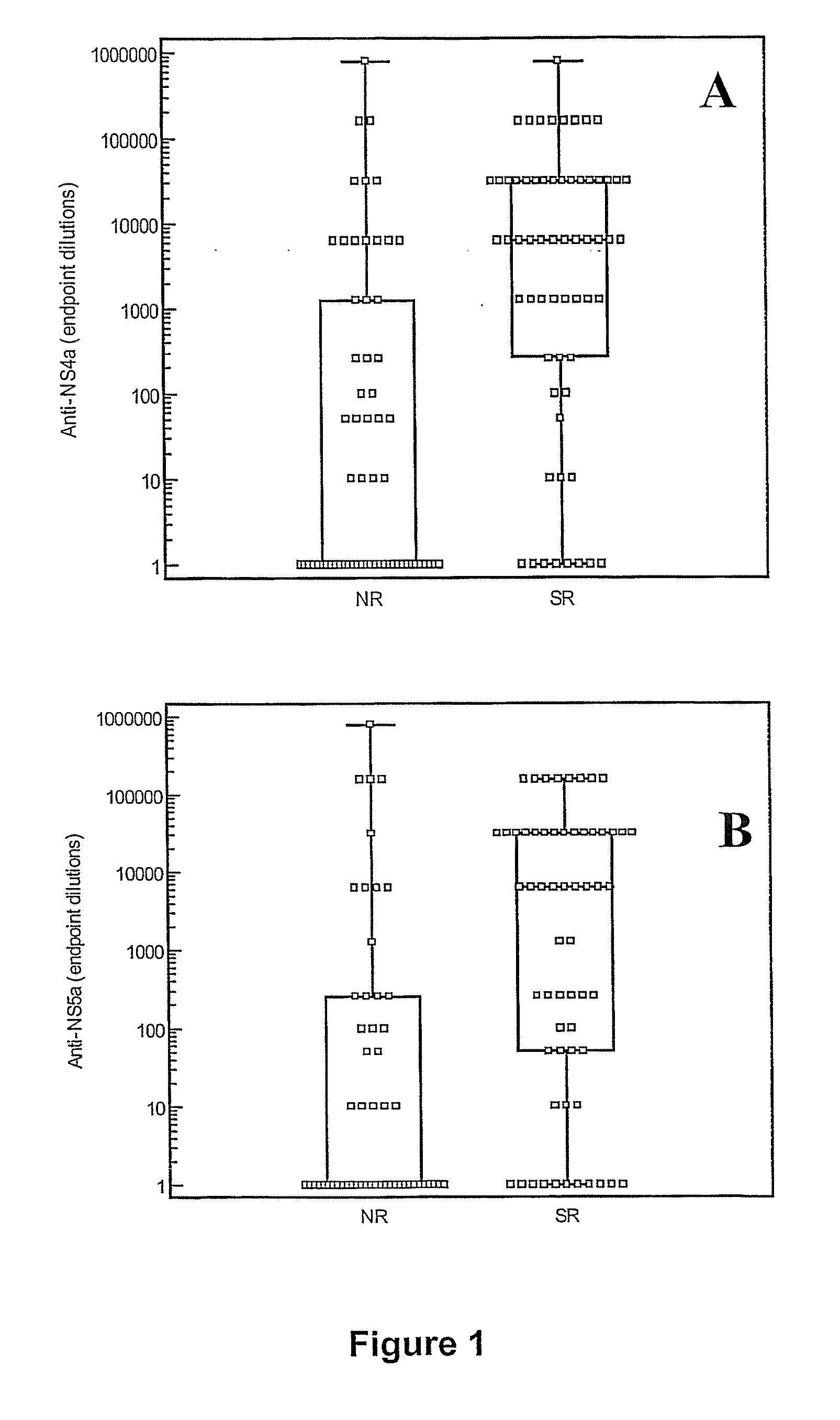
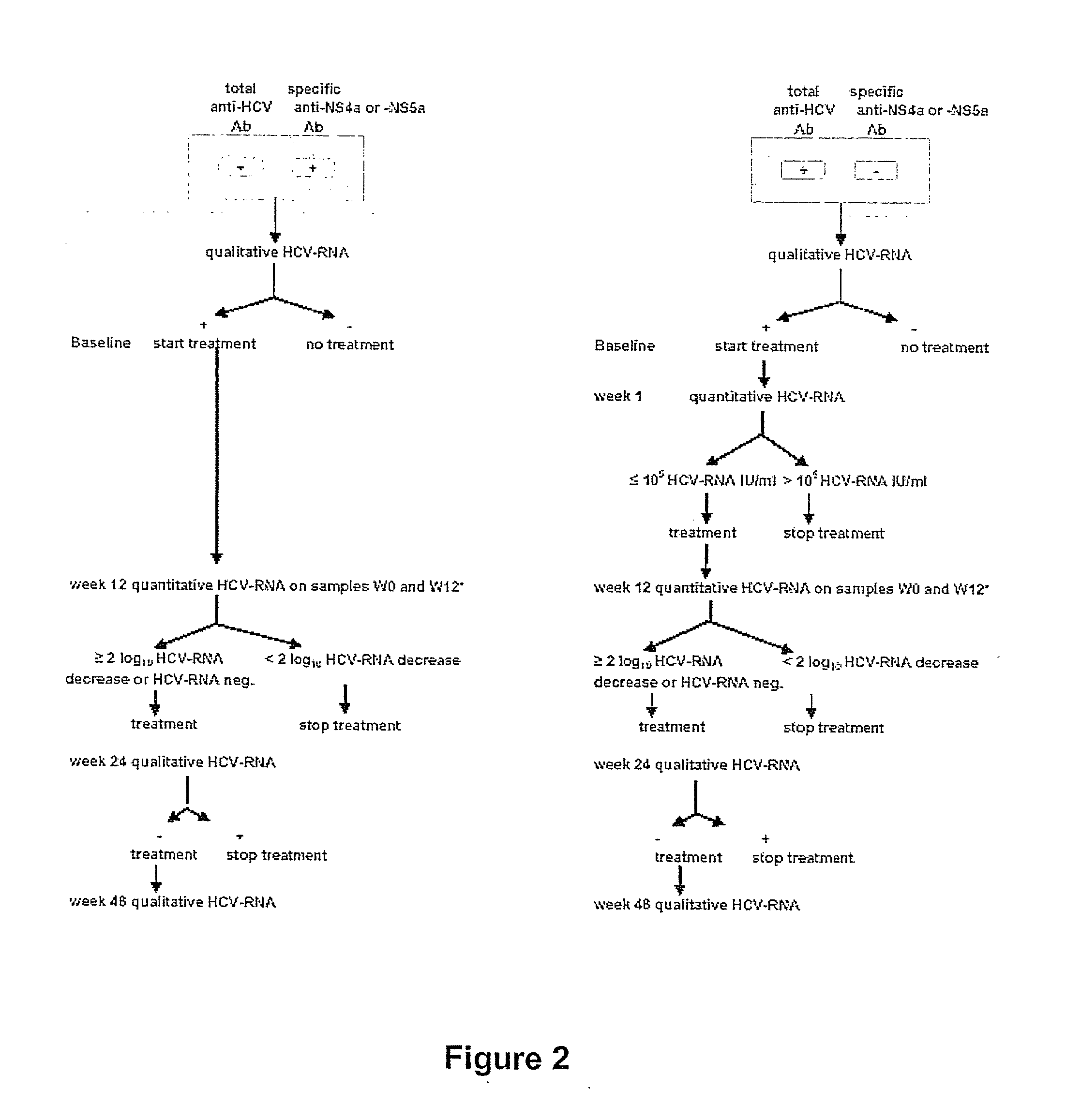
Examples
example 1
General Methodology
Example 1.1
[0070] Patient Selection and Sample Collection
[0071] Over a period of seven years detailed clinical data and specimens from chronic HCV patients participating in three therapeutic trials were collected. Study A involved untreated chronic HCV patients that were randomized to be treated with interferon-alpha (IFN-alpha mono-therapy (3×3 MU / wk, 18 months)), or with combination therapy (IFN-alpha (3×3 MU / week)+ribavirin (1000-1200 mg / day)) for 6 or 18 months. Study B involved chronic HCV patients that relapsed following IFN-alpha mono-therapy and that were retreated with a combination therapy of IFN-alpha (3×3 MU / week) and ribavirin (1000 or 1200 mg / day). The total treatment duration was 6 or 12 months. Study C was designed to study the influence of daily induction dosing (5 MU / day) versus thrice weekly administration (3×5 MU / week) of IFN-alpha mono-therapy during 4 weeks, followed by a combination with ribavirin (1000 or 1200 mg / day) during the 4 next w...
example 1.2
HCV-RNA Determination
[0072] Measurements of serum HCV-RNA were performed with two qualitative and two quantitative representative detection methods in the context of a comparative evaluation of these methods. HCV-RNA was detected qualitatively by the Cobas Amplicor HCV 2.0 assay (Roche Diagnostics, Mannheim, Germany) and by a transcription-mediated amplification (TMA)-based assay (Versant™ HCV-RNA Qualitative Assay (Bayer Diagnostics, Emeryville, USA). The lower detection limit of the Cobas Amplicor is 50-100 IU / ml while the analytical sensitivity of the TMA-assay is 5 to 10 IU / ml [Lee et al. (2002) J Clin Microbiol 38, 4171-4179; Nolte et al. (2001) J Clin Microbiol 39, 4005-4012]. Quantitative HCV-RNA measurements were performed with the Cobas Amplicor HCV Monitor 2.0 assay (Roche Diagnostics) and with the third generation b-DNA assay (Versant™ HCV-RNA 3.0 Assay, Bayer Diagnostics). The lower detection limits of both tests are 600 IU / ml and 615 IU / ml [Beld et al. (2002) J Clin Mi...
example 1.3
HCV-Genotyping
[0074] Genotyping was performed using a line-probe assay (HCV Genotype Assay (LiPA, Versant®, Bayer Diagnostics) in accordance with the manufacturer's instructions.
PUM
| Property | Measurement | Unit |
|---|---|---|
| OD | aaaaa | aaaaa |
| OD | aaaaa | aaaaa |
| threshold value | aaaaa | aaaaa |
Abstract
Description
Claims
Application Information
 Login to View More