Technique for allocating register to variable for compiling

US20090064112A1Inactive Publication Date: 2009-03-05IBM CORP
17 Cites 34 Cited by

Patent Information

Authority / Receiving Office
US · United States
Current Assignee / Owner
Publication Date
2009-03-05
Estimated Expiration
Not applicable · inactive patent

Smart Images

  • Figure 1
    Figure 1
  • Figure 2
    Figure 2
  • Figure 3
    Figure 3
Patent Text Reader

Abstract

The present invention relates to allocating registers to variables in order to compile a program. In an embodiment of the present invention a compiler apparatus stores interference information indicating an interference relationship between variables, selects a register and allocates the register to each variables in accordance with a predetermined procedure, without allocating the same register to a set of variables having interference relationships. The compiler further replaces multiple variables having the same register allocated thereto with a new variable and generates an interference relationship by merging the interference relationships each concerning one of multiple variables. The compiler further updates interference information according to the generated interference relationship and allocates to each variable in the program using the new variable a register, selected in accordance with the predetermined procedure without allocating the same register to a set of variables having the interference relationships, based on the updated interference information.
Need to check novelty before this filing date? Find Prior Art

Description

CROSS-REFERENCE TO RELATED APPLICATIONS

[0001] This application claims priority under 35 U.S.C. §119 to Japanese Patent Application No. 2007-223143 filed Aug. 29, 2007, the entire contents of which is incorporated herein by reference.FIELD OF THE INVENTION

[0002] The present invention relates to compiling of a program. In particular, the present invention relates to a technique for allocating registers to variables in order to compile a program.BACKGROUND OF THE INVENTION

[0003] A compiler enhances the execution efficiency of a program by causing registers to hold values of variables used in the program. A technique for allowing a compiler to determine which register to hold each of variables is referred to as register allocation. If a certain register is caused to consistently hold a certain variable used in a program through the register allocation, the register is occupied by the variable even during the execution of a part of the program not using the variable frequently. As a result,...

Examples

Embodiment Construction

[0051]The novel features believed characteristic of the invention are set forth in the appended claims. The invention itself, however, as well as a preferred mode of use, further objectives and advantages thereof, will best be understood by reference to the following detailed description of an illustrative embodiment when read in conjunction with the accompanying drawings.

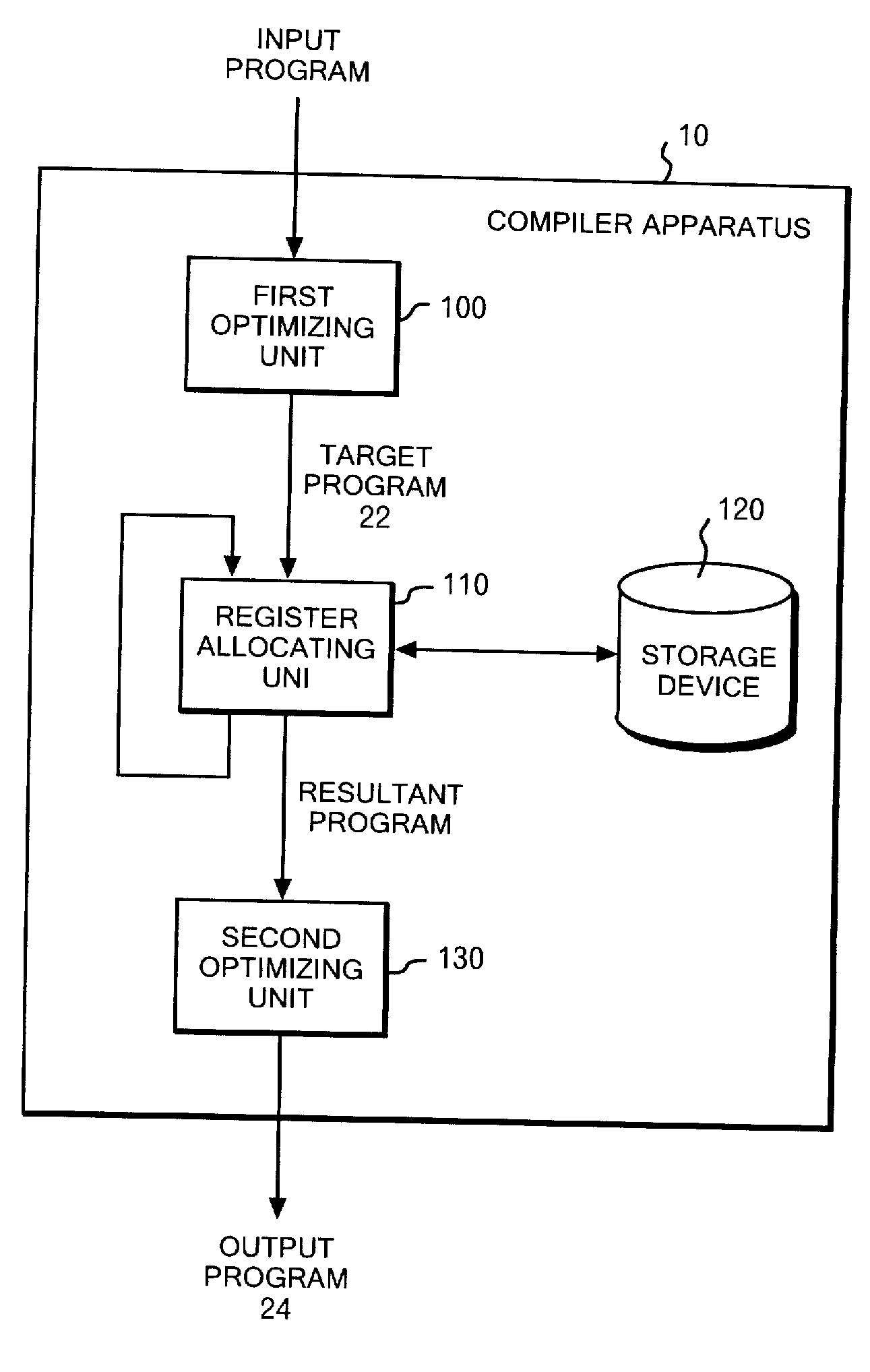
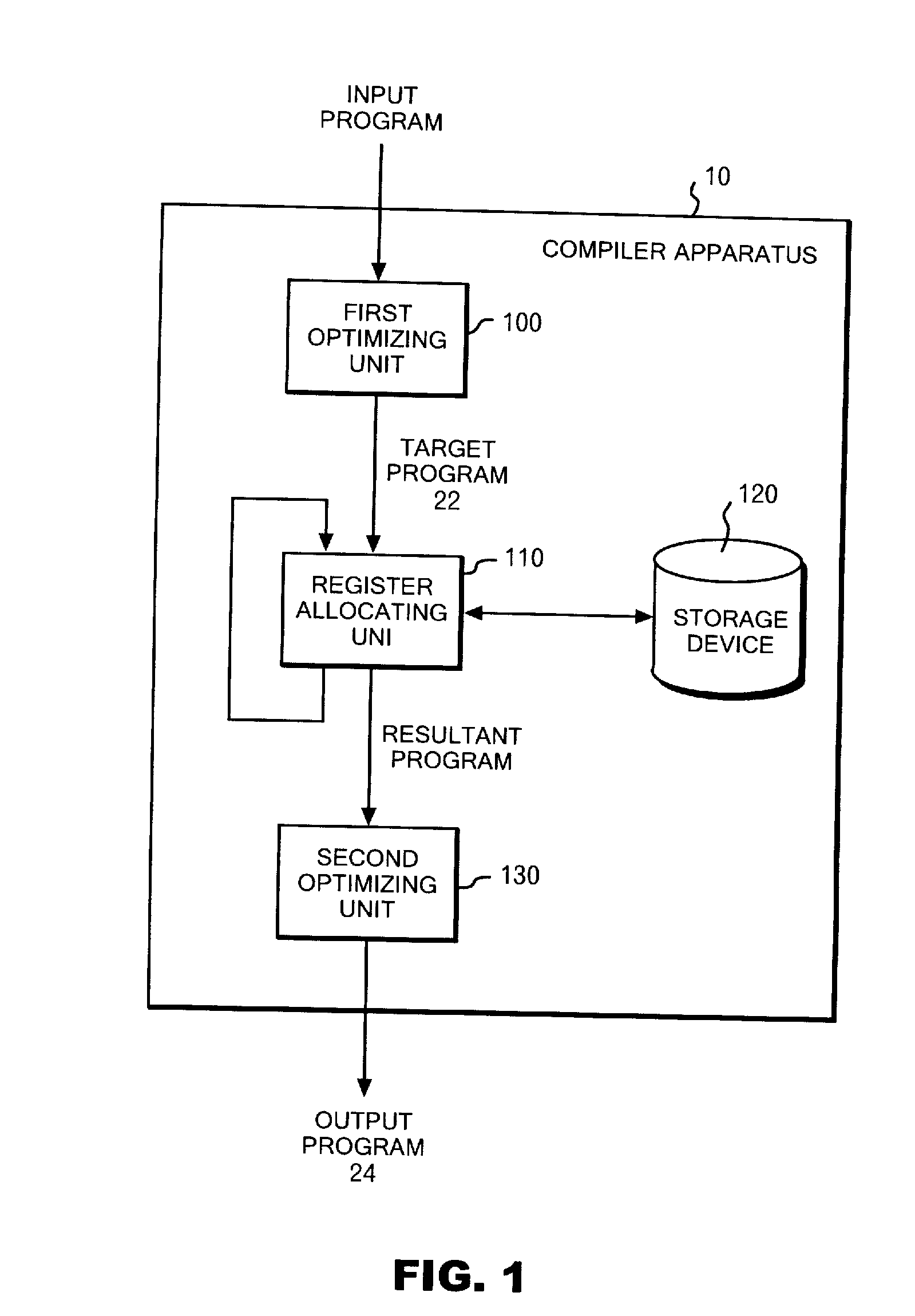
[0052]FIG. 1 shows an entire configuration of a compiler apparatus 10 according to this embodiment. The compiler apparatus 10 converts an inputted program into a machine language program and outputs the machine language program. In addition to this, the compiler apparatus 10 performs optimization to achieve the efficient execution of the machine language program. Specifically, the compiler apparatus 10 includes a first optimizing unit 100, a register allocating unit 110, a storage device 120 and a second optimizing unit 130.

[0053]The first optimizing unit 100 receives a program to be compiled. This program is refer...