
Female External Incontinence Device
a female external incontinence and device technology, applied in the field of external incontinence devices, can solve the problems of external incontinence, difficult to accurately place, and high rate of skin breakdown and decubitis ulcer formation of diapers
- Summary
- Abstract
- Description
- Claims
- Application Information
AI Technical Summary
Benefits of technology
Problems solved by technology
Method used
Image

Examples
Embodiment Construction
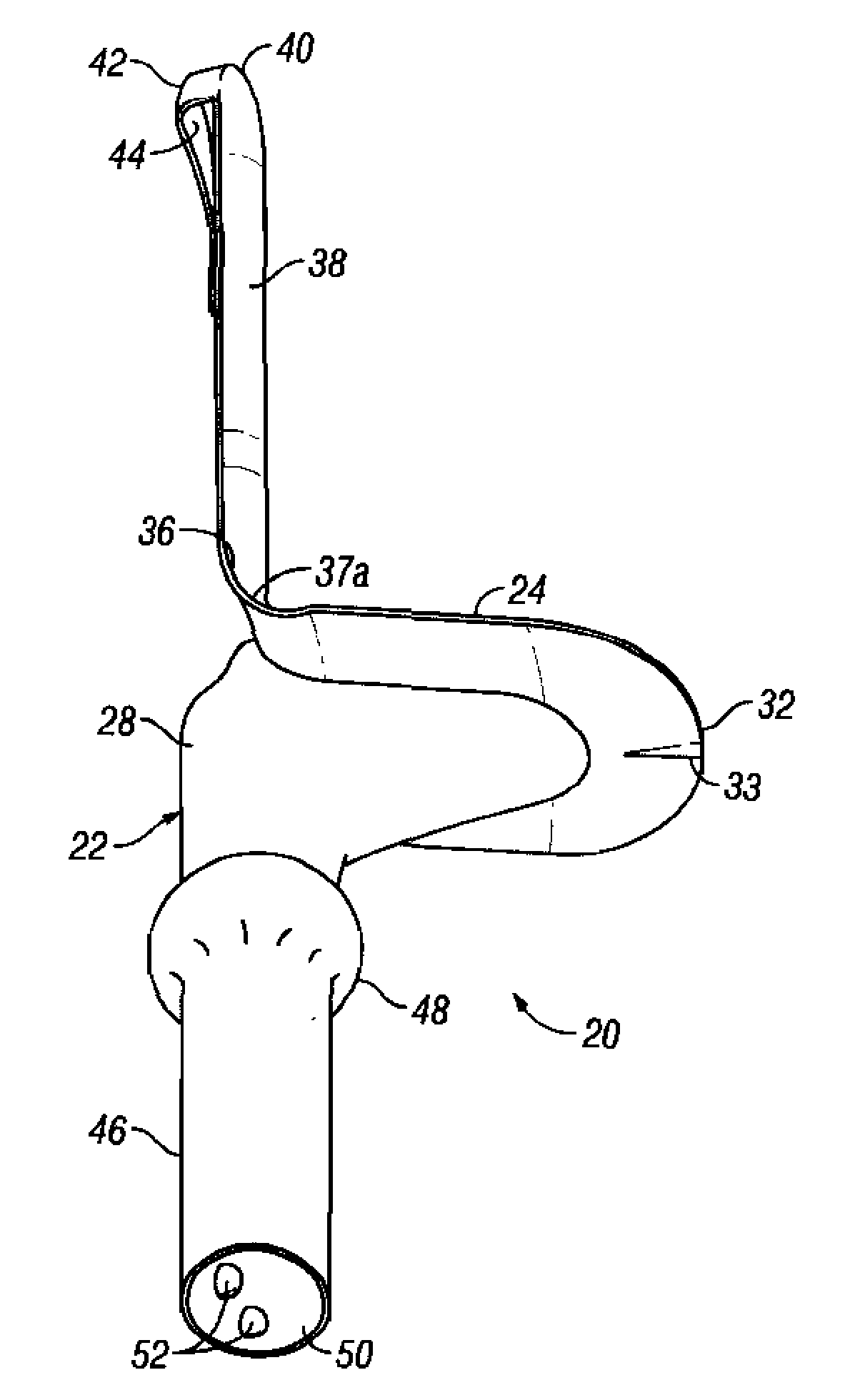
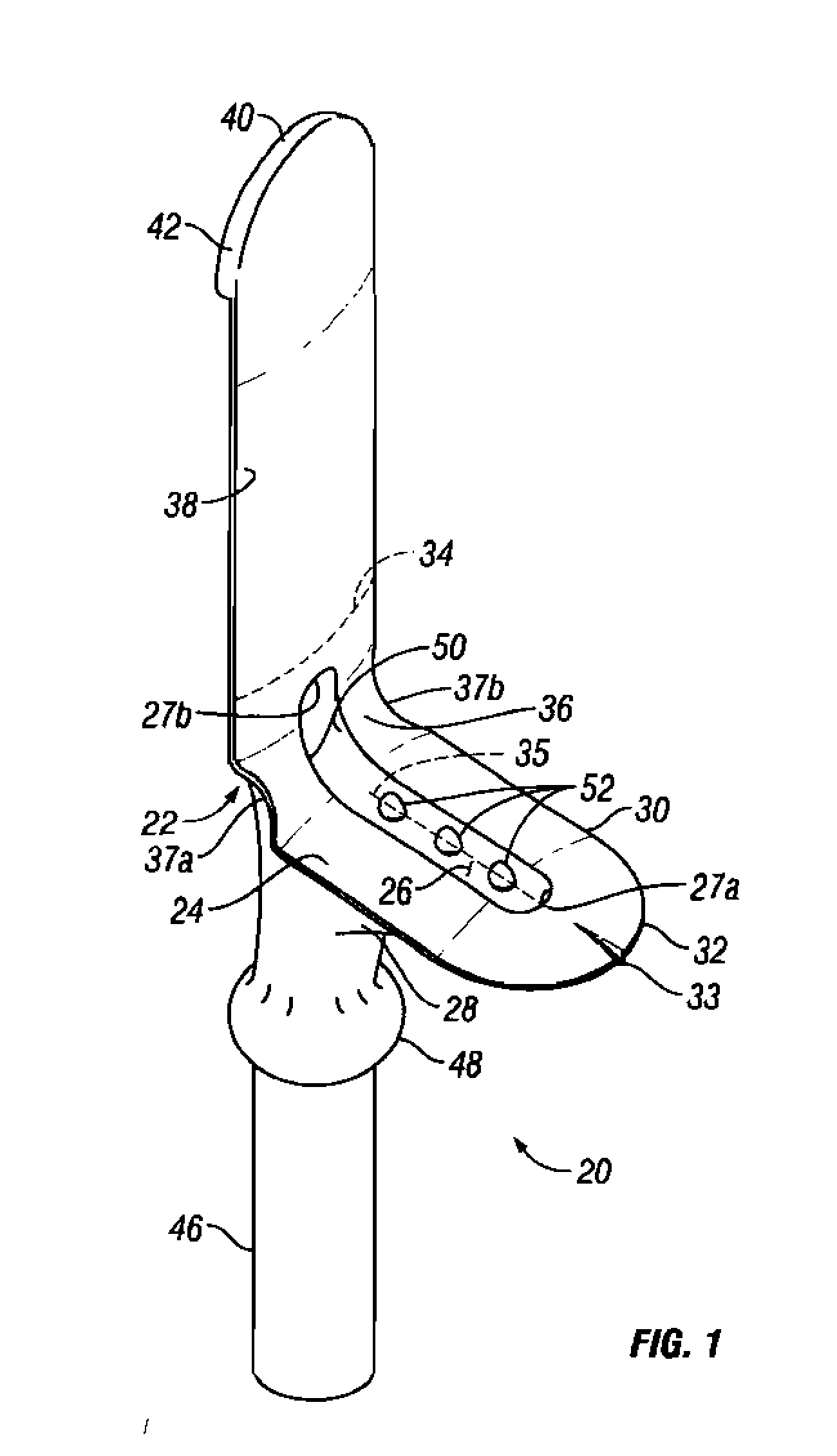
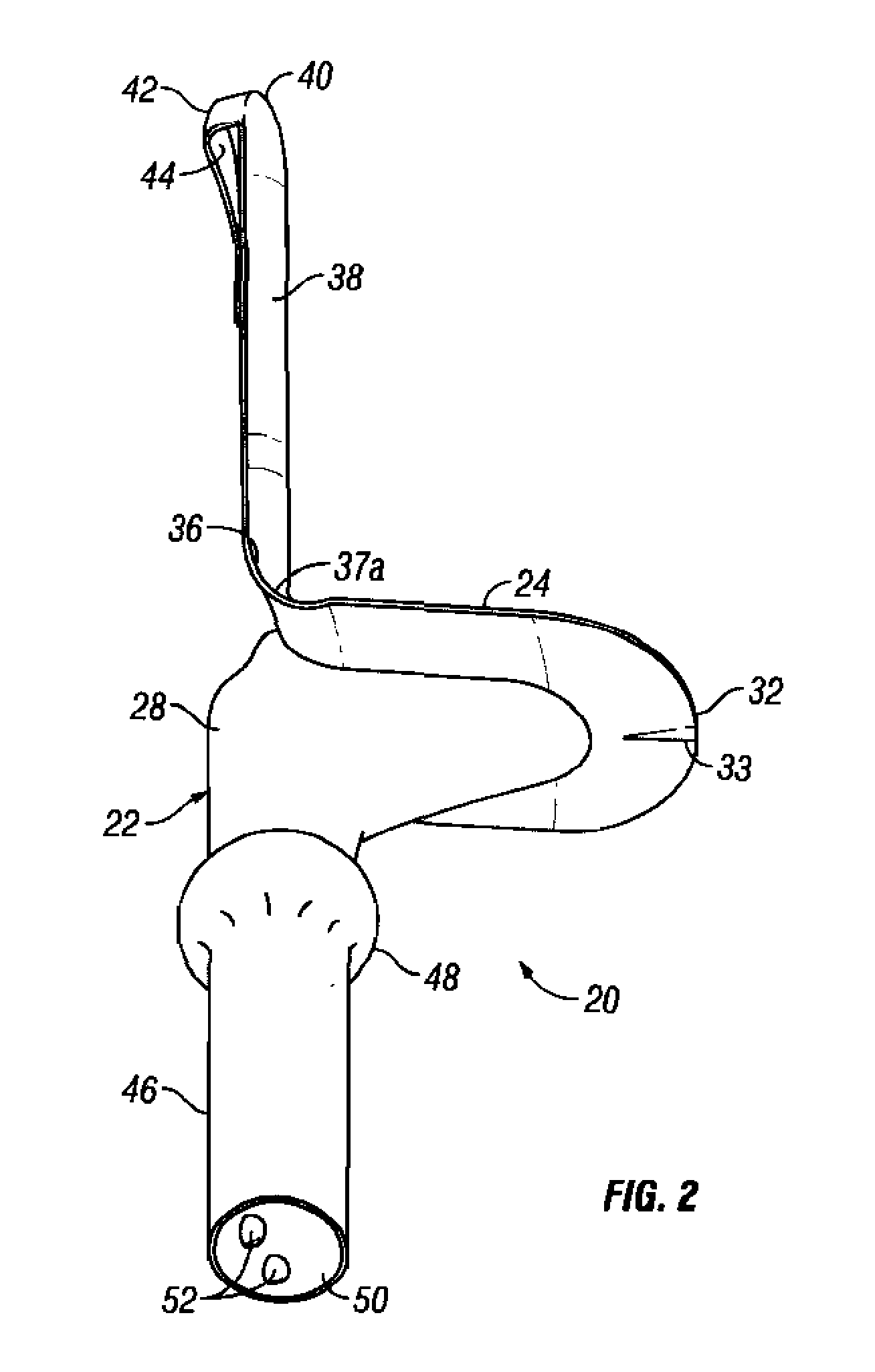
[0028]As shown in FIGS. 1 and 2, a female external incontinence device 20 according to the present invention includes a housing 22 having a flange 24 defining an elongate opening 26 therethrough communicating with a urine collection channel 28 depending from the flange. The opening 26 has curved, opposed proximal and distal ends 27a and 27b, respectively. The flange 24 forms a structure for adhesive attachment to tissue in the introitus and can have a margin 30 with an arcuate or curved anterior end 32 or, depending on the manner in which the housing 22 is formed, the flange 24 can have a minimal lateral dimension as compared to the longitudinal dimension extending from the end 32 to a location 34 posterior of the end of opening 26 shown by a dotted line. The anterior portion of flange 24 has a V-shape in an end-wise view looking posteriorly along the flange to define a fold-type line 33 aligned with a midline of housing 22 shown in dotted lines at 35 such that the housing is biased...
PUM
 Login to View More
 Abstract
Description
Claims
Application Information
 Login to View More