
Endoscopic high-frequency hemostatic forceps
a high-frequency, hemostatic technology, applied in the field of endoscopic high-frequency hemostatic forceps, can solve the problems of unnecessary tissue destruction, bleeding or perforation, etc., and achieve the effect of high-frequency hemostatic treatment, safe and fas
- Summary
- Abstract
- Description
- Claims
- Application Information
AI Technical Summary
Benefits of technology
Problems solved by technology
Method used
Image

Examples
first embodiment
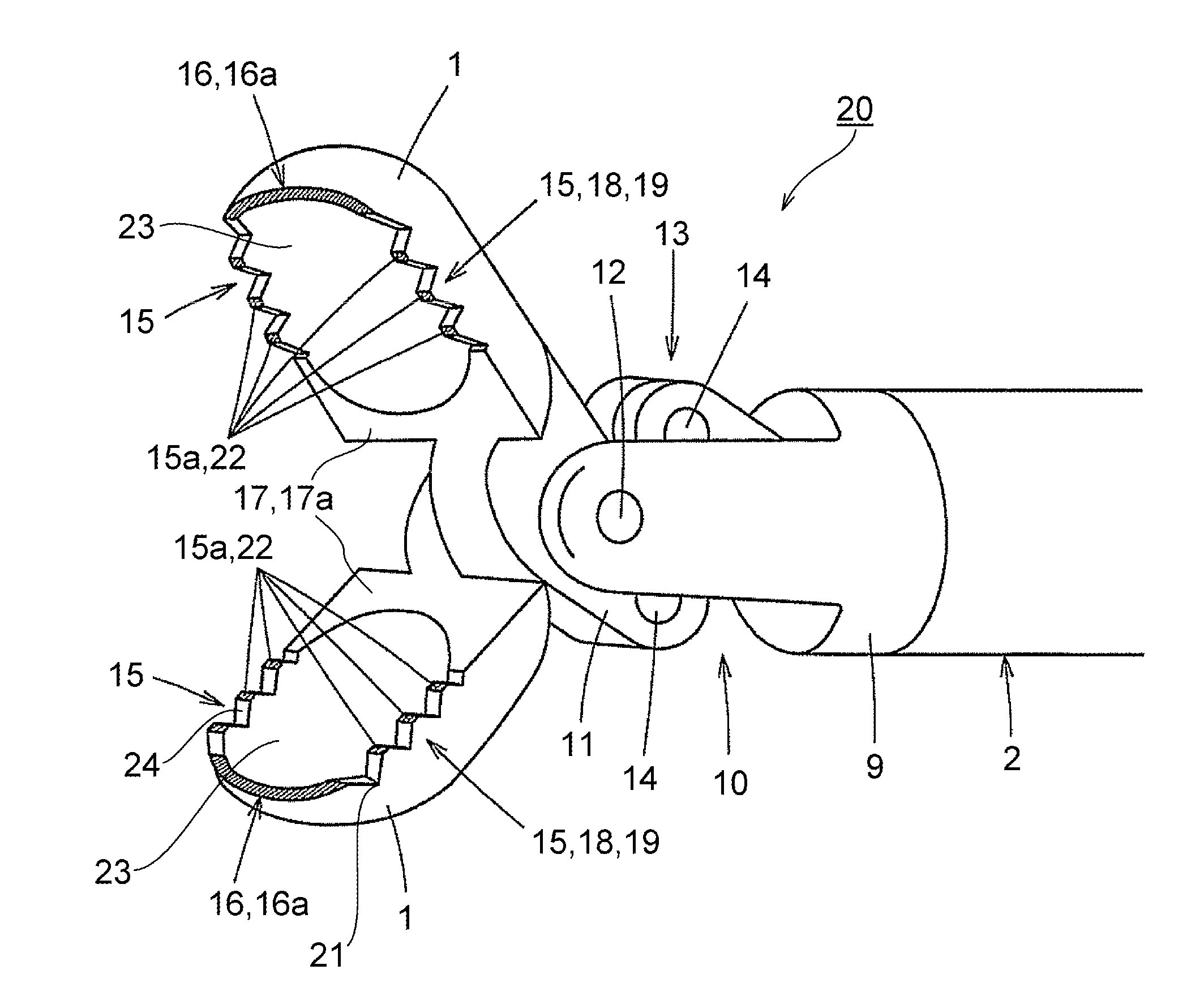
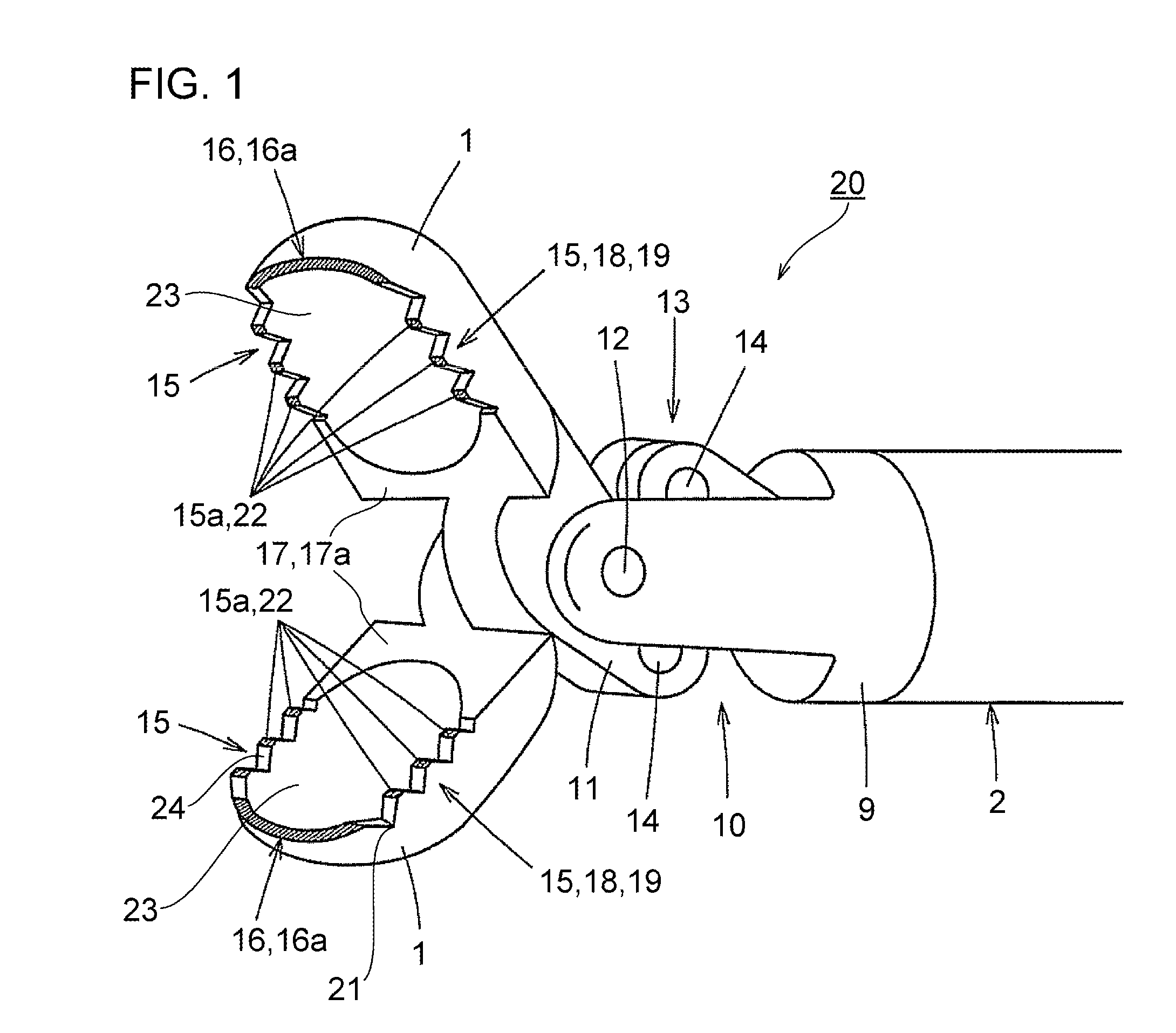
[0027]FIG. 1 is a perspective view showing a distal portion of an endoscopic high-frequency hemostatic forceps (hemostatic forceps 20) according to the present invention.
[0028]First, a general description of the hemostatic forceps 20 according to this embodiment will be given.
[0029]The hemostatic forceps 20 includes a pair of forceps elements (forceps cups 1) constituted of a conductive metal so as to serve as a high-frequency electrode, and configured to be able to freely change into a state where front portions of the pair of forceps elements are open, and a state where the pair of forceps elements are close.
[0030]A sawtooth portion 15 having a plurality of concavo-convex structures which constitute a sawtooth-shape is provided on at least one of opposing closing-side surfaces 17 of the pair of forceps cups 1. A bottom portion 21 of the sawtooth-shape of the sawtooth portion 15 is provided with an electrically insulative coating, while a top portion 22 of the sawtooth-shape of the...
second embodiment
[0061]FIG. 6 shows a distal portion of the hemostatic forceps 20 according to the present invention. In this embodiment, the sawtooth portion 15 are provided on the front edge portion 16 of the outer periphery 18 of the respective closing-side surfaces 17 of the pair of forceps cups 1, in addition to the side edge portions 19.
[0062]Each of the sawtooth portion 15 is provided with the electrically insulative coating over its entirety except for the respective top portions 22, and hence the exposed metal surface 15a where the conductive metal is exposed is formed only in the top portions 22 of the sawtooth portion 15. The configuration of the remaining portion is the same as that of the first embodiment. Forming thus the sawtooth portion 15 on the front edge portion 16 and the respective side edge portions 19 of the closing-side surface 17 of the forceps cup 1 leaving only the top portions 22 as the exposed metal surface 15a enables the hemostatic treatment to be performed even more q...
fifth embodiment
[0070]FIG. 10 is a perspective view showing a distal portion of the hemostatic forceps 20 according to the present invention.
[0071]In the hemostatic forceps 20 according to this embodiment, the pair of forceps cups (forceps elements) 1 each includes the opening 23 on the respective closing-side surface 17, as in the first embodiment. However, a difference from the first embodiment lies in that the inner surface of the opening 23 is not provided with the electrically insulative coating, and is hence conductive.
[0072]In this embodiment, the conductive metal constituting the forceps cup 1 is exposed in the top portions 22 (exposed metal surfaces 15a) of the sawtooth portion 15, the exposed metal surface 16a of the front edge portion 16, and in the inner surface of the opening 23. Such a configuration allows a high-frequency current to be supplied also to a portion of the biological tissue in contact with the inner surface of the opening 23. Therefore, the configuration according to thi...
PUM
 Login to View More
 Abstract
Description
Claims
Application Information
 Login to View More