
Resonator Electrode Shields
a shielding and resonance technology, applied in the field of microelectromechanical systems, can solve the problems of reducing the signal quality of the oscillator, affecting the overall integrity of the generated timing signal, interfering currents, etc., and achieves the effects of reducing undeired capacitive coupling, reducing feed-through current, and simple and efficient operation
- Summary
- Abstract
- Description
- Claims
- Application Information
AI Technical Summary
Benefits of technology
Problems solved by technology
Method used
Image



Examples
Embodiment Construction
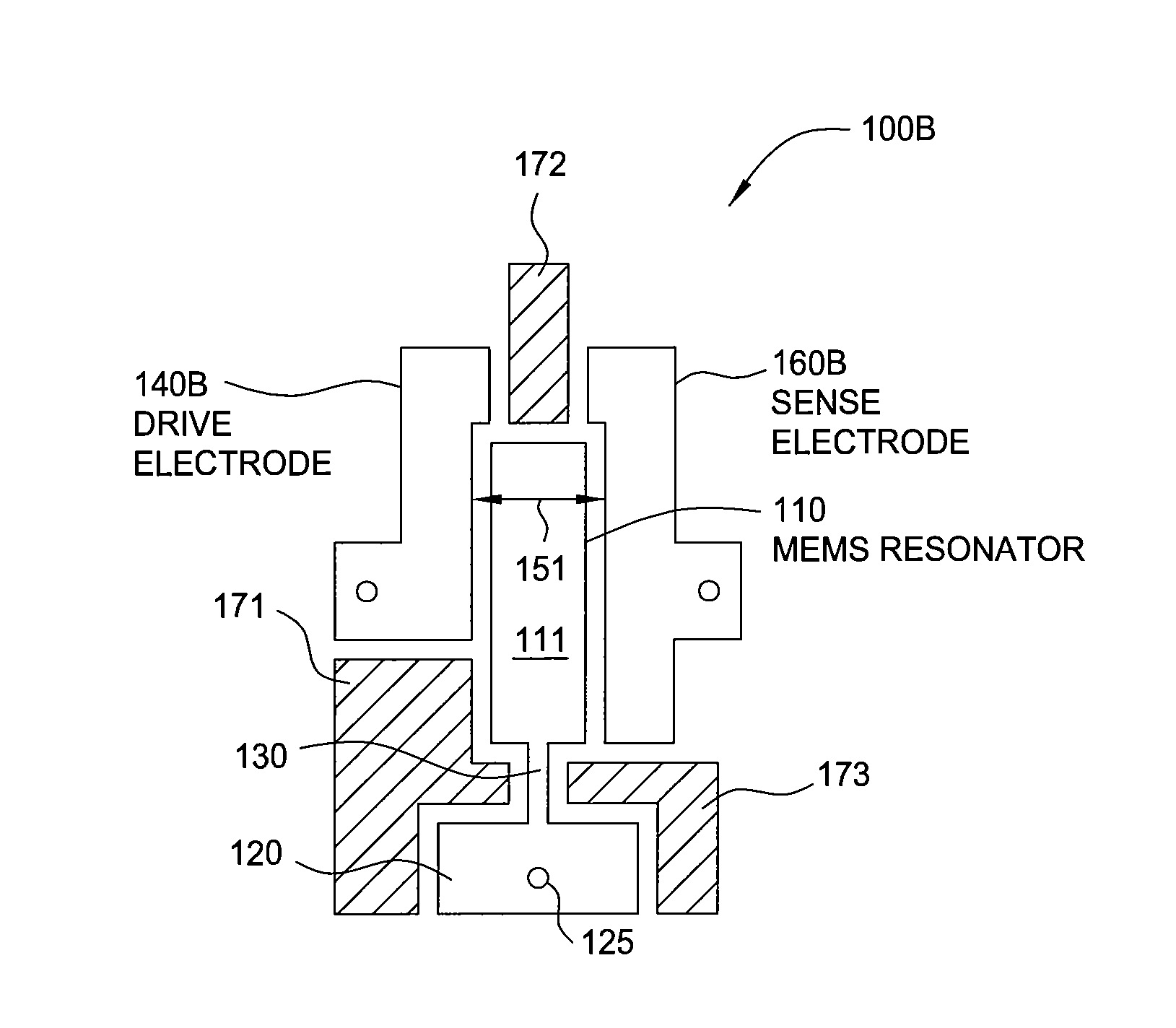
[0032]FIG. 1A illustrates a MEMS resonator system 100A without resonator electrode shields, according to prior art. As shown, the MEMS resonator system 100A includes a MEMS resonator 110, a drive electrode 140A, and a sense electrode 160A. The MEMS resonator further includes a MEMS resonator beam 111, a support element 120, and a flexure element 130. The MEMS resonator beam 111 is referred to herein as an “active element” of the MEMS resonator 110 because the motion of the MEMS resonator beam 111 ultimately leads to the generation of the desired timing signal in the MEMS resonator system 100A. The support element 120 and the flexure element 130 are referred to herein as “non-active elements” of the MEMS resonator 110 because there elements are not supposed to be driven by the drive electrode 140A and, therefore, should not contribute to the timing signal produced by the MEMS resonator system 100A. The support element 120 is configured to provide an anchor 125 for the MEMS resonator ...
PUM
 Login to View More
 Abstract
Description
Claims
Application Information
 Login to View More