
Wide scan steerable antenna with no key-hole
a steerable antenna and wide-scan technology, applied in the field of steerable antennas, can solve the problems of increasing the complexity of the drive electronics system, requiring one rotary joint, and requiring more complex and costly drive electronics, so as to improve the reliability of the antenna system, and optimize the antenna geometry
- Summary
- Abstract
- Description
- Claims
- Application Information
AI Technical Summary
Benefits of technology
Problems solved by technology
Method used
Image

Examples
Embodiment Construction
[0030]With reference to the annexed drawings the preferred embodiments of the present invention will be herein described for indicative purpose and by no means as of limitation.
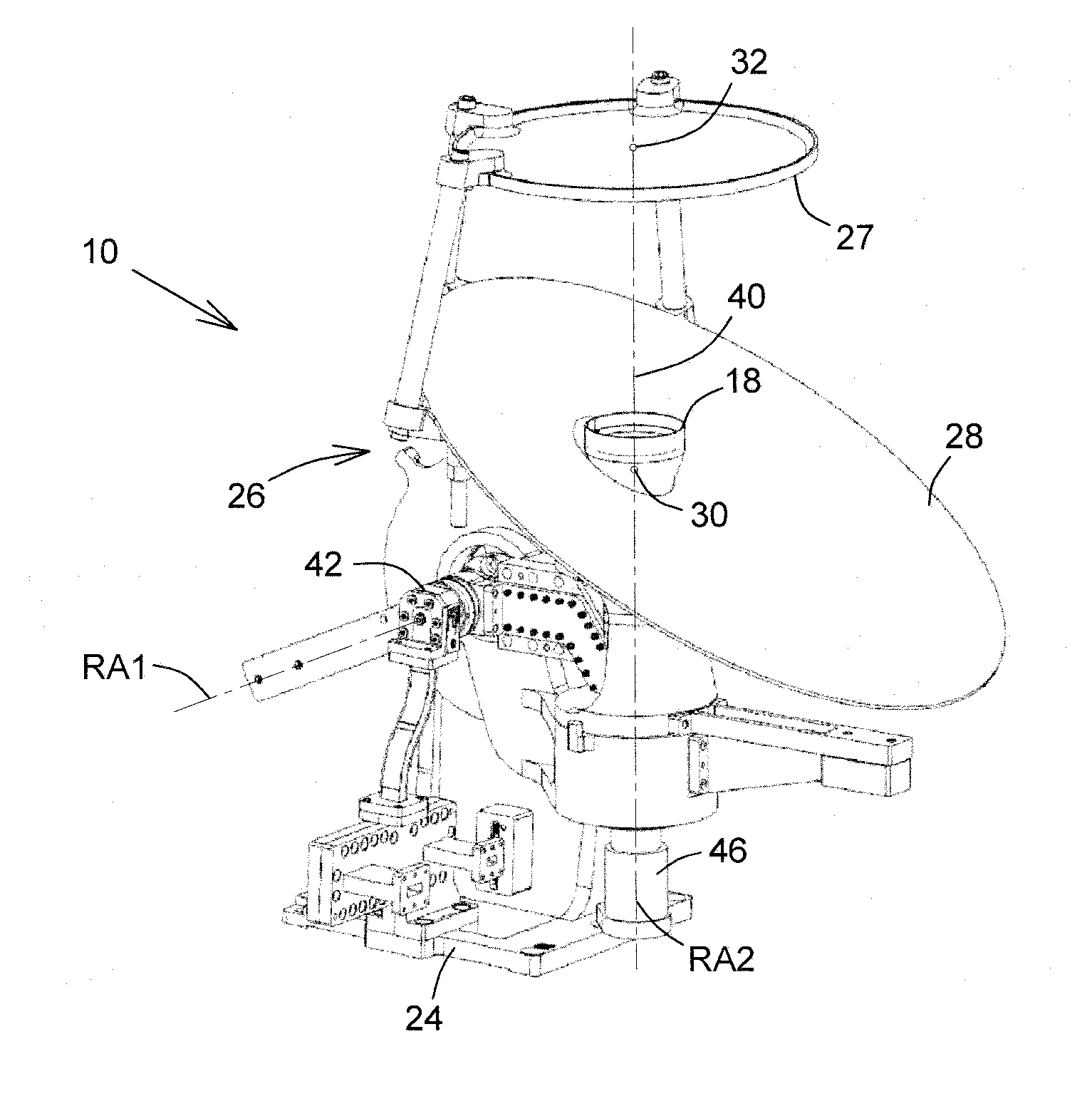
[0031]Referring to FIGS. 3 and 3a, there is shown a steerable antenna 10 for allowing transmission and / or reception of an electromagnetic signal within an antenna coverage region 14, as shown by the shaded area in FIG. 7, over a predetermined surface, such as the surface of the Earth. The electromagnetic signal travels through a feed chain and between a feed source 18 and a target. The target moves within the antenna coverage region 14 in which the antenna signal beam 12 is to be steered.
[0032]Although the antenna 10 described hereinafter is mounted on the earth facing panel 24 or deck of a satellite pointing at the Earth surface (not shown) with the target being a specific location thereon, it should be understood that any other configuration of a similar antenna such as a ground antenna facing at orbiting s...
PUM
 Login to View More
 Abstract
Description
Claims
Application Information
 Login to View More