
Self-Righting Toothbrush
- Summary
- Abstract
- Description
- Claims
- Application Information
AI Technical Summary
Benefits of technology
Problems solved by technology
Method used
Image

Examples
Embodiment Construction
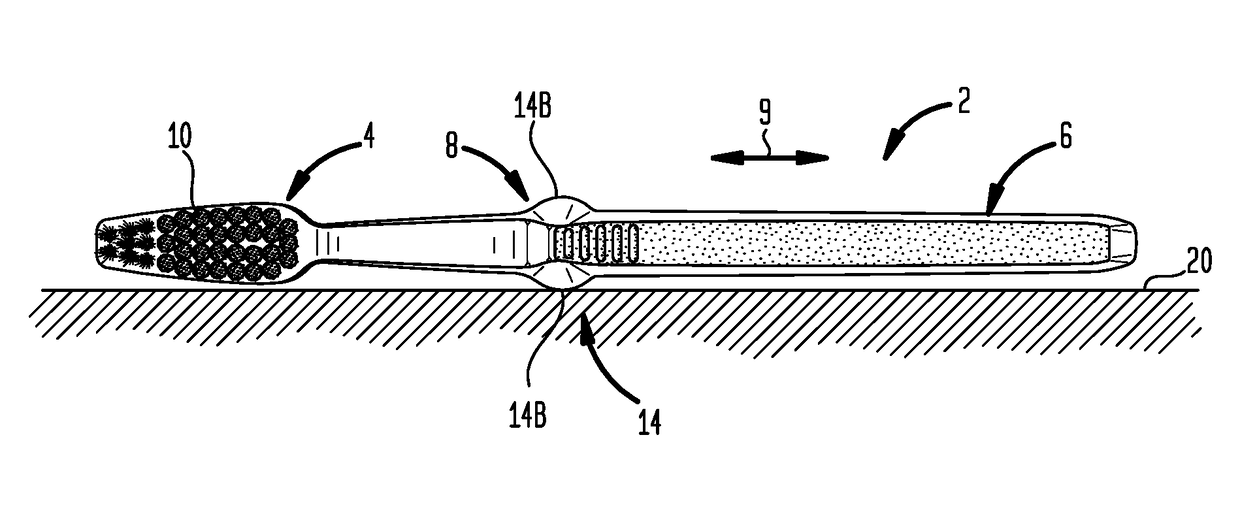
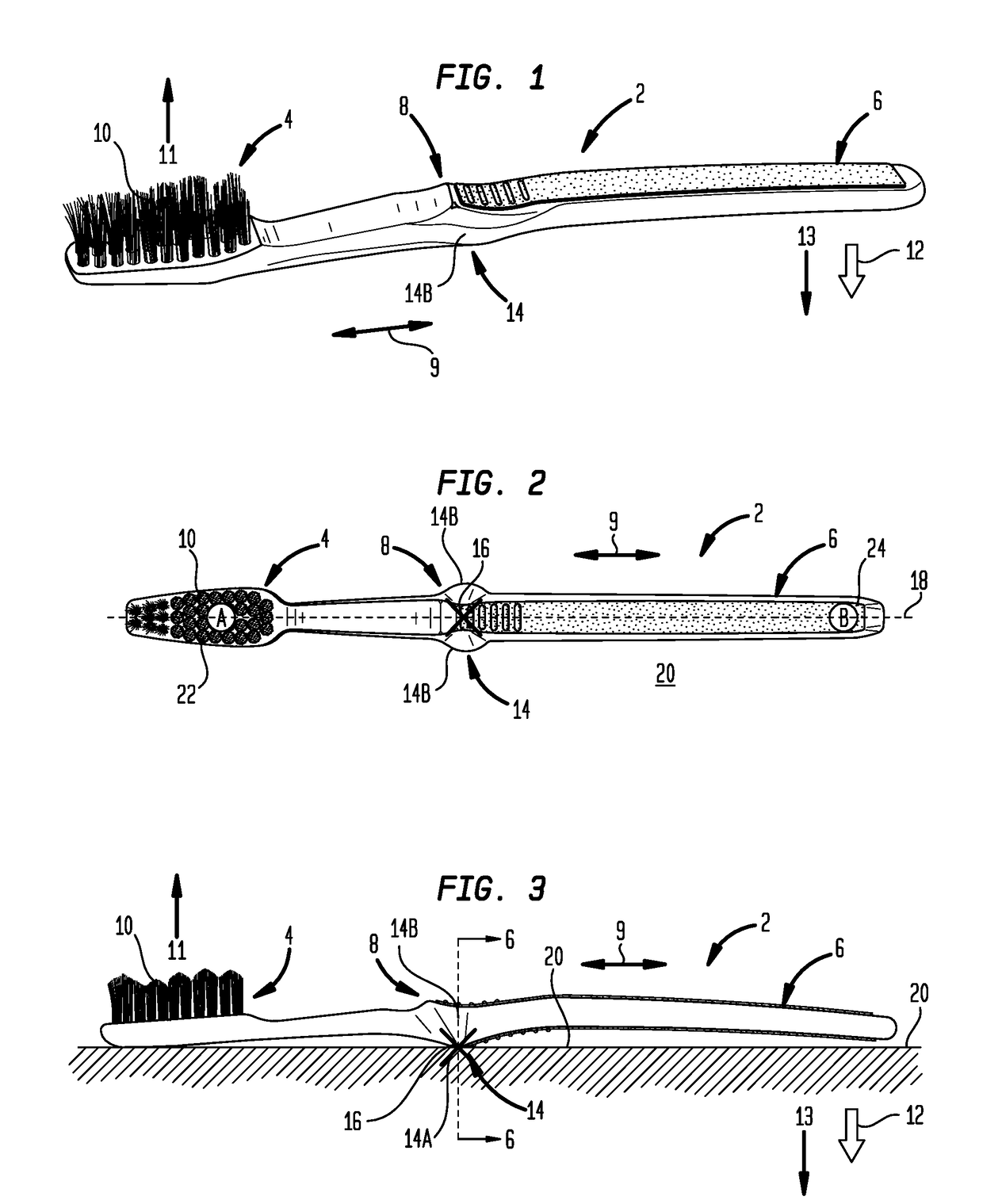
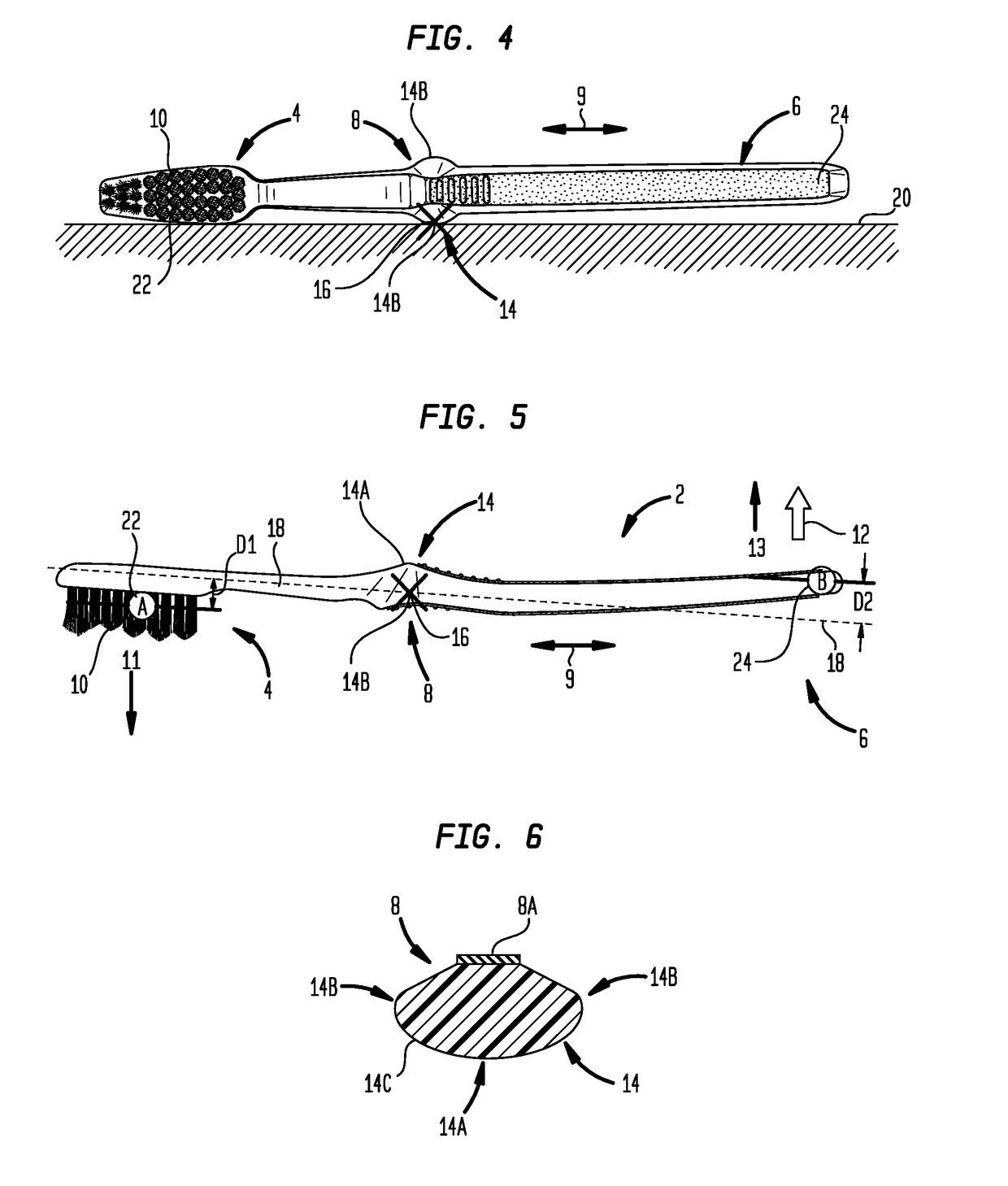
[0046]Turning now to the drawing figures, in which like reference numbers illustrate like structure in all of the several views, FIGS. 1-4 illustrate an example embodiment of a self-righting toothbrush 2 having a head section 4, a tail section 6, and a medial section 8. The medial section 8 is disposed at a junction of the head section 4 and the tail section 6 in a longitudinal direction 9 of the toothbrush 2. The distal end of the head section 4 mounts a set of bristles 10. Unless otherwise indicated, the materials used to fabricate the toothbrush 2 are the same as may be found in conventional toothbrushes, which are mainly plastics such as polypropylene or polyethylene for the rigid non-bristle component(s), and Nylon for the bristles.
[0047]As can be seen in FIGS. 1, 3 and 5, the bristles 10 extend in a frontward direction 11 of the toothbrush 2, starting from their point of attachment to the head section 4. The tail section 6 has a lateral asymmetry 12 that extends in a rearward ...
PUM
 Login to View More
 Abstract
Description
Claims
Application Information
 Login to View More