
Amplifier, circuit for trimming a bias voltage, method for amplifying an input signal and method for trimming a bias voltage
a technology for amplifying input signals and circuits, applied in amplifiers, dc-isolation amplifiers, semiconductor devices/discharge tubes, etc., can solve problems such as overall limited bias voltage, drift of bias voltage compared to a state, and energy may be conserved, so as to avoid distortion, optimal properties, and optimal power consumption
- Summary
- Abstract
- Description
- Claims
- Application Information
AI Technical Summary
Benefits of technology
Problems solved by technology
Method used
Image

Examples
Embodiment Construction
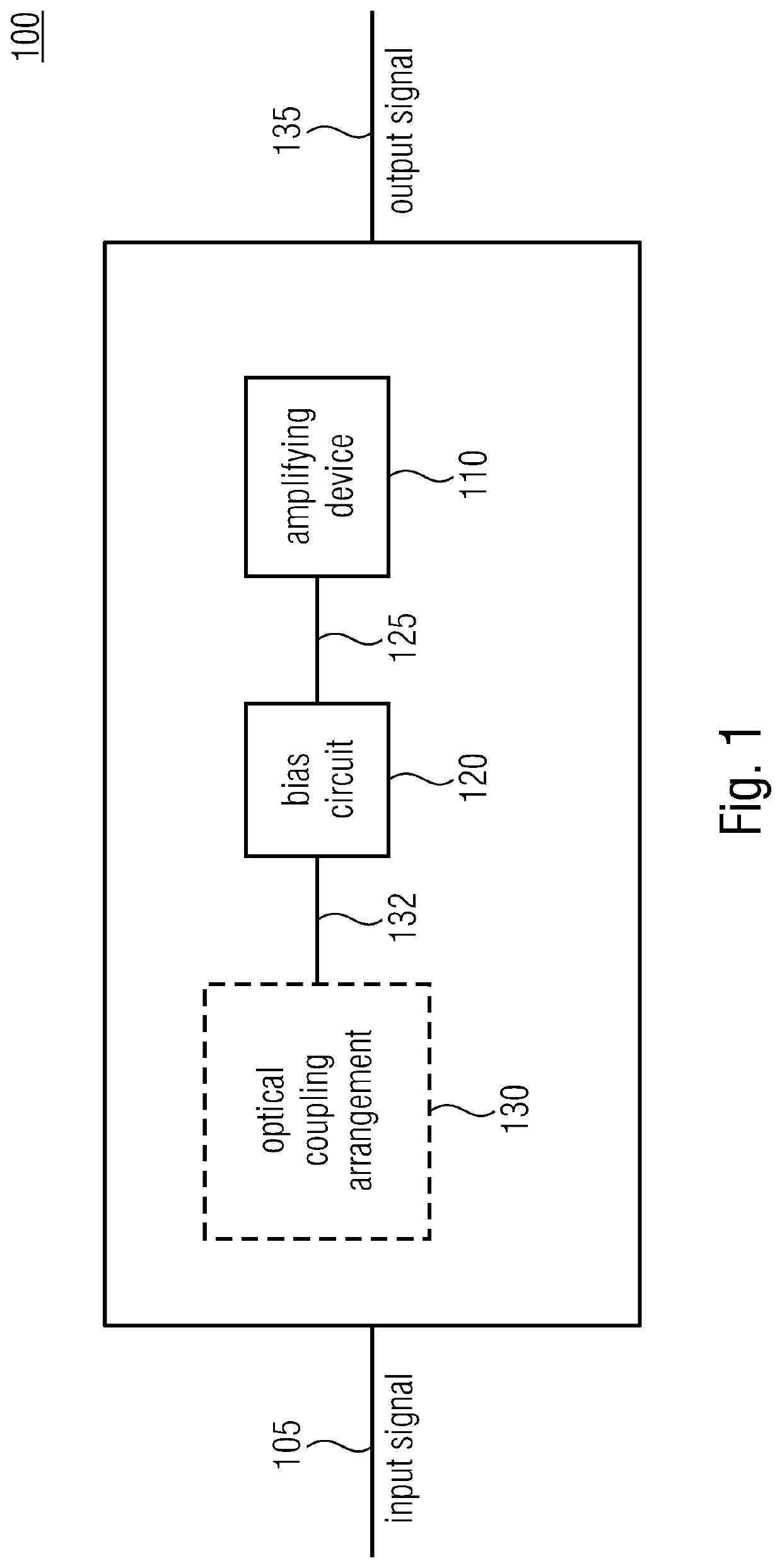
[0052]FIG. 1 shows a block diagram of an amplifier 100 according to embodiments of the invention. The amplifier 100 comprises an amplifying device 110, a bias circuit 120 and an optical coupling arrangement 130 (which may be a part of the bias circuit 120 or which may be an external component). Moreover, the amplifier 100 takes as input an input signal 105 and provides an amplified input signal as the output signal 135.
[0053]The bias circuit 120 is configured to provide a bias voltage for the amplifying device 110, wherein the bias circuit 120 is configured to provide the bias voltage 125 in dependence on an output signal 132 of the optical coupling arrangement 130 which provides for an electrical isolation. Further, the amplifying device 110 may be configured to work at an operation point. Therefore, a bias voltage 125 is provided to the amplifying device 110 by the bias circuit 120. As the bias voltage 125 may deviate from a desired voltage, e.g., which may be used for keeping the...
PUM
 Login to View More
 Abstract
Description
Claims
Application Information
 Login to View More