Pneumatic Tire

a pneumatic tire and tire technology, applied in the field of pneumatic tires, can solve the problems of degrading drainage performance, degrading rigidity, and affecting the stability of steering on dry road surfaces, so as to improve steering stability performance on wet road surfaces, suppressing pattern noise, and improving steering stability performan

US20200384810A1Active Publication Date: 2020-12-10YOKOHAMA RUBBER CO LTD
5 Cites 1 Cited by

Patent Information

Authority / Receiving Office
US · United States
Current Assignee / Owner
Publication Date
2020-12-10

Smart Images

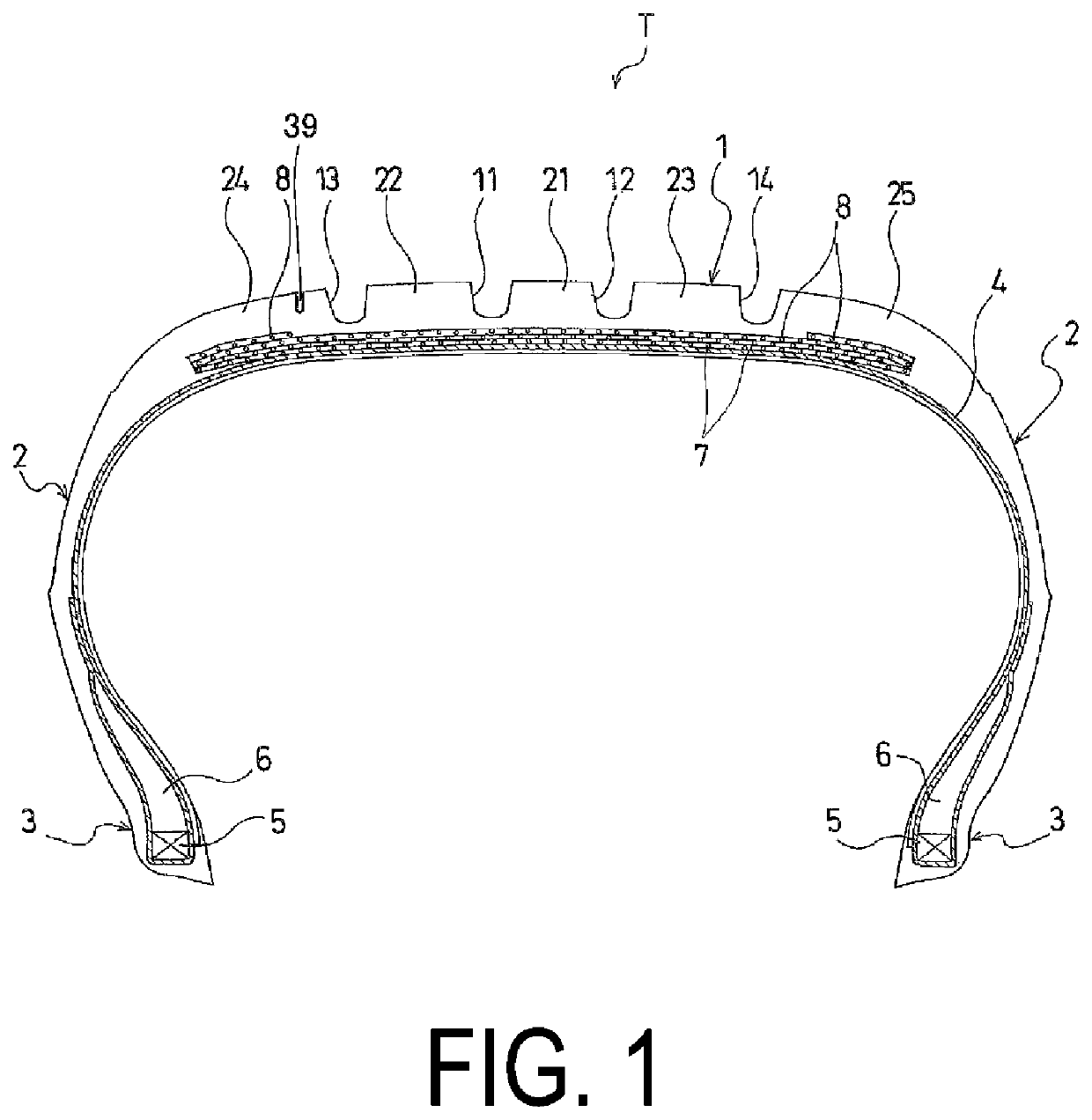
  • Figure 1
    Figure 1
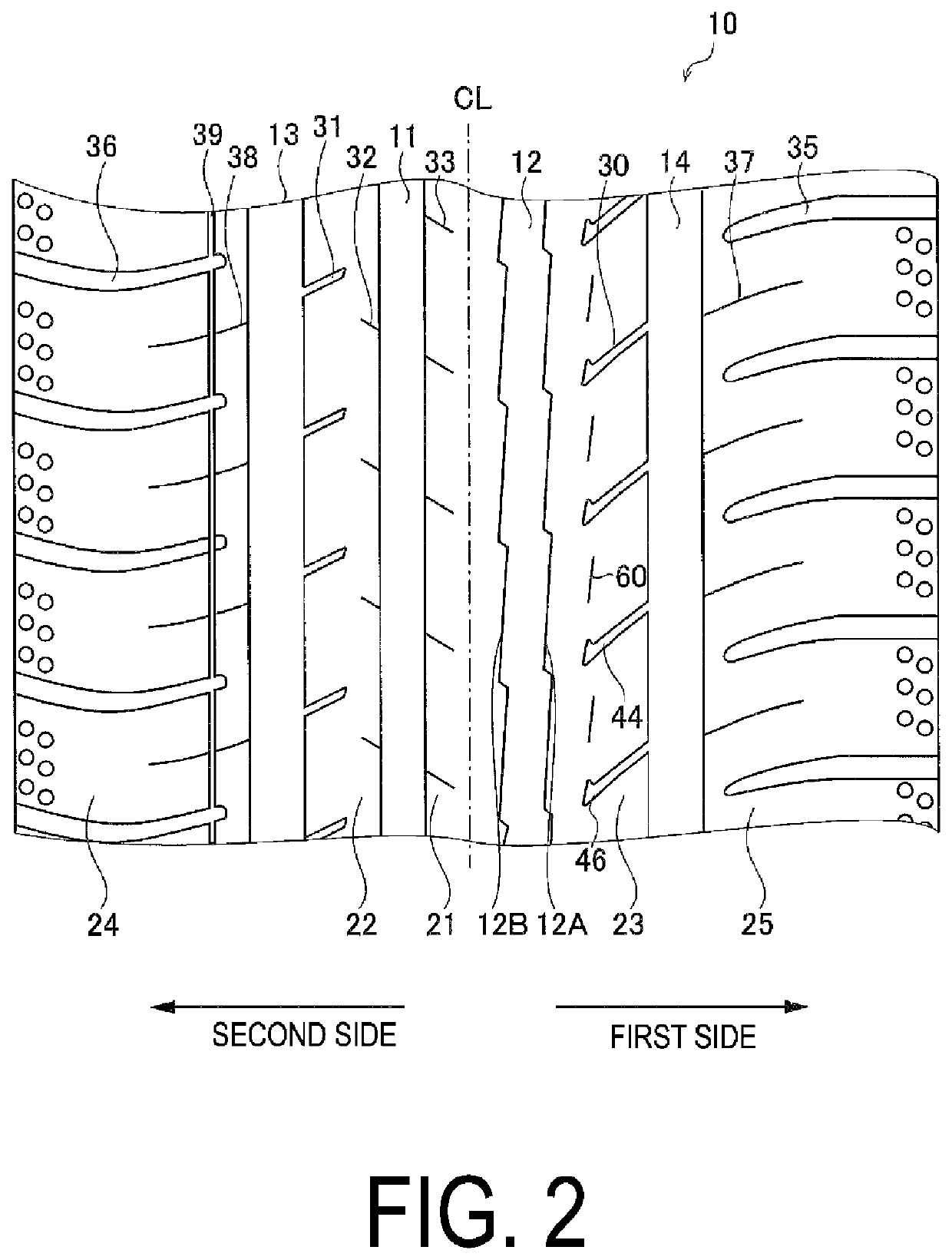
  • Figure 2
    Figure 2
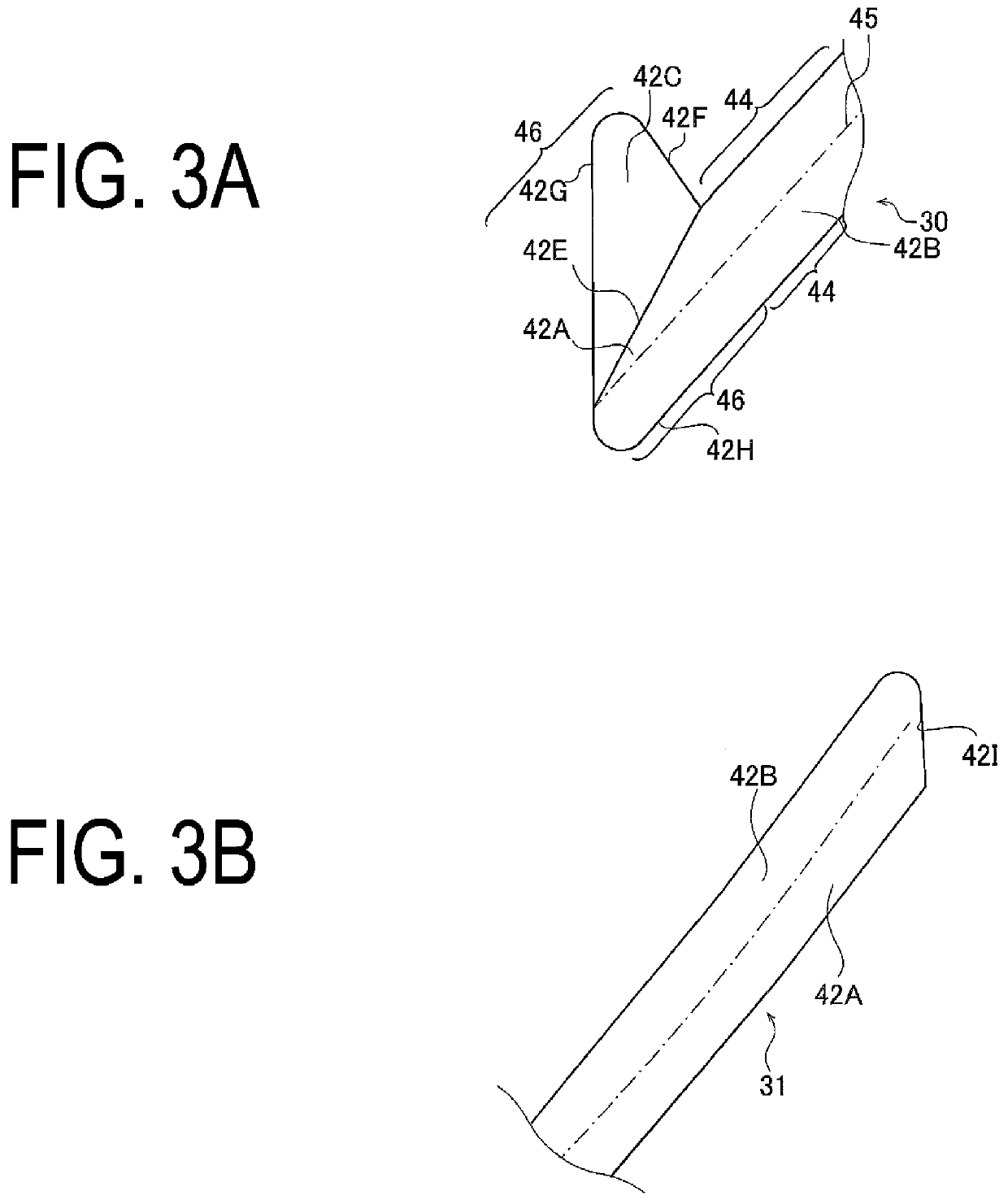
  • Figure 3
    Figure 3
Patent Text Reader

Abstract

A tread pattern of a pneumatic tire includes continuous lands provided in half treads on first and second sides, circumferential main grooves, and sipes having a chamfered configuration. The sipes extend inward in a lateral direction from the circumferential main grooves and are closed in the middle of regions of the continuous lands. An edge shape of each of sipes on the first side includes an extending portion extending inward in the lateral direction constantly in an extension direction and a bent portion that is provided to be joined to an end of the first extending portion and that has the edge shape bent from the extension direction of the first extending portion to a direction close to the circumferential direction. Every portion of the first extending portion and the bent portion of the sipes are provided with a main body portion and a sipe chamfered portion.
Need to check novelty before this filing date? Find Prior Art

Description

TECHNICAL FIELD

[0001] The present technology relates to a pneumatic tire.BACKGROUND ART

[0002] For a pneumatic tire, on a tread portion, a tread pattern is formed in which a plurality of main grooves extending in a tire circumferential direction are provided and a plurality of rows of land portions are defined by the plurality of main grooves. In such a pneumatic tire, good drainage performance is achieved by providing a plurality of lug grooves extending in a tire lateral direction in each of the land portions of the tread portion.

[0003] However, when the number of the lug grooves in the tread portion is increased, the rigidity of the tread portion (tread rigidity) is degraded, which degrades steering stability performance on dry road surfaces. In contrast, when the number of lug grooves in the tread portion is reduced, drainage performance is degraded, which degrades steering stability on wet road surfaces. Thus, steering stability on dry road surfaces and steering stability on wet ro...

Examples

Embodiment Construction

[0039]Hereinafter, a pneumatic tire of the present embodiment will be described in detail.

[0040]In the present specification, “tire lateral direction” refers to the direction of the center axis of rotation of a pneumatic tire. “Tire circumferential direction” refers to a rotation direction in which a tread surface rotates, when the tire rotates about the center axis of rotation of the tire. “Tire radial direction” refers to the direction radiating from the center axis of rotation of the tire. “Outward in the tire radial direction” refers to the direction away from the center axis of rotation of the tire. “Inward in the tire radial direction” refers to the direction towards the center axis of rotation of the tire. “Outward in the tire lateral direction” refers to the direction away from the tire equator line in the tire lateral direction. “Inward in the tire lateral direction” refers to the direction toward the tire equator line in the tire lateral direction.

[0041]FIG. 1 is a profile...