Parallel efficiency calculation method and apparatus

a performance evaluation and parallel computer technology, applied in multi-programming arrangements, instruments, nuclear elements, etc., can solve the problems of inability to detect processing with poor parallel efficiency, strict parallel performance evaluation cannot be performed, and the processing cannot be performed strictly, so as to shorten the processing time and improve the parallel efficiency

Active Publication Date: 2009-09-08
FUJITSU LTD
View PDF6 Cites 13 Cited by
  • Summary
  • Abstract
  • Description
  • Claims
  • Application Information

AI Technical Summary

Benefits of technology

[0010]Still another object of the invention is to provide a technique for enabling a suitable judgment on capability increase, renewal, or the like of a parallel computer system by using a parallel efficiency and the like.
[0011]Still another object of the invention is to provide a technique for enabling the suitable execution of tuning and / or selection of an algorithm of a program executed in a parallel computer system.
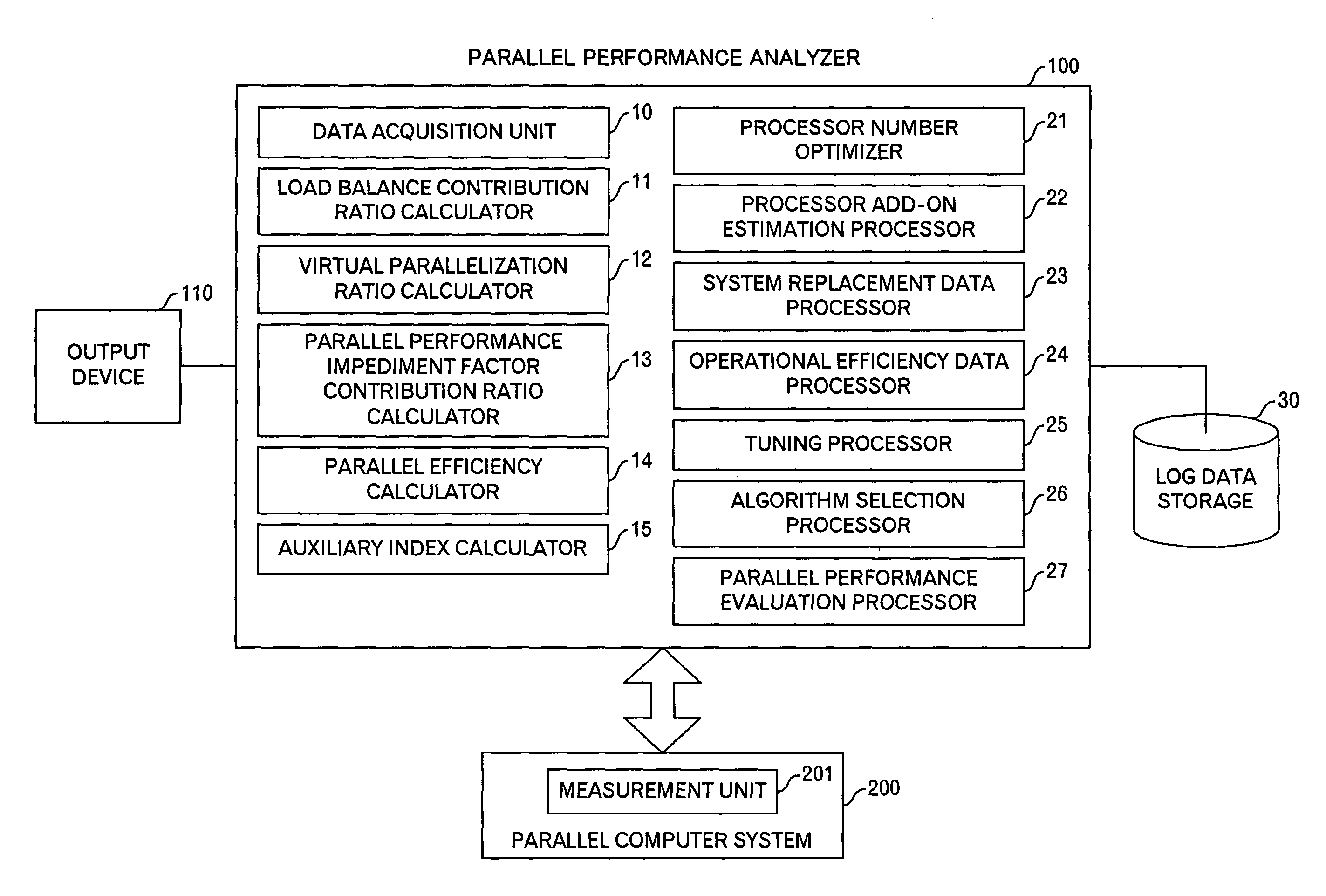
[0030]Besides, the first to fifth aspects of the invention may further comprise the steps of: setting a target parallel efficiency; and calculating an optimum number of processors by dividing a product of the calculated parallel efficiency and the number of processors by the target parallel efficiency and storing it into the storage device. Even if many processors are added, the processing time is not necessarily shortened, and if the optimum number of processors can be computed as stated above, it is possible to prevent wasteful addition of resources. The optimum number of processors may be outputted to an output device such as a display device.
[0036]Besides, the first to fifth aspects of the invention may further comprise the steps of: setting a target processing time; calculating an estimated value of the number of required processors for each different algorithm by using a parallel efficiency in each algorithm and storing it into the storage device; and extracting an algorithm in which the estimated value of the number of processors is smaller than an acceleration ratio representing a limit of improvement in a shortening degree of the processing time by parallelization of the processing by the algorithm and becomes a minimum value in the estimated values of the number of processors calculated on different algorithms. It becomes possible to quantitatively select the algorithm, which can further improve the parallel efficiency. The extracted algorithm may be outputted to an output device such as a display device.

Problems solved by technology

Although the self-complete type performance evaluation can be carried out by using an index called a parallel efficiency, it has not been actually executed.
Besides, the scalability evaluation is qualitative, and a strict parallel performance evaluation cannot be performed.
Accordingly, at present, processings with poor parallel efficiency cannot be detected, and they are put in an ungoverned state.
However, even if the parallel efficiency is determined by the conventional method, since the quantitative relation to parallel performance impediment factors is not clear, it has not been understood which impediment factor has what influence on the parallel efficiency.
US-2003-0036884-A1), as shown in FIG. 1, there is required a condition “load balance is kept, and respective processing times γi (parallel part), χi,1 (redundancy processing part), χi,2 (communication part), or χi,others (other parallel performance impediment factors) are identical to one another for all “i””, and there has been a problem that it can be applied to only a certain special parallel processing.
Besides, it is difficult to apply the conventional methods to the parallel processing by a grid or a cluster.
This is because when resources distributed on the grid or cluster and required for calculation, such as memories, data and CPUs, are concentrated in one processor, there often occurs a case where the processing becomes so large that it can not be accomplished by the one processor.
That is, it is difficult to measure τ(1) itself.
However, since the respective processor performances on the grid or the cluster are generally different from one another, there is also a problem that even if the actually measured τ(1) and τ(p) are substituted into the expression (1), an accurate parallel efficiency cannot be determined.

Method used

the structure of the environmentally friendly knitted fabric provided by the present invention; figure 2 Flow chart of the yarn wrapping machine for environmentally friendly knitted fabrics and storage devices; image 3 Is the parameter map of the yarn covering machine
View more

Image

Smart Image Click on the blue labels to locate them in the text.
Viewing Examples
Smart Image
  • Parallel efficiency calculation method and apparatus
  • Parallel efficiency calculation method and apparatus
  • Parallel efficiency calculation method and apparatus

Examples

Experimental program
Comparison scheme
Effect test

Embodiment Construction

Principle of the Invention

[0099]In the present invention, a parallel efficiency Ep(p) is described by parallel performance evaluation indexes so that the parallel efficiency Ep(p) is quantitatively connected to parallel performance impediment factors. As shown in FIG. 2, is processing time τi(p) can be expressed as expression (3) using the sum of a processing time γi(p) of a parallel calculation part and processing times χi,j(p) of respective parallel performance impediment factors j and can be represented as expression (3). Here, 1≦j≦jothers. Incidentally, in FIG. 2, i is a processor number, p is the number of processors. Besides, FIG. 2 shows only a processor i and a processor i+1.

[0100]τi⁡(p)≡γi⁡(p)+∑j=1jOthers⁢χi,j⁡(p)(3)

[0101]The expression (1) is transformed as set forth below, and the parallel efficiency Ep(p) is described by introducing, as parallel performance evaluation indexes, a load balance contribution ratio Rb(p), a virtual parallelization ratio Rp(p), and a parallel ...

the structure of the environmentally friendly knitted fabric provided by the present invention; figure 2 Flow chart of the yarn wrapping machine for environmentally friendly knitted fabrics and storage devices; image 3 Is the parameter map of the yarn covering machine
Login to View More

PUM

No PUM Login to View More

Abstract

This parallel efficiency calculation method can be applied, even in a case where a load balance is not kept, to many parallel processing including a heterogeneous computer system environment, and quantitatively correlates a parallel efficiency with a load balance contribution ratio and a virtual parallelization ratio, as parallel performance evaluation indexes, and parallel performance impediment factor contribution ratios. A parallel efficiency Ep(p) is calculated by using a load balance contribution ratio Rb(p) representing a load balance degree between respective processors included in a parallel computer system, a virtual parallelization ratio Rp(p) representing a ratio, with respect to time, of a portion calculated in parallel by the respective processors to processing executed in the parallel computer system, and a parallel performance impediment factor contribution ratio Rj(p) representing a ratio of a processing time of a portion of each parallel performance impediment factor to a total processing time of all the processors.

Description

TECHNICAL FIELD OF THE INVENTION[0001]The present invention relates to a performance evaluation technique of a parallel computer system and a usage technique of the result of the performance evaluation. Incidentally, the technique of the invention can be applied to all fields in which a parallel processing is performed, such as a field (structural analysis, fluid analysis, computational chemistry, etc.) handled in the conventional high performance computing (HPC), a biosimulation expanded on a grid or a cluster, or a Web service (for example, MtoM (Machine to Machine)).BACKGROUND OF THE INVENTION[0002]The performance of a parallel computer system remarkably varies for each application. Accordingly, its performance evaluation is important. A performance evaluation method of the parallel computer system includes (1) a method in which a specific processing is executed by various computers and a comparison is made, and (2) a self-complete type method to evaluate how much performance a c...

Claims

the structure of the environmentally friendly knitted fabric provided by the present invention; figure 2 Flow chart of the yarn wrapping machine for environmentally friendly knitted fabrics and storage devices; image 3 Is the parameter map of the yarn covering machine
Login to View More

Application Information

Patent Timeline
no application Login to View More
IPC IPC(8): G06F15/00G06F11/30G06F5/00G06F9/50G06F11/34G06F15/177G06F17/10
CPCG06F11/3447G06F11/3404G06F11/3419G06F11/3433
InventorORII, SHIGEO
OwnerFUJITSU LTD