
Folding bicycle
a bicycle and folding technology, applied in the field of folding bicycles, can solve the problems of affecting the strength and rigidity the rear part of the bicycle cannot be folded sufficiently close to the beam, and the bicycle is still too bulky for packing and carrying, so as to reduce the height of the folded bicycle, reduce the width, and be more compact
- Summary
- Abstract
- Description
- Claims
- Application Information
AI Technical Summary
Benefits of technology
Problems solved by technology
Method used
Image

Examples
Embodiment Construction
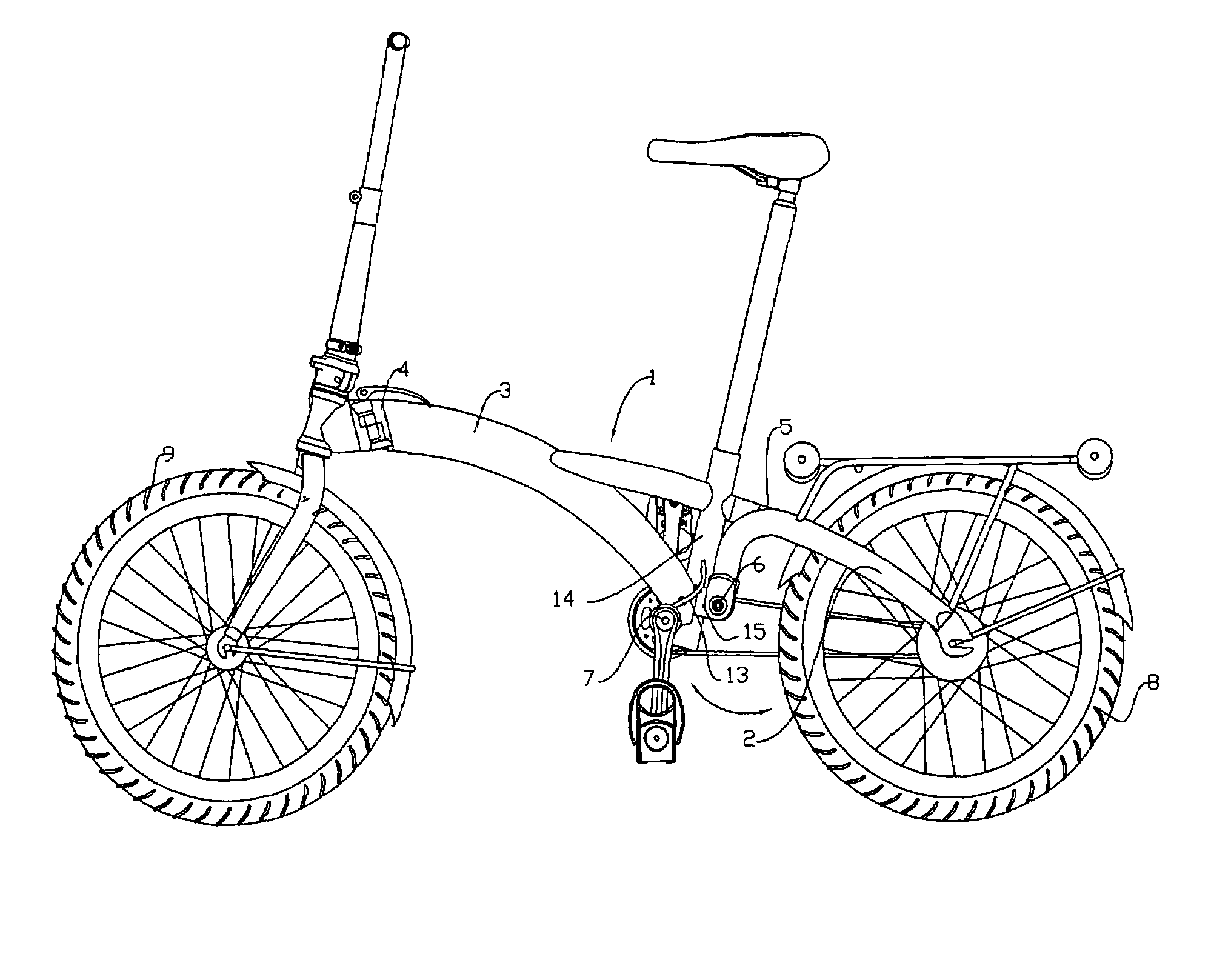
[0015]A folding bicycle of the present invention is shown in FIGS. 4 and 5. Wherein the rear fork 2 is hinged with the frame 1 via a hinge axle 6, a folding joint 4 is installed on the beam 3, and on the rear fork 2 is installed a support bar 5 which rests against the frame 1. Viewing from the top, the beam 3 is slightly S-shaped, and the hinge axle 6 is tilted by an acute angle θ with respect to the frame central axle 7. As shown in FIG. 6, when the rear fork 2 is folded forward, the rear wheel 8 moves to one side of the beam 3 instead of being located below the beam 3, and the height of the folded bicycle can be reduced to be the same as that of its wheels. As shown in FIG. 7, since the beam 3 is slightly S-shaped, when the bicycle is folded, the front wheel 8 and the rear wheel 9 are located separately, each at one side of the beam 3 and within the concave section of the S-shaped beam 3, so that the bicycle is more compact and has a less width after being folded.
[0016]To ensure t...
PUM
 Login to View More
 Abstract
Description
Claims
Application Information
 Login to View More