
Underwater sounding apparatus capable of calculating fish quantity information about fish school and method of such calculation
a sounding apparatus and fish quantity technology, applied in the field of underwater sounding apparatuses, can solve the problems of fish-finding echo sounder not allowing fishers, not so easy for fishers, and variations in obtained data
- Summary
- Abstract
- Description
- Claims
- Application Information
AI Technical Summary
Benefits of technology
Problems solved by technology
Method used
Image

Examples
first embodiment
[0063]The principle of calculating the fish quantity information by use of a cylindrical coordinate system and five specific forms thereof using this principle are described below with reference to First to Fifth Examples. As described in the first embodiment, the ship 7 moves in a positive direction of the x-axis.
Principle of Fish Quantity Information Calculation Using Cylindrical Coordinate System
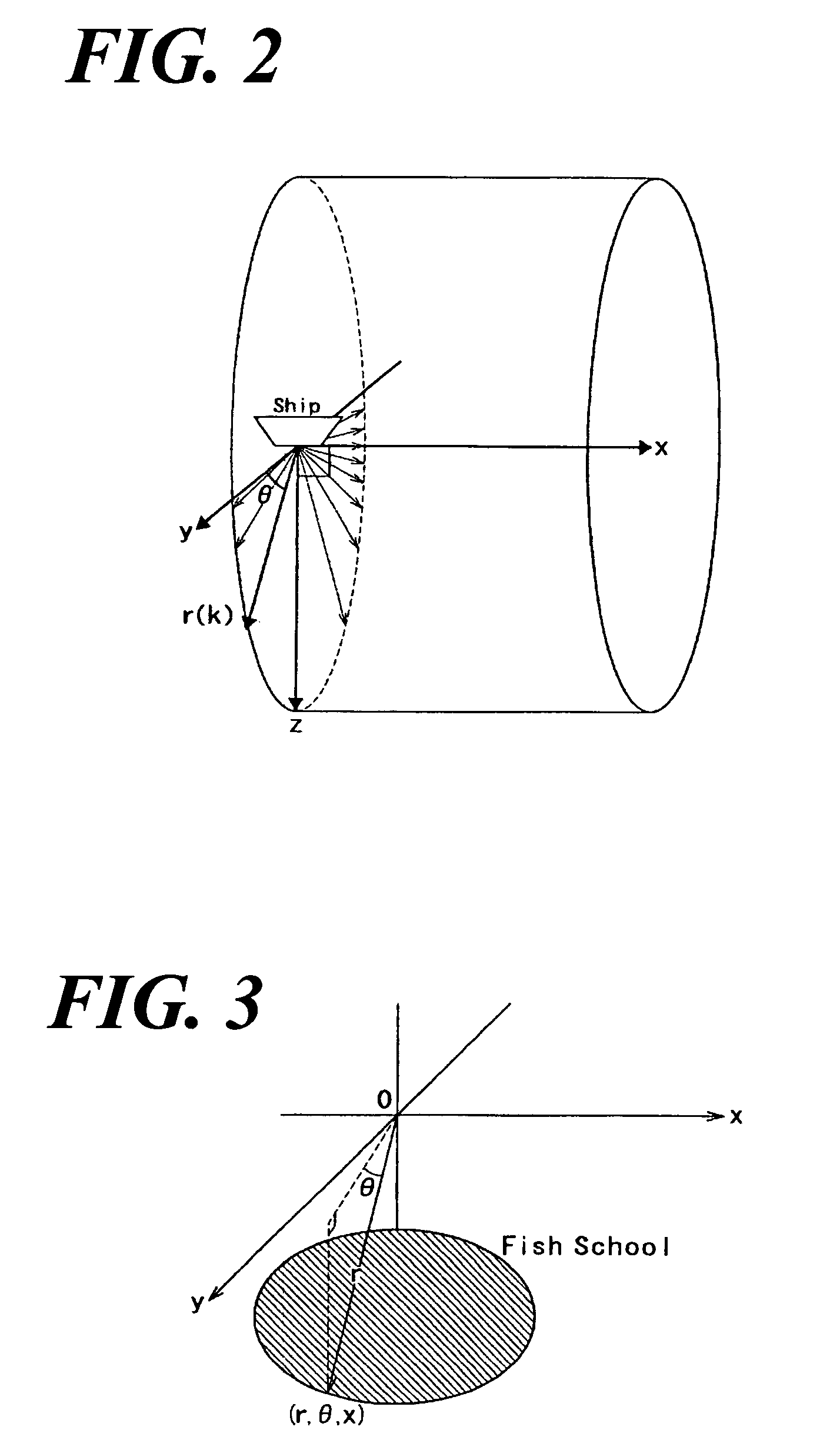
[0064]The principle of fish quantity information calculation using the cylindrical coordinate system is explained with reference to FIGS. 2 and 3, of which FIG. 2 is a diagram showing a model of the cylindrical coordinate system, and FIG. 3 is a diagram showing a positional relationship between the transducer 2 (origin O) and a fish school FS.
[0065]Discussed below is a situation in which an acoustic sounding beam emitted into a body of sea water from the transducer 2 is reflected from inside the fish school FS and the transducer 2 receives an echo thus reflected by a receiving beam as ill...
first example
[0089]The First Example is a practical example of a method of calculating fish quantity information using a vertical cylindrical coordinate system. Thus, the principle of fish quantity information calculation using the cylindrical coordinate system can be applied as it is. The First Example based on the principle of fish quantity information calculation using the cylindrical coordinate system is described with reference to FIGS. 2, 5 and 6. FIG. 5 is a diagram showing data picked up by the receiving beam when the acoustic beam is steered along the yz-plane within a range of 0≦θ≦π / 2 (rad). The data shown in FIG. 5 indicates equivalent input sound intensities PM2 picked up by the receiving beam, so that the larger the equivalent input sound intensity PM2 picked up by the receiving beam, the higher the density shown in FIG. 5. FIG. 6 is a diagram showing a model of how the ship 7 advances. The transducer 2 has a spherical shape.
[0090]Referring to FIG. 2, the ship 7 runs in the positive...
second example
[0105]The Second Example is a practical example of a method of calculating fish quantity information using an inclined axis cylindrical coordinate system. Thus, the principle of fish quantity information calculation using the cylindrical coordinate system can not be directly applied as it is but needs to be modified. Here, it is assumed that the transducer 2 has a spherical shape. The principle of fish quantity information calculation using the cylindrical coordinate system of the Second Example is now described with reference to FIGS. 7 to 11.
[0106]FIG. 7 is a diagram showing a model of the inclined axis cylindrical coordinate system. As illustrated in FIG. 7, the ship 7 is moving in the positive direction of the x-axis while steering the acoustic beam along a slant plane H1. An algorithm used for calculating the fish quantity information using the inclined axis cylindrical coordinate system is explained in the following. The “slant plane H1” is an imaginary plane containing the y-...
PUM
 Login to View More
 Abstract
Description
Claims
Application Information
 Login to View More