
Photochromic materials and photochromic compositions and articles including the same
a technology of composition and photochromic material, applied in the field of photochromic materials, can solve the problems of ophthalmic lenses, ocular damage, and the tendency of photochromic materials to migrate, and to be susceptible to mechanical damag
- Summary
- Abstract
- Description
- Claims
- Application Information
AI Technical Summary
Problems solved by technology
Method used
Image



Examples
example 1
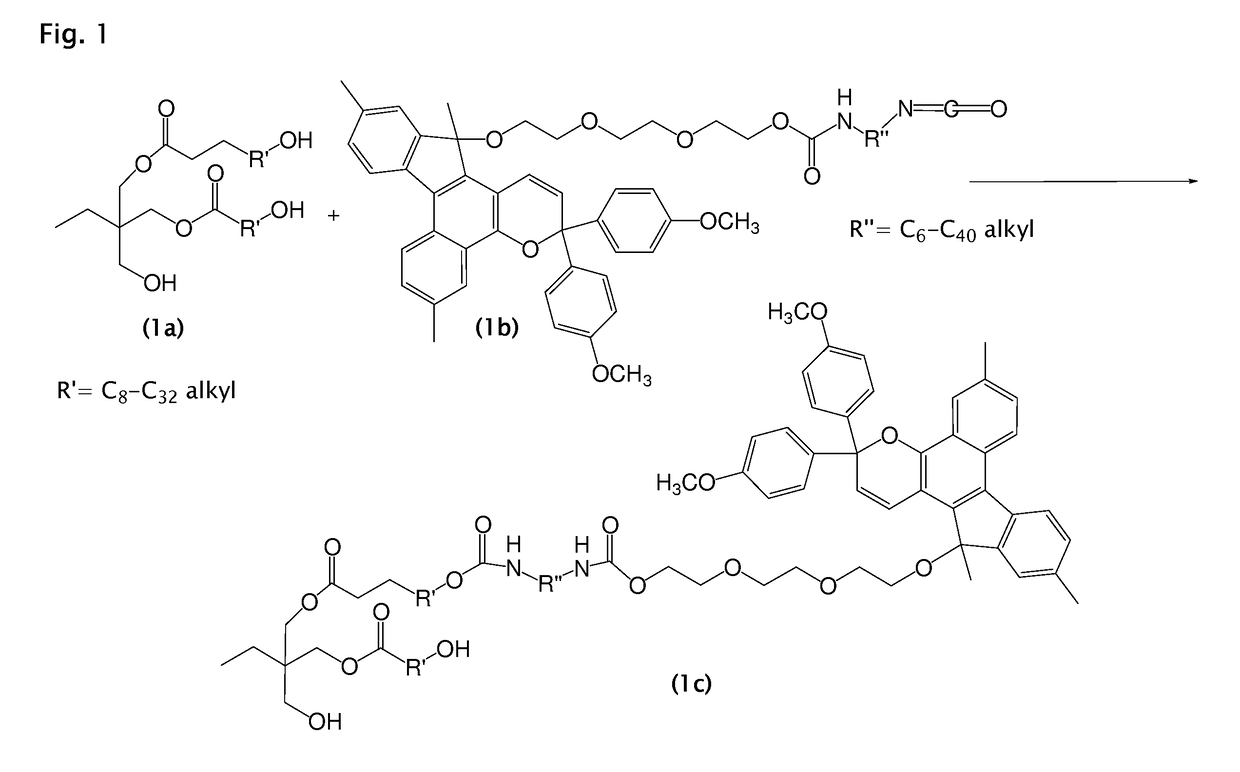
[0272]A polyester polymer was prepared using Compositions A and C as described above. The ingredients of Charge 1, used to prepare the polyester polymer Example 1, are listed in Table 4.
[0273]
TABLE 4Ingredients for Example 1IngredientsCharge 1Weight (grams)Composition A100.0Composition C14.4Dibutyltin dilaurate0.06
[0274]The ingredients of Charge 1 were added in the order listed to a three neck round bottom flask equipped with a mechanical stirrer, heating mantle, condenser, and nitrogen sparge. The contents of the reaction flask were stirred and heated to 80° C., a nitrogen blanket was applied, and the temperature was maintained at 80° C. for one hour. The reaction mixture was held under these conditions an additional 30 minutes until all of the free isocyanate was zero or close to zero as determined by infrared analysis as described in the preparation of Composition A. The calculated Hydroxyl Number of the resulting polyester polyol was 49.5 milligrams potassium hydroxide per gram....
example 2
[0275]The procedure of Example 1 was followed except that 50.23 g of Composition A was used instead of 100.0 g of Composition A and Composition D (11.84 g) was used instead of Composition C (14.4 g). The calculated Hydroxyl Number of the resulting polyester polyol was 44.6 milligrams potassium hydroxide per gram.
example 3
[0276]The procedure of Example 1 was followed except that Composition B (50.03 g) was used in place of Composition A (100.0 g) and Composition D (7.82 g) was used instead of Composition C (14.4 g) and N-methylpyrrolidinone (17.5 g) was added. The calculated Hydroxyl Number of the resulting polyester polyol was 37.5 milligrams potassium hydroxide per gram.
Part 5—Preparation of Coating Compositions and Coated Lenses
[0277]Each coating composition was prepared by pre-dissolving the appropriate photochromic material in N-methylpyrrolidinone (NMP) and subsequently adding the remaining components set forth in Table 5 in the listed amounts to this solution. The resultant mixture was stirred using a magnetic stir bar for approximately 30 minutes until a homogeneous mixture was obtained. After mixing, each coating composition, except Example 1, was applied to a pair of Gentex PDQ hardcoated polycarbonate lens (1.5 mm×70 mm), which had been previously plasma treated, by spin coatings at 1500 r...
PUM
| Property | Measurement | Unit |
|---|---|---|
| temperature | aaaaa | aaaaa |
| temperature | aaaaa | aaaaa |
| temperature | aaaaa | aaaaa |
Abstract
Description
Claims
Application Information
 Login to View More