Supercharge Your Innovation With Domain-Expert AI Agents!

Telecommunications network

a technology of telecommunications network and paging, applied in the field of telecommunication network, can solve the problems of sae/lte network and other problems, and achieve the effect of efficient paging of mobile terminals

Inactive Publication Date: 2012-05-01
VODAFONE GRP PLC
View PDF5 Cites 25 Cited by
  • Summary
  • Abstract
  • Description
  • Claims
  • Application Information

AI Technical Summary

Benefits of technology

This approach reduces latency and costs by ensuring data traffic is routed through the nearest available nodes, improving network efficiency and user experience, especially for mobile devices that move significantly within the network.

Problems solved by technology

A corresponding problem also exists for SAE / LTE networks in relation to Packet Data Network Gateway (PDN-GW) selection.

Method used

the structure of the environmentally friendly knitted fabric provided by the present invention; figure 2 Flow chart of the yarn wrapping machine for environmentally friendly knitted fabrics and storage devices; image 3 Is the parameter map of the yarn covering machine
View more

Image

Smart Image Click on the blue labels to locate them in the text.
Viewing Examples
Smart Image
  • Telecommunications network
  • Telecommunications network
  • Telecommunications network

Examples

Experimental program
Comparison scheme
Effect test

first embodiment

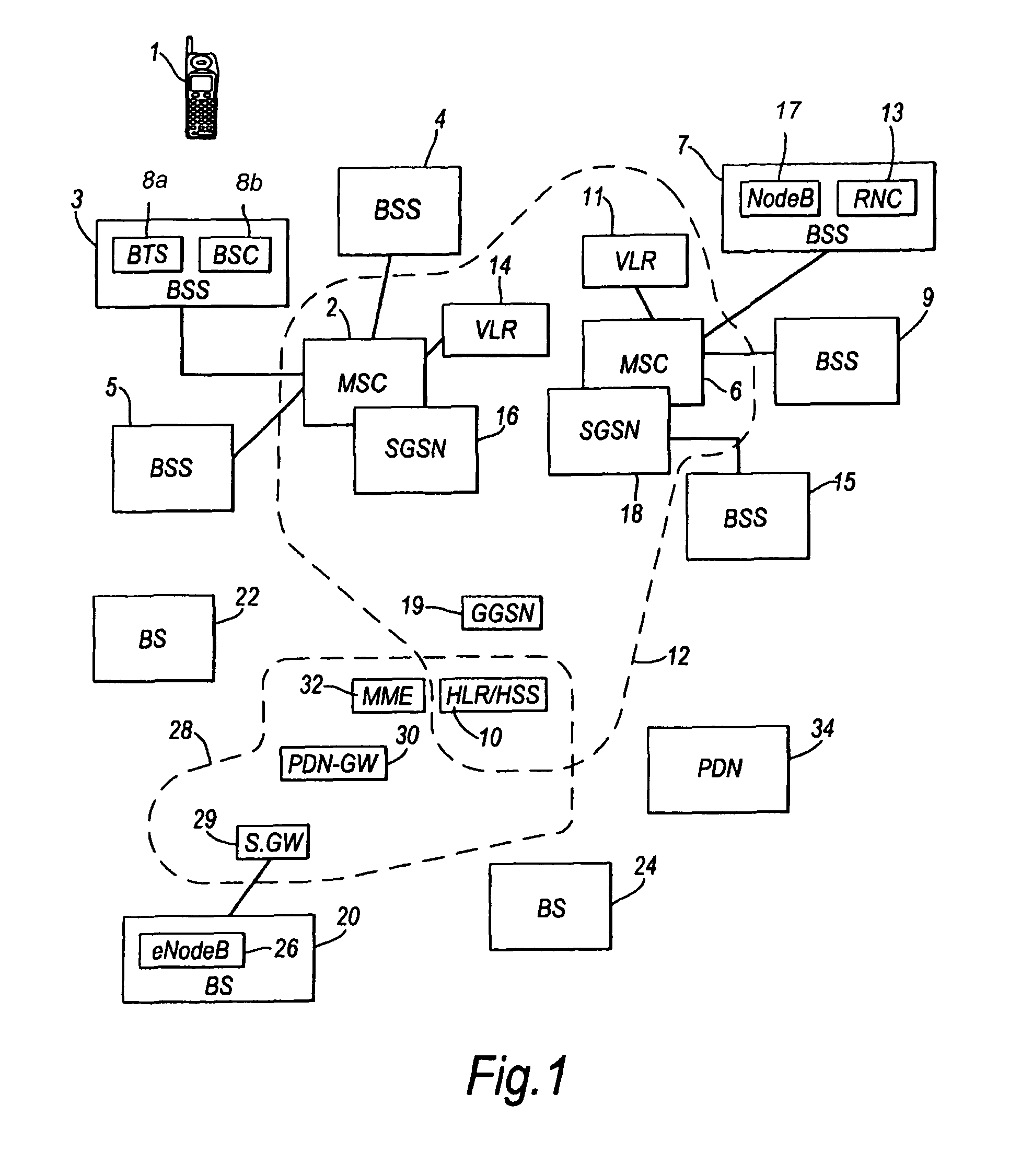
[0061]According to the system described herein, the SGSN 16 / MME 32 is configured with a table of GGSNs / PDN-GWs that are commonly allocated by that SGSN 16 / MME 32 when they activate a PDP context, so that “non-local” GGSNs / PDN-GWs for which “routing improvement” is desired can be identified. Then, if the SGSN 16 / MME 32 receives a Periodic Routeing / Tracking Area Update Request from a mobile device using one of the “non-local” GGSNs / PDN-GWs, the SGSN 16 / MME 32 answers with “Detach, re-attach required”. This resolves the mis-routeing problems for those users who have an inactivity period of greater than the PRAU / PTAU timer (e.g. >60 minutes). Sending this “Detach, re-attach required” at the time of a PRAU / PTAU gives a good probability that the user of the terminal will not be perturbed by this network action.

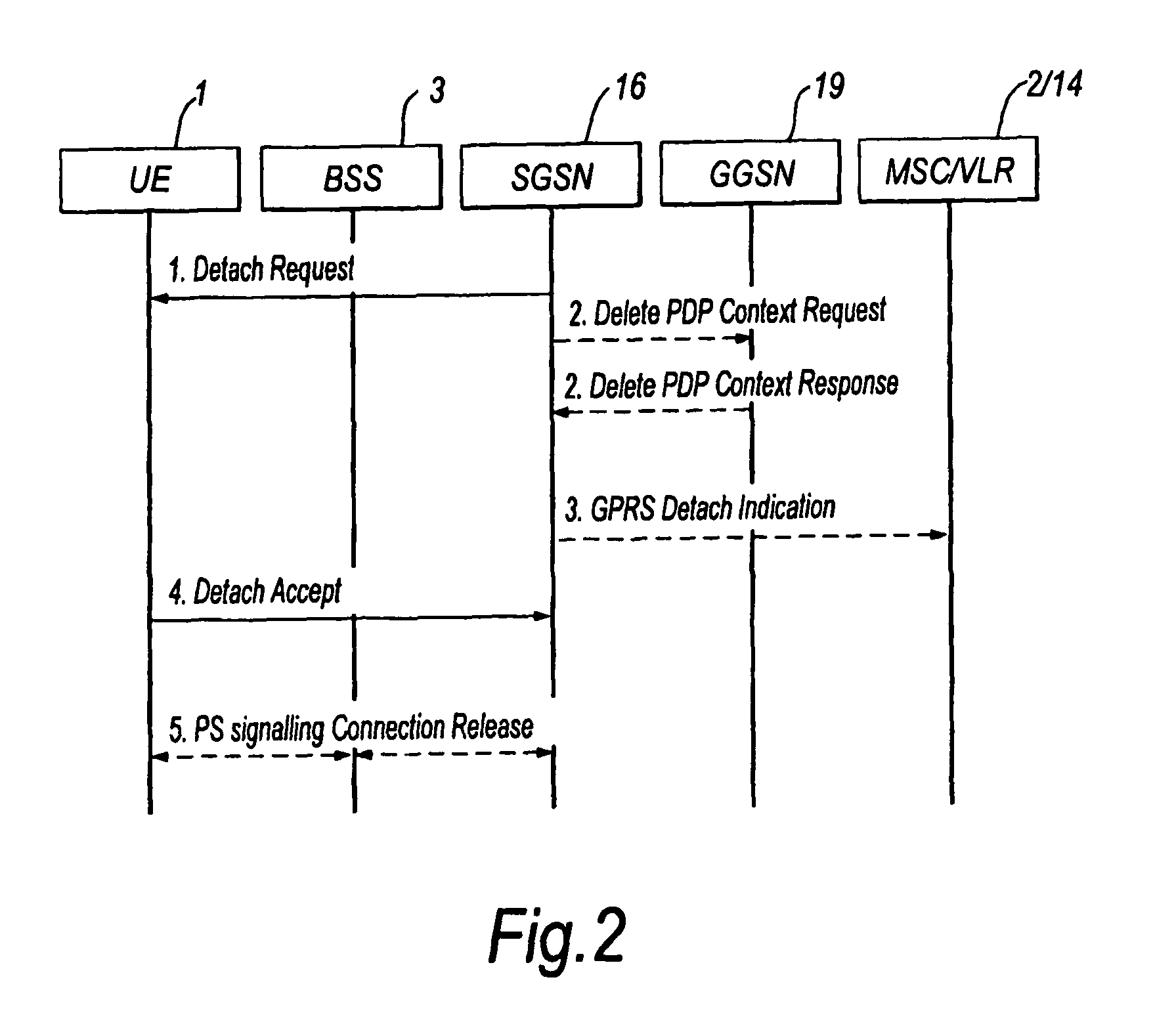
[0062]The first embodiment will now be described with reference to the flow charts of FIGS. 3 and 4.

[0063]The flow chart of FIG. 3 relates to a mobile terminal (UE) in the 3G PS dom...

second embodiment

[0076] if the mobile terminal again performs the Periodic Tracking Area Updates with the MME 32, these updates might need to be performed irrespective of whether or not there is user plane activity (the mobile terminal is in the active state). In this case (and for some other situations), the PDN-GW 30 would be the place to detect user inactivity (e.g. a pause in the transmission of data). In such a situation, the PDN-GW 30 can be configured with a list of “local” MMEs and / or eNodeBs. Then for APNs that need local routeing when the mobile terminal enters to LTE-IDLE mode in a “non-local zone” (i.e. a zone not in the list), the PDN-GW can either immediately, or, upon expiry of a, probably short, timer (eg 10 seconds-10 minutes) signal to the MME 32 to get the MME 32 to detach the terminal (with cause=re-attach required).

[0077]The second embodiment of the system described herein will now be described in more detail with reference to the flow chart of FIG. 5.

[0078]At step H the mobile ...

the structure of the environmentally friendly knitted fabric provided by the present invention; figure 2 Flow chart of the yarn wrapping machine for environmentally friendly knitted fabrics and storage devices; image 3 Is the parameter map of the yarn covering machine
Login to View More

PUM

No PUM Login to View More

Abstract

A method of controlling selection of a data transmission network node, such as a base station, node B, eNodeB, GGSN or LTE PDN-GW, for a mobile device in a telecommunications network is disclosed. The mobile telecommunications network includes a plurality of mobility management nodes, such as SGSN and LTE MME. When the mobile terminal moves from a first one of the mobility management nodes to a second of the nodes, it is determined at the second node whether to cause the mobile terminal to re-select a data transmission network node. The determining step may be performed in response to a periodic routing area / periodic tracking area update request generated by the mobile terminal or in response to the mobile terminal being in an idle communication state. When the data transmission network node is re-selected, a data transmission network node that is relatively geographically near to the mobile terminal is selected.

Description

FIELD OF THE INVENTION[0001]This application relates to a method of controlling selection of a data transmission node for a mobile device in a mobile telecommunications network and to a mobile telecommunications network.BACKGROUND TO THE INVENTION[0002]Currently 2G (GSM), 2.5G (GPRS) and 3G (UMTS / UTRA) mobile or cellular telecommunications networks (PLMNs) co-exist. A development of the radio access network part of 3G mobile telecommunications is “evolved” UTRA or E-UTRA, also referred to as LTE (Long Term Evolution). “System Architecture Evolution” (SAE) is the development of the core network part of 3G mobile telecommunications. The combined core network and radio network development is sometimes referred to as SAE / LTE. It is desirable for mobile terminals to provide continuous service also when moving from an LTE coverage area to a 3G or 2G coverage area.[0003]With current GPRS / UMTS packet switched (PS) networks, the GGSN is selected when the PDP context is activated. This is des...

Claims

the structure of the environmentally friendly knitted fabric provided by the present invention; figure 2 Flow chart of the yarn wrapping machine for environmentally friendly knitted fabrics and storage devices; image 3 Is the parameter map of the yarn covering machine
Login to View More

Application Information

Patent Timeline
no application Login to View More
Patent Type & Authority Patents(United States)
IPC IPC(8): H04W40/00H04W40/34H04W48/00H04W64/00H04W76/04
CPCH04W40/34H04W48/17H04W64/006H04W76/041H04W76/22
Inventor PUDNEY, CHRISTOPHER DAVID
Owner VODAFONE GRP PLC
Features
  • R&D
  • Intellectual Property
  • Life Sciences
  • Materials
  • Tech Scout
Why Patsnap Eureka
  • Unparalleled Data Quality
  • Higher Quality Content
  • 60% Fewer Hallucinations
Social media
Patsnap Eureka Blog
Learn More