[0005]The object of the invention is therefore to provide a medium dispenser of the generic type, which increases the likelihood that the user discharges the medium in the desired mixing ratio of the components of the medium.
[0022]In the case of the use of LEDs or another optical output device, it is particularly advantageous if the output device is designed to indicate at least three states differentiable for the user. This may be achieved for example via an LED which, besides the switched-off state, can also output light in two different colors. An embodiment with two LEDs is also able to indicate the desired three differentiable states. The possibility of indicating three differentiable states via the output device makes it possible, besides a rest state, to also make a further state visible for the user, in which the onset of the shaking process has been registered, however the shaking process performed is not yet sufficient. In the embodiment with one LED, this could, for example, assume a first color with the onset of the shaking process and could assume a second color after sufficient shaking.
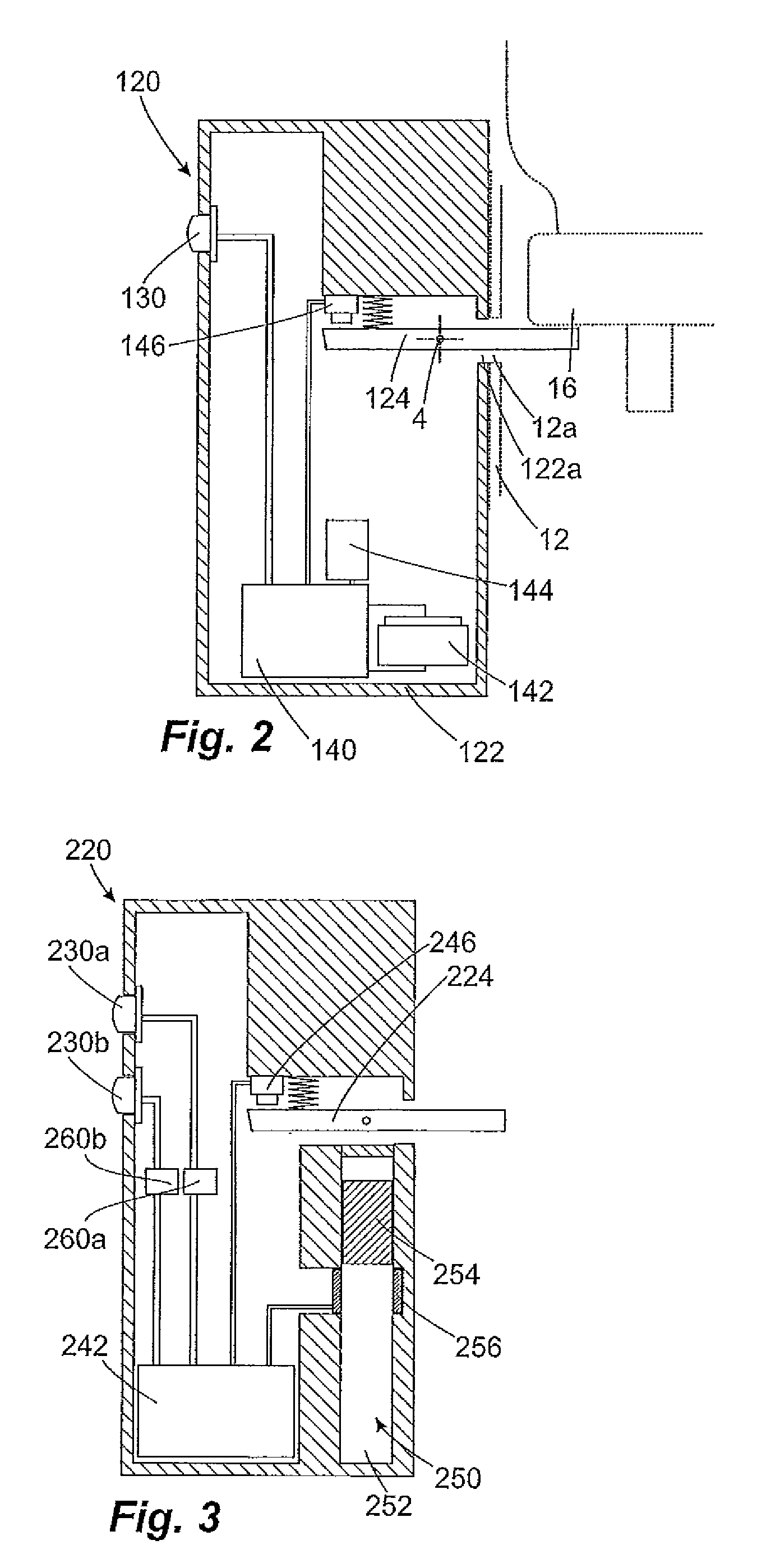
[0025]The conversion of the energy introduced mechanically into the system into electrical energy enables a particularly simple embodiment of a medium dispenser according to the invention. With this embodiment, the output device is connected to the mentioned energy store via a circuit which causes a separation of the energy store from the output device as long as the energy stored in the energy store does not exceed a specific measure. Only when a limit value, which for example may be a voltage limit value or an energy limit value, has been exceeded is current supplied to the output device. With such an embodiment, in which the limit value switch forms a comparator so to speak, it is therefore possible to dispense completely with a microprocessor where necessary, since merely the energy introduced into the energy store by the shaking in conjunction with the limit value switch makes it possible for the user to identify whether he has already shaken the dispenser to a sufficient extent.
[0030]Even with such an embodiment with a microprocessor, effective coupling with the actuating handle may be provided, as a result of which, after an actuation process or a defined number of actuation processes, the microprocessor is reset, such that it initially starts again from the unshaken state of the dispenser for a renewed discharge process.
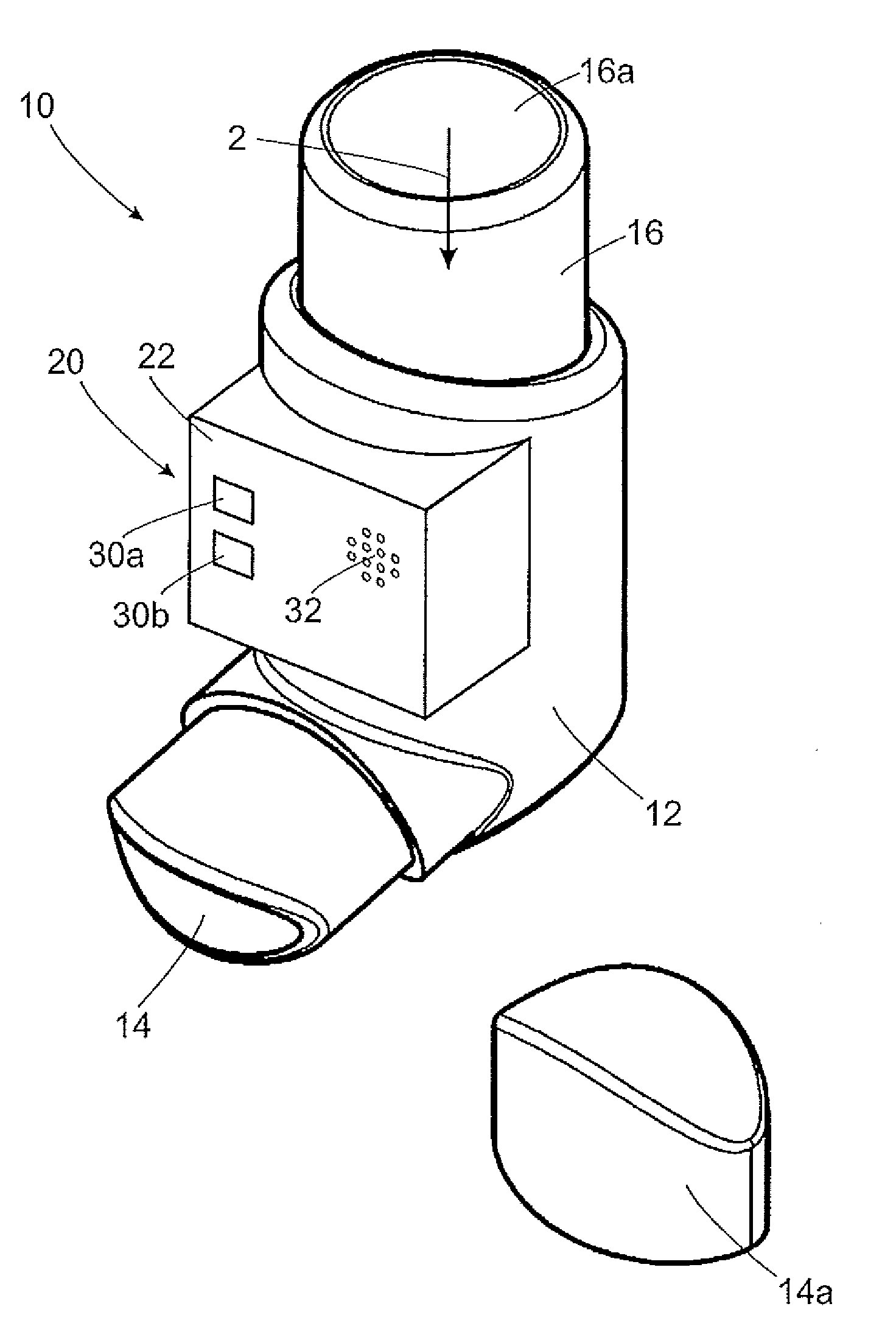
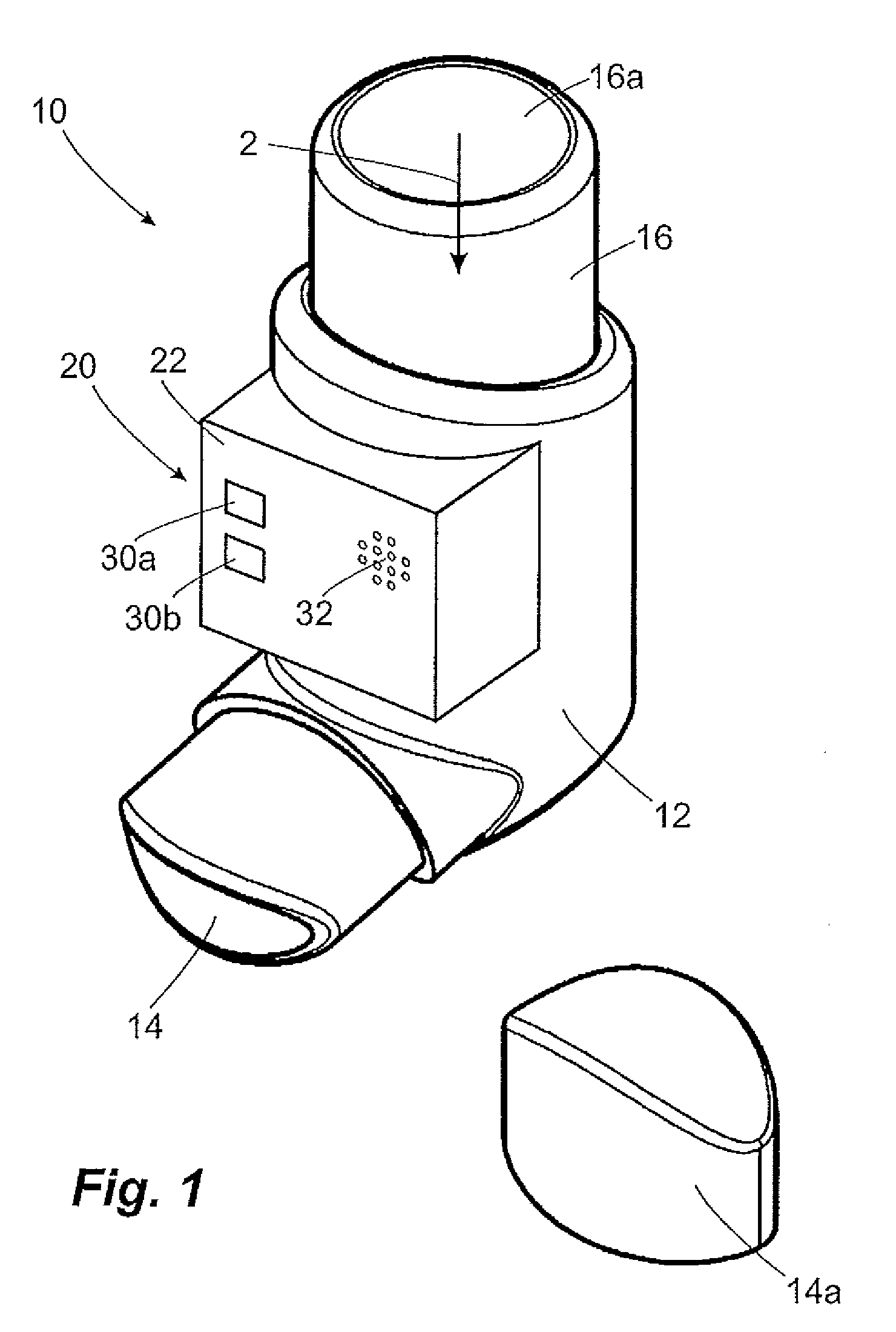
[0032]It is particularly advantageous if the detecting device is formed as a separate module, in particular as a separate module with a module housing separate from a main housing of the medium dispenser. The separate embodiment of the detecting device as a module makes it possible to use this in unchanged or largely unchanged form in various dispensers. This modular embodiment is to be understood to mean that all components necessary for the functioning of the detecting device, that is to say in particular the output device and any mechanism that causes a change of state of the output device upon shaking, are comprised in one structural unit that can be handled as a whole. If this comprises a separate module housing, attachment to the outer face of a dispenser is also possible.
[0034]The coupling device, by means of which the separate module can be connected to the main housing, can be designed differently depending on who is supposed to carry out the change. In the case of a detecting device that is provided for a number of dispenser types, but is not to be exchangeable by the end user, the coupling device can be arranged so as to be inaccessible from outside. In the case of intended exchange by the user, the coupling device is preferably accessible for the user and easy to handle.


 Login to View More
  Login to View More