
Skin treatment system
a skin treatment and skin technology, applied in the field of skin treatment system, can solve the problems of not all energy is absorbed in the skin, the hair removal effect the energy invested in light frequencies is not effective or sufficiently effective, so as to prevent or limit the possibility of pain, the effect of reducing the pain
- Summary
- Abstract
- Description
- Claims
- Application Information
AI Technical Summary
Benefits of technology
Problems solved by technology
Method used
Image

Examples
Embodiment Construction
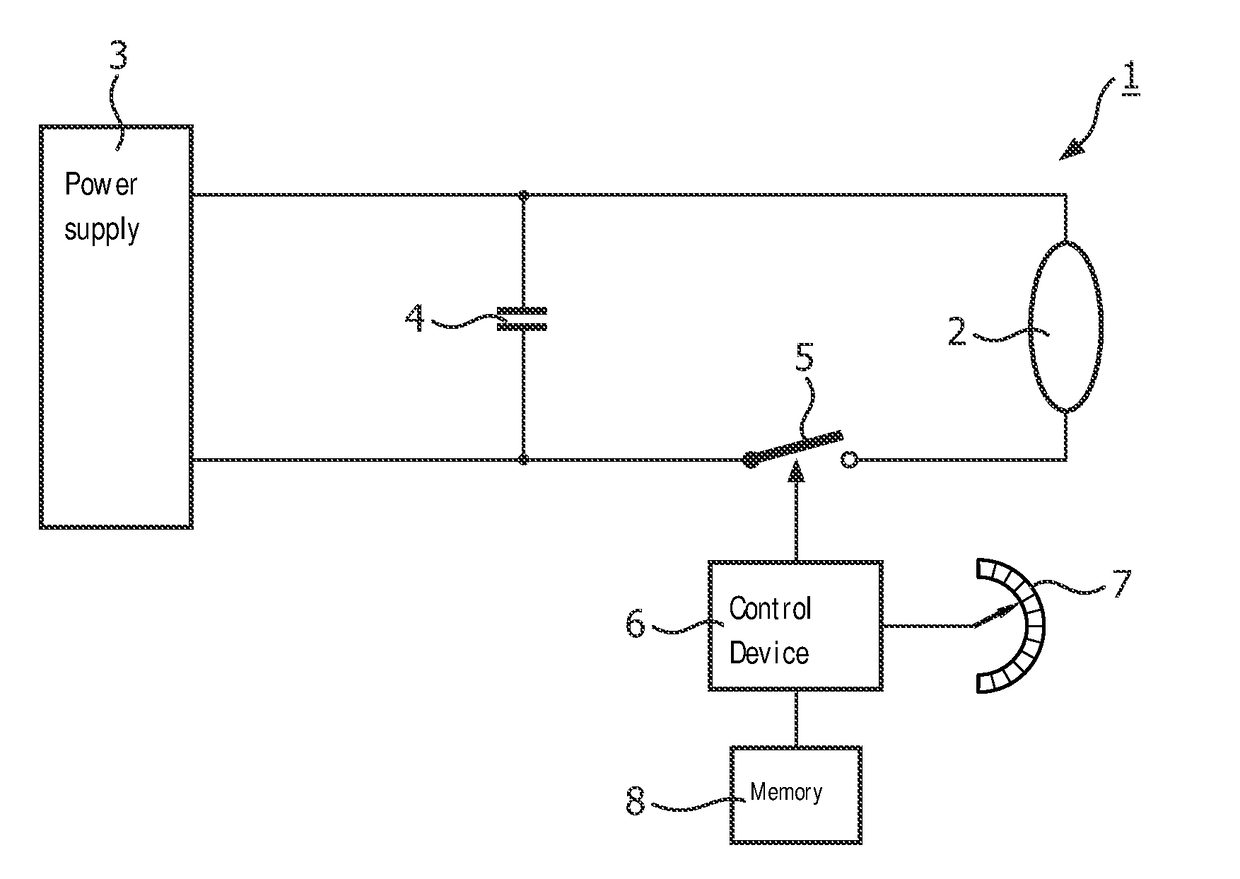
[0018]FIG. 1 schematically shows an electrical block diagram of a skin treatment system 1 according to the present invention, comprising a flashlamp 2. The flashlamp 2 is a discharge lamp, including a gas-filled vessel with two electrodes, as known per se. Although other types of flashlamps are possible, the flashlamp 2 typically is a xenon discharge lamp. A discharge capacitor 4 is mounted in parallel with the lamp 2, with a controllable switch 5 arranged in a current path between the lamp 2 and the capacitor 4. The capacitor 4 is supplied from a power source 3, typically a voltage source. The controllable switch 5 is controlled by a control device 6, for instance a microprocessor or the like.
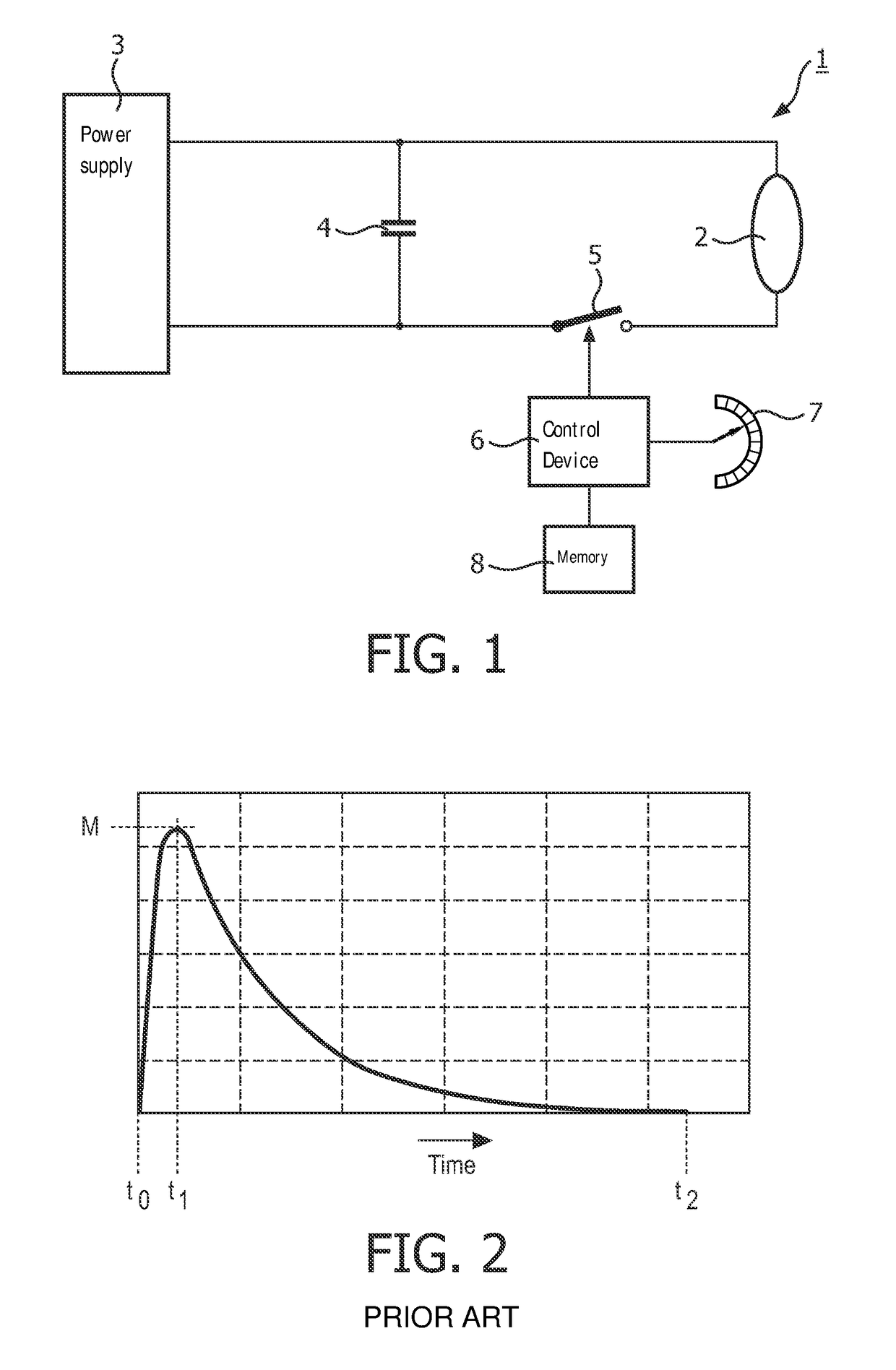
[0019]FIG. 2 is a graph, showing lamp current density as a function of time, for illustrating prior art operation of such a flash lamp. First, the capacitor 4 is charged from the source 3. The switch 5 is open (i.e. non-conductive). At a certain moment t0, the control device 6 closes the switc...
PUM
 Login to View More
 Abstract
Description
Claims
Application Information
 Login to View More