
Semi-tower type medium-temperature separation biomass circulating fluidized bed boiler
A circulating fluidized bed and half-tower technology, which is applied in the field of half-tower medium-temperature biomass circulating fluidized bed boilers, can solve the problems of hindering combustion, difficult to burn out fuel, affecting the fluidization quality of bed materials, etc. The effect of preventing slagging and bed material agglomeration, controlling ash accumulation and ash blocking, and reducing the cohesiveness of fly ash
Patent Information
- Authority / Receiving Office
- CN · China
- Patent Type
- Applications(China)
- Current Assignee / Owner
- Publication Date
- 2012-11-14
Smart Images
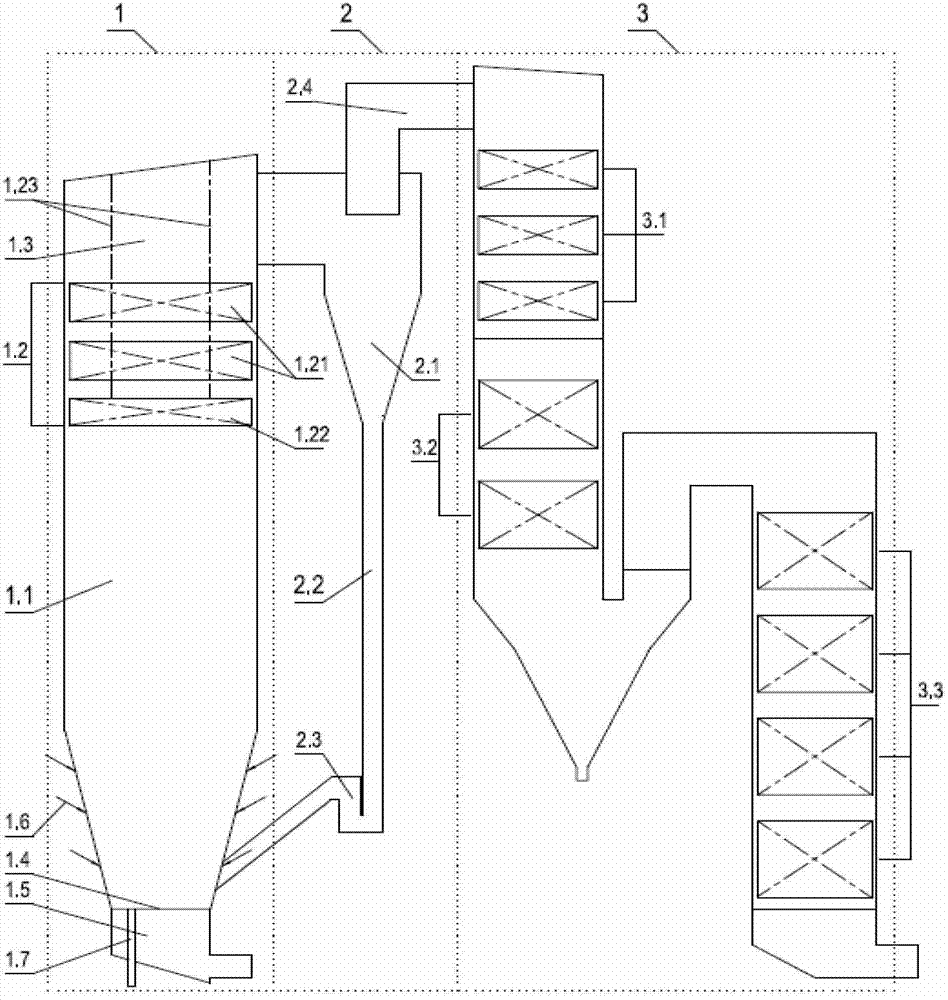
Figure 1 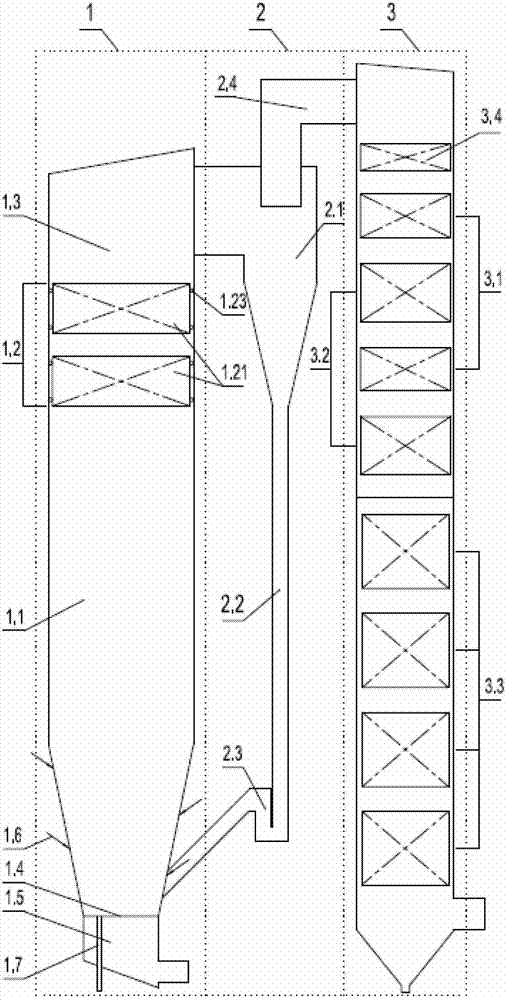
Figure 2
Abstract
Description
technical field
[0001] The invention relates to a circulating fluidized bed boiler, in particular to a half-tower type mid-temperature separation biomass circulating fluidized bed boiler. Background technique
[0002] Biomass energy is energy converted from natural plants, feces, and urban and rural organic waste. It is an energy form in which solar energy is stored in biomass in the form of chemical energy. It has the characteristics of renewable, low pollution, wide distribution, and large total amount. , is a high-quality renewable energy source. When biomass, especially agricultural and forestry waste, is used as fuel, it has variety and complexity, high combustible volatile content, low sulfur content, low ash content, low bulk density, high alkali metal content, and low ash melting point. Features. Circulating fluidized bed boiler combustion technology has good fuel adaptability, so it has developed rapidly in the field of biomass combustion power generation in recen...
Examples
Embodiment 1
[0026] Biomass fuel enters the furnace 1.1 through the feeding device in front of the furnace, and the primary air is sent into the furnace 1.1 from the primary air chamber 1.5 at the bottom of the furnace through the air distribution device 1.4 as the primary combustion air and the fluidized medium of the materials in the furnace, and the secondary air 1.6 The lower part of the furnace is divided into three layers along the height direction, and each layer is arranged in parallel to ensure sufficient combustion air for fuel.
[0027] Biomass fuel ignites in the dense-phase zone at the lower part of the furnace, burns and releases most of the heat in an oxygen-deficient state, and the unburned volatile matter and carbon particles enter the dilute-phase zone of the furnace through the transition zone of the furnace, and are formed in the secondary air Further combustion in the oxidizing area generates high-temperature flue gas, and the SO in the flue gas 2 Reaction with alkali ...
Embodiment 2
[0033] The overall layout of this embodiment is basically the same as that of Embodiment 1. The difference between the two is that only the convection heating surface 1.21 is arranged in the convection shaft 1.2 on the upper part of the furnace in this embodiment, and the convection heating surface 1.21 is suspended on the water wall through the support device 1.23 Up. Two layers of secondary air 1.6 are arranged on the water-cooled walls of the lower part of the furnace 1.1, and the staggered arrangement is adopted, so that under the disturbance of the staggered secondary air 1.6, the biomass fuel with low density forms a similar "S" in the process of the furnace. The shape of the trajectory prolongs its residence time in the high temperature zone of the furnace. The tail flue 3 is set as a single flue gas passage, and is provided with an evaporation heating surface 3.4, superheaters 3.1 arranged crosswise, economizers 3.2 and air preheaters 3.3 from top to bottom.
[0034] ...