
Method for preparing gd2ti2o7:ce nano-luminescent powder by reverse co-precipitation
A reverse co-precipitation, luminescent powder technology, applied in luminescent materials, chemical instruments and methods, etc., can solve the problems of uneven product particle size, complex preparation process, high cost, accurate and controllable reaction conditions, and wide application Prospect, the effect of short preparation cycle
Patent Information
- Authority / Receiving Office
- CN · China
- Patent Type
- Patents(China)
- Current Assignee / Owner
- Publication Date
- 2015-07-29
- Estimated Expiration
- Not applicable · inactive patent
Smart Images
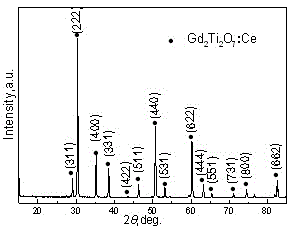
Figure 1 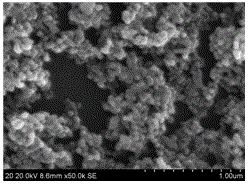
Figure 2 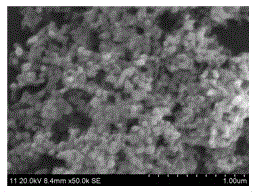
Figure 3
Abstract
Description
technical field
[0001] The invention relates to a method for preparing nano-luminescent powder, in particular to a method for preparing Gd by reverse co-precipitation 2 Ti 2 o 7 : The method of Ce nano-luminescent powder. Background technique
[0002] Gd 2 Ti 2 o 7 It is an oxygen-containing rare earth compound with a pyrochlore structure, and has unique properties in electricity, magnetism, luminescence and catalysis. Gd 2 Ti 2 o 7 It has the characteristics of high melting point, high chemical stability and ionic conductivity, and has high scientific research value and application prospects in the fields of ion conductors, catalysts, luminescent matrix materials, and radioactive waste solidification. Currently, on Gd 2 Ti 2 o 7 The research mainly focuses on the microstructure, magnetic properties and electrical properties. Study shows Gd with pyrochlore structure 2 Ti 2 o 7 It is an excellent rare earth luminescent host material with low phonon energy. Th...
Examples
Embodiment 1
[0021] The material selection of the present invention: experimental raw material is Gd 2 o 3 (99.99%), Ce(NO 3 ) 3 (99.9%), Ti(SO 4 ) 2 , ammonia, nitric acid, absolute ethanol and sodium dodecylbenzenesulfonate (SDBS) are all analytical reagents, and distilled water is secondary water. The above reagents were not purified.
[0022] The preparation process of the present invention: weigh Gd according to the precise stoichiometric ratio 2 o 3 , Ti(SO 4 ) 2 and Ce(NO 3 ) 3 . Will Gd 2 o 3 Dissolved in excess dilute nitric acid solution to obtain Gd(NO 3 ) 3 solution; then Ti(SO 4 ) 2 Dissolve in water and then dissolve in the above solution to prepare a mother salt solution with a metal cation concentration of 0.08mol / L. Weigh 0.3% (mol fraction) of Ce(NO 3 ) 3 Dissolve in the mother salt solution and stir well until the mixture is uniform. Prepare 1mol / L ammonia water as the precipitant, weigh 1wt%~2wt% dispersant SDBS, dissolve it in the precipitant ammon...
Embodiment 2
[0024] Mother salt concentration is 0.06mol / L, and other conditions are as embodiment 1, and the morphology of gained sample is as follows image 3 As shown in the middle SEM, the shape of the sample is basically spherical, the particle size is about 60nm, the dispersion of the sample is average, and there is agglomeration phenomenon.
Embodiment 3
[0026] Mother salt concentration is 0.10mol / L, and other conditions are as embodiment 1, and the morphology of gained sample is as follows Figure 4 As shown in the middle SEM, the shape of the sample is basically spherical, the particle size distribution is uneven, and the agglomeration phenomenon is obvious.