
A kind of ferromolybdenum catalyst with core-shell structure and its preparation and application
A core-shell structure and catalyst technology, which is used in catalyst activation/preparation, oxidation to prepare carbonyl compounds, physical/chemical process catalysts, etc. problem, to achieve the effect of high catalytic performance
Patent Information
- Authority / Receiving Office
- CN · China
- Patent Type
- Patents(China)
- Current Assignee / Owner
- Publication Date
- 2022-02-11
Smart Images
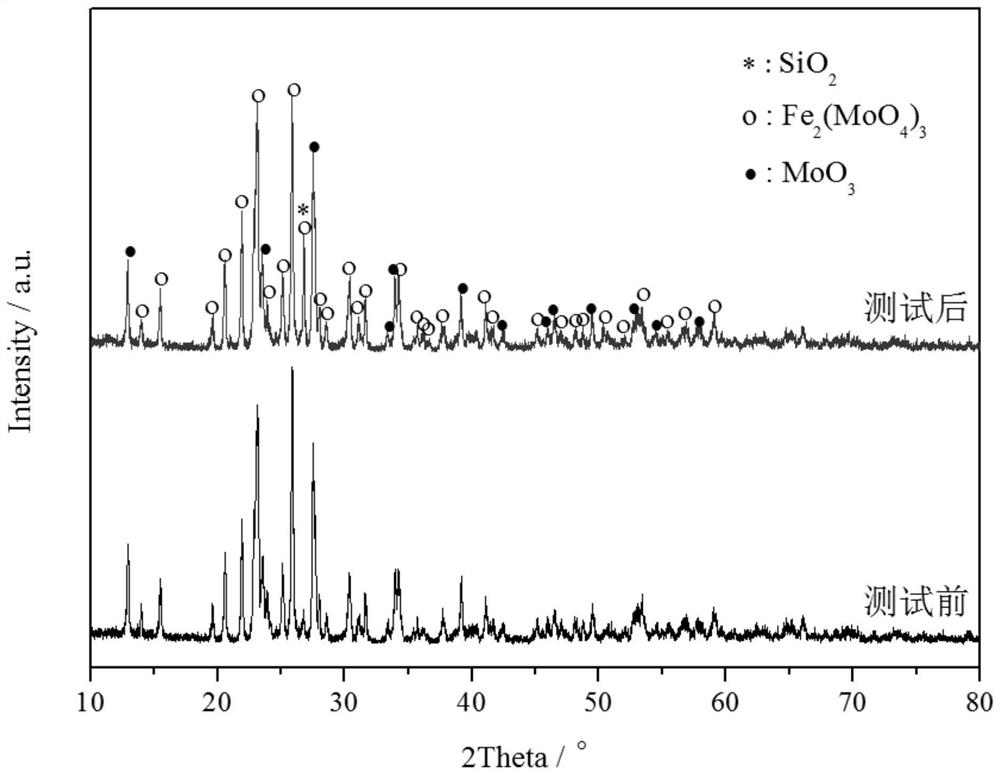
Figure 1 
Figure 2 
Figure 3
Abstract
Description
technical field
[0001] The invention belongs to the field of carbon-chemical industry, and relates to a novel structure ferromolybdenum catalytic material and its preparation and use, in particular to a core-shell structure ferromolybdenum catalyst prepared by an ultrasonic-assisted impregnation process and its use in methanol oxidation to produce high-concentration formaldehyde use in . Background technique
[0002] my country is the world's largest producer and consumer of formaldehyde. In the future, with the further increase in the consumption of resins, paints, (polyoxymethylene) and other products and the rise of new products such as acrylic acid (ester) and polyoxymethylene dimethyl ether, my country's demand for high-concentration formaldehyde will increase day by day. As we all know, the iron-molybdenum process is an advanced process for the production of concentrated formaldehyde, but the ferro-molybdenum catalyst used in this process in my country relies heavily ...
Examples
preparation example Construction
[0022] A method for preparing a molybdenum-iron catalyst with a core-shell structure, comprising the following steps: preparing a ferric nitrate solution, weighing dried molybdenum trioxide, completing the process of impregnating a molybdenum carrier with an iron-containing solution under the action of ultrasonic waves, followed by drying, roasting, A core-shell ferromolybdenum catalyst was formed.
[0023] The molar fraction of the solute in the ferric nitrate solution is 1.0-5.0 mol / L, and the solvent is water, ethanol or acetone.
[0024] The molybdenum trioxide is a mesoporous material with a large specific surface and is dried at 100-120° C. for 0.5-3.0 hours before use.
[0025] The process of impregnating the molybdenum carrier with the iron-containing solution is: adding molybdenum trioxide to the ferric nitrate solution or adding the ferric nitrate solution dropwise into the molybdenum trioxide.
[0026] The power of the ultrasonic wave is 50-100W, and the vibration ...
Embodiment 1
[0034] Dry molybdenum trioxide at 105°C for 2.0h; prepare a 4.5mol / L aqueous solution of ferric nitrate; weigh 30.0g of dried molybdenum trioxide and place it in an ultrasonic oscillator with a power setting of 100W, and add 15.4mL of Ferric nitrate solution; dry the impregnated carrier without solution on the surface at 100°C for 15 hours; then calcinate at 600°C for 1 hour to obtain the core-shell structure ferromolybdenum catalyst.
[0035] The catalyst is used in the oxidation of methanol to formaldehyde at a reaction temperature of 298°C. After the tail gas is absorbed by water, trace amounts of carbon monoxide and carbon dioxide are analyzed. Methanol and formaldehyde in the absorption liquid are detected on the Agilent chromatogram, and the obtained data are calculated according to the following formula Catalyst performance indicators:
[0036]
[0037]
[0038]
[0039]
[0040] Y FA= x MeOH ×S FA
[0041] Note: X MeOH —Methanol conversion rate per pas...
Embodiment 2
[0045] Dry molybdenum trioxide at 120°C for 2.5h; prepare 3.6mol / L ethanol solution of ferric nitrate; weigh 30.0g of dry molybdenum trioxide and place it in an ultrasonic oscillator with a power setting of 90W, and add 29.0mL nitric acid to it Iron solution; the impregnated carrier without solution on the surface is dried at 80°C for 8 hours; then calcined at 450°C for 2 hours to obtain the molybdenum-iron catalyst with core-shell structure.
[0046]The catalyst was used in the reaction of methanol oxidation to formaldehyde at a reaction temperature of 340°C, and the following performance data were obtained through gas-liquid phase product analysis and experimental data calculation:
[0047] X MeOH / %