
Method for removing nitric oxide in kiln tail gas by using carbon dioxide catalytic conversion product
A technology for catalytic conversion and carbon dioxide, which is applied in the production of hydrocarbons from carbon oxides, carbon compound catalysts, chemical instruments and methods, etc., can solve problems such as process design uncertainty, and achieve the purpose of suppressing the effect of deactivation, improving conversion efficiency, and promoting The effect of the reduction reaction
Patent Information
- Authority / Receiving Office
- CN · China
- Patent Type
- Applications(China)
- Current Assignee / Owner
- Publication Date
- 2022-03-25
Smart Images
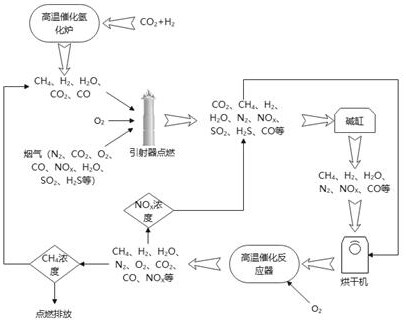
Figure 1
Abstract
Description
technical field
[0001] The invention relates to the technical field of lime kiln tail gas treatment, in particular to a method for removing nitrogen oxides in kiln tail gas by using carbon dioxide catalytic conversion products. Background technique
[0002] In the existing calcium carbide production process, the production site of quicklime, one of the raw materials - lime kiln, the flue gas produced therein includes N 2 , CO 2 , O 2 and CO, which also contains NO X 、H 2 O, SO 2 、H 2 S et al. Because the flue gas contains a large amount of nitrogen oxides NO X Such as NO, if these nitrogen oxides are directly discharged into the atmosphere, they will pollute the air, form photochemical smog and acid rain, and endanger human health. X ) a series of technical problems such as high operating cost of the treatment process and difficulty in meeting emission standards, urgently need to develop NO X A new process for waste gas treatment and resource utilization.
[0003] ...
Examples
Embodiment 1
[0023] A method for removing nitrogen oxides in kiln tail gas by using carbon dioxide catalytic conversion products, comprising the following steps:
[0024] 1) Add 1 equivalent of CO 2 and 5 equivalents of H 2 Placed in a high temperature catalytic hydrogenation furnace, using ZrO 2 Catalyst loaded with Ni, reacted at 350°C for 4.5h, CH 4 The yield is close to 80%, and the resulting methane gas mixture contains CH from large to small in component content 4 、H 2 、H 2 O.CO 2 and CO components;
[0025] 2) Take the flue gas from the lime kiln, which contains N according to the component content from large to small 2 , CO 2 , O 2 , CO, NO X 、H 2 O, SO 2 、H 2 S component, methane mixed gas, newly blown O 2 And after the flue gas is mixed according to the volume ratio of 3:1:2, it is guided to the burner by the ejector to ignite, and the flame is completely extinguished and naturally extinguished, the combustion heat is collected, and high-temperature exhaust gas is g...
Embodiment 2
[0033] All steps are exactly the same as in Example 1, the difference is that the hydrogenation reaction principle in step 1) of Example 1 is replaced by: 1 equivalent of CO 2 and 6 equivalents of H 2 , examine different H 2 Quantity versus CH 4 with NO X The efficiency of the denitrification reaction, test run, a single NO with a high temperature catalytic reactor X The conversion rate, the number of cycles of the tail gas, and the number of cycles of the exhaust tail gas are process parameters, and are compared with Example 1.
Embodiment 3
[0035] All steps are exactly the same as in Example 1, the difference is that the hydrogenation reaction principle in step 1) of Example 1 is replaced by: 1 equivalent of CO 2 and 7 equivalents of H 2 , examine different H 2 Quantity versus CH 4 with NO X The efficiency of the denitrification reaction, test run, a single NO with a high temperature catalytic reactor X The conversion rate, the number of cycles of the tail gas, and the number of cycles of the exhaust tail gas are process parameters, and are compared with Example 1.