
Regeneration method of molecular sieve catalyst
A catalyst and molecular sieve technology, applied in the field of molecular sieve catalyst regeneration, can solve problems such as damage to the internal structure of the catalyst, and achieve the effects of protecting from damage, alleviating strong heat release, and reducing flying temperature.
Patent Information
- Authority / Receiving Office
- CN · China
- Patent Type
- Applications(China)
- Current Assignee / Owner
- Publication Date
- 2022-04-22
Smart Images
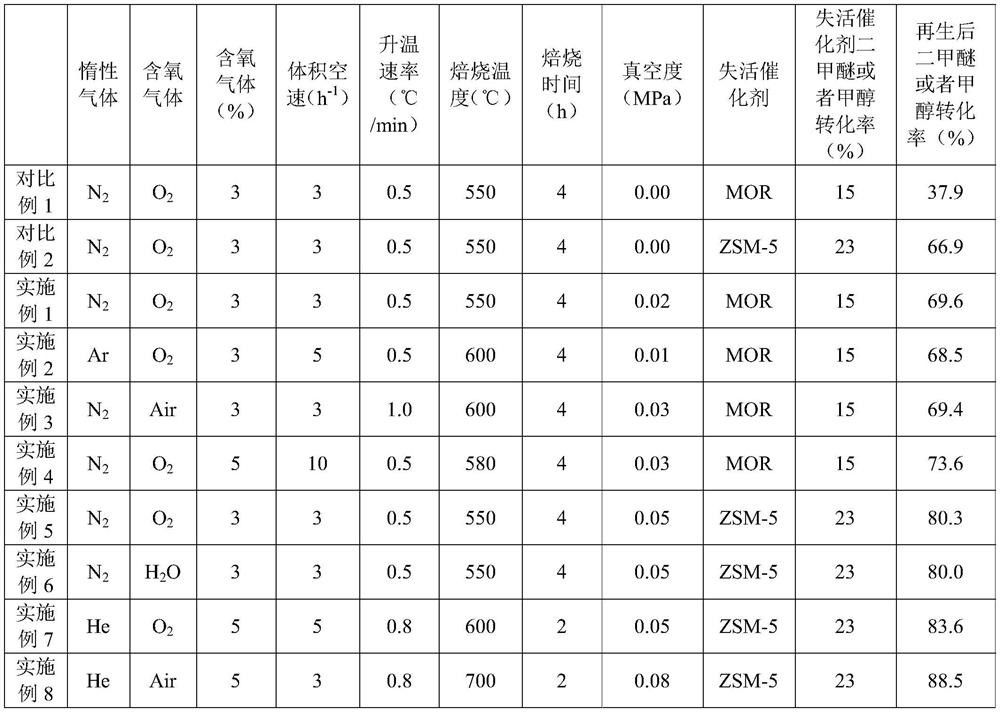
Figure 1
Abstract
Description
technical field
[0001] The application relates to a regeneration method of a molecular sieve catalyst, which belongs to the field of chemical catalysis. Background technique
[0002] Molecular sieves have been widely used in petrochemical and fine chemical fields such as catalytic cracking and catalytic cracking due to their unique pore structure, strong acidity, and good shape-selective properties. However, under high temperature and high pressure reaction conditions for a long time, carbonaceous substances or other substances are deposited in the pores of the catalyst, resulting in a reduction in pore size (or pore opening), so that the reactant molecules cannot diffuse into the pores, and gradually lead to the gradual loss of pores. Blockage, so that the active sites of the catalyst will be lost in large quantities, the properties of the pores will be reduced, the active components will be embedded by the carrier, and the active components will be lost due to the generati...
Examples
Embodiment 1
[0052] Take 10ml of Cat.1, fill it into the fixed bed regeneration device, feed the mixed gas of nitrogen and oxygen into the fixed bed regeneration reaction tube, the volume content of oxygen is 3%, and the total gas velocity is 3.0h -1 , the tail gas is connected to the vacuum pump, turn on the vacuum pump, keep the vacuum at 0.02MPa, raise the temperature to 550°C at 0.5°C / min, and roast for 4h.
Embodiment 2
[0054] Take 10ml of Cat.1, fill it into the fixed bed regeneration device, feed the mixed gas of argon and oxygen into the fixed bed regeneration reaction tube, the volume content of oxygen is 3%, and the total gas velocity is 5.0h -1 , the tail gas is connected to the vacuum pump, the vacuum pump is turned on, the vacuum degree is kept at 0.01MPa, the temperature is raised to 600°C at 0.5°C / min, and roasted for 4h.
Embodiment 3
[0056] Take 10ml of Cat.1, fill it into the fixed bed regeneration device, feed the mixed gas of nitrogen and air into the fixed bed regeneration reaction tube, the volume content of oxygen is 3%, and the total gas velocity is 3.0h -1 , the tail gas is connected to the vacuum pump, turn on the vacuum pump, keep the vacuum at 0.03MPa, raise the temperature to 600°C at 1°C / min, and roast for 4h.