
Process for the gas phase polymerization and copolymerization of olefin monomers
a gas phase polymerization and copolymerization technology, applied in the field of gas phase polymerization and copolymerization of olefin monomers, can solve the problems of limiting the polymer production rate in the gas phase reactor, few drawbacks, and solidification of the bed
Patent Information
- Authority / Receiving Office
- US · United States
- Patent Type
- Applications(United States)
- Current Assignee / Owner
- Publication Date
- 2003-08-14
- Estimated Expiration
- Not applicable · inactive patent
Smart Images
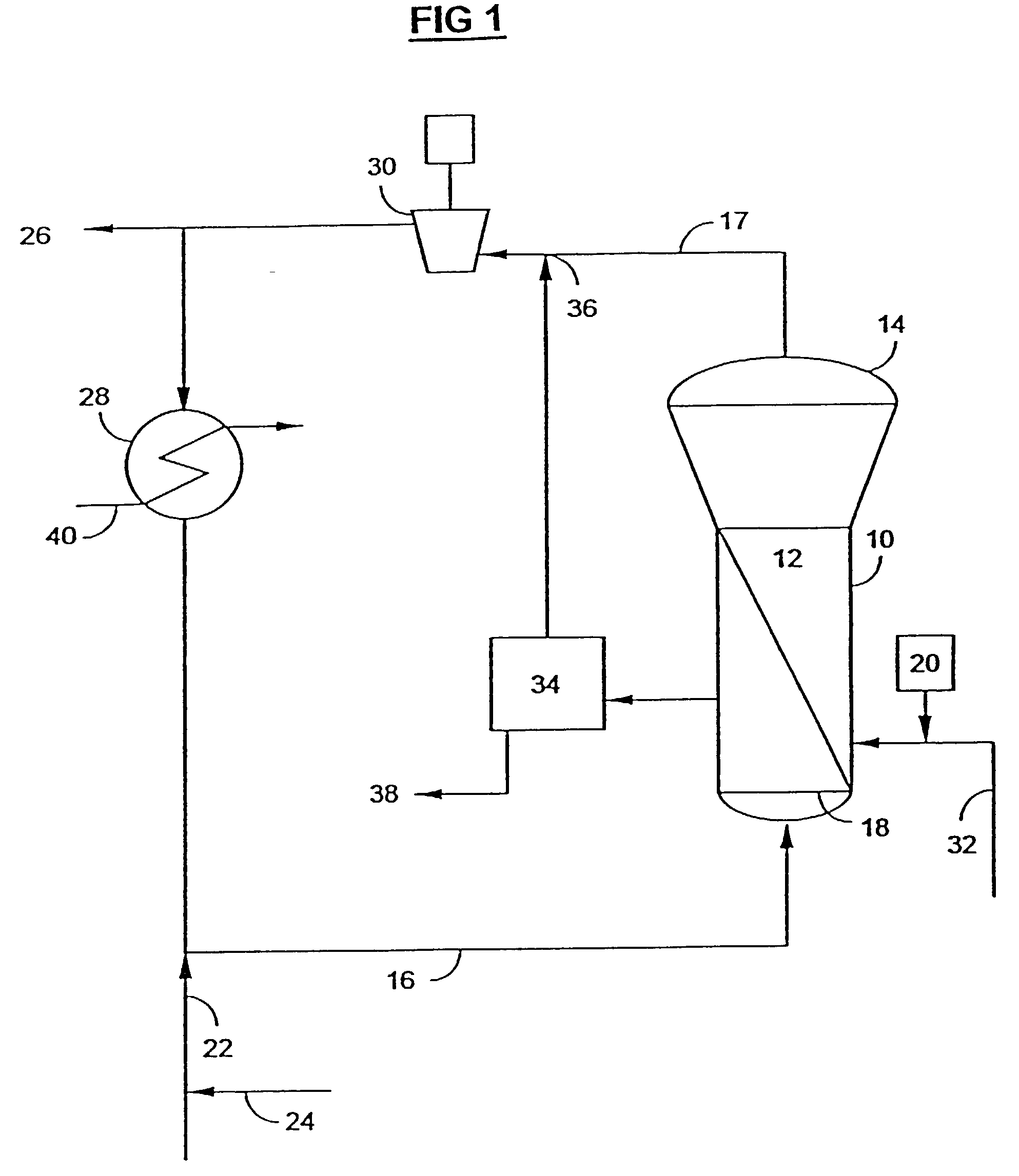
Figure 1
Abstract
Description
[0001] The present invention refers to a process for the polymerization of olefin monomers in gas phase reactors. More specifically, the present invention refers to a process for the polymerization and copolymerization of olefin monomers in the gas phase, in fluidized bed reactors, in the presence of a mixture of inert diluents having a composition that leads to the adjustment of the dew point, this making possible to attain high production rates and stable operation in the non condensed mode.BACKGROUND INFORMATION
[0002] The development of the process for the polymerization in gas phase reactors led to the production of a wide range of polymers. The use of a polymerization process in a gaseous fluidized bed significantly lowers energy requirement and capital investment as compared to other processes. A limiting factor in the polymer production rate in a gas phase reactor is the maximum rate at which the exothermic heat of the reaction may be removed from the reactor. Usually, heat r...
Examples
example 1
[0077] In this example, a polymerization process in fluidized bed was used to carry out the polymerization of ethylene and 1-butene in the non condensed mode, subject to the following common parameters:
1 Reactor diameter: 4.75 meters Height of the bed 13.3 meters Absolute pressure of the reactor 2.4 bar Reactor temperature: 88.degree. C. Specific activity of the catalyst 1,030 g polymer / g catalyst / h / bar of monomer pressure Superficial velocity of the 0.75 m / s recirculation gas: Minimum limit temperature for 35.degree. C. cooling the recirculation gas:
[0078] Data of this Example demonstrate that through the practice of the present invention, herein called super-dry (Example 1c), it is possible to increase the production proportionally to the heat removal ability of the recycle stream, when compared to the normal mode of dry operation using a nitrogen-rich (Example 1a) or ethane-rich (Example 1b) inert diluent, without the presence of intermediate volatility alkanes. In this example, ...
example 2
[0081] In this Example, a process for polymerizing in a fluidized bed was used to conduct the copolymerization of ethylene and 1-butene in the non condensed as well as in the condensed mode, subject to the following common parameters:
3 Reactor Diameter: 4.75 meters Height of the bed: 13.3 meters Absolute Pressure in the reactor: 22.4 bar Reactor Temperature: 88.degree. C. Specific Activity of the catalyst: 1,030 g polymer / g catalyst / h / bar of monomer pressure Superficial Velocity of the 0.75 m / s recirculation gas: Limiting Minimum Temperature to 35.degree. C. which the recirculation gas may be cooled:
[0082] Data of this Example illustrate that by the practice of the present invention (Examples 2d-2e) where the best composition of the gaseous mixture designed for the control of the dew point is worked, it is possible to increase production proportionally to the ability of heat removal of the recycle stream, when compared to the normal dry operation mode using an isolated ethane-rich (...
example 3
[0087] In this Example, a process for polymerizing in a fluidized bed was used to run the copolymerization of ethylene and 1-hexene in the non condensed as well as in the condensed mode, subject to the following common parameters:
5 Reactor Diameter: 4.75 meters Height of the bed: 13.3 meters Absolute Pressure in the reactor: 22.4 bar Reactor Temperature: 88.degree. C. Specific Activity of the catalyst: 600 g polymer / g catalyst / h / bar of monomer pressure Superficial Velocity of the 0.75 m / s recirculating gas: Limiting Minimum Temperature to 35.degree. C. which the recirculating gas may be cooled:
[0088] Data from this Example are analogous to those of Example 1, except for the use of 1-hexene, in a lower concentration, as a monomer for copolymerizing with ethylene. In this Example, a catalyst of significantly lower specific activity as compared to other examples, is employed. The chosen activity of 600 g of polymer / g catalyst / h / bar of monomer pressure is close to the minimum recommende...