
Manufacture and measuring of automotive components
Patent Information
- Authority / Receiving Office
- US · United States
- Current Assignee / Owner
- Publication Date
- 2008-08-14
- Estimated Expiration
- Not applicable · inactive patent
Smart Images
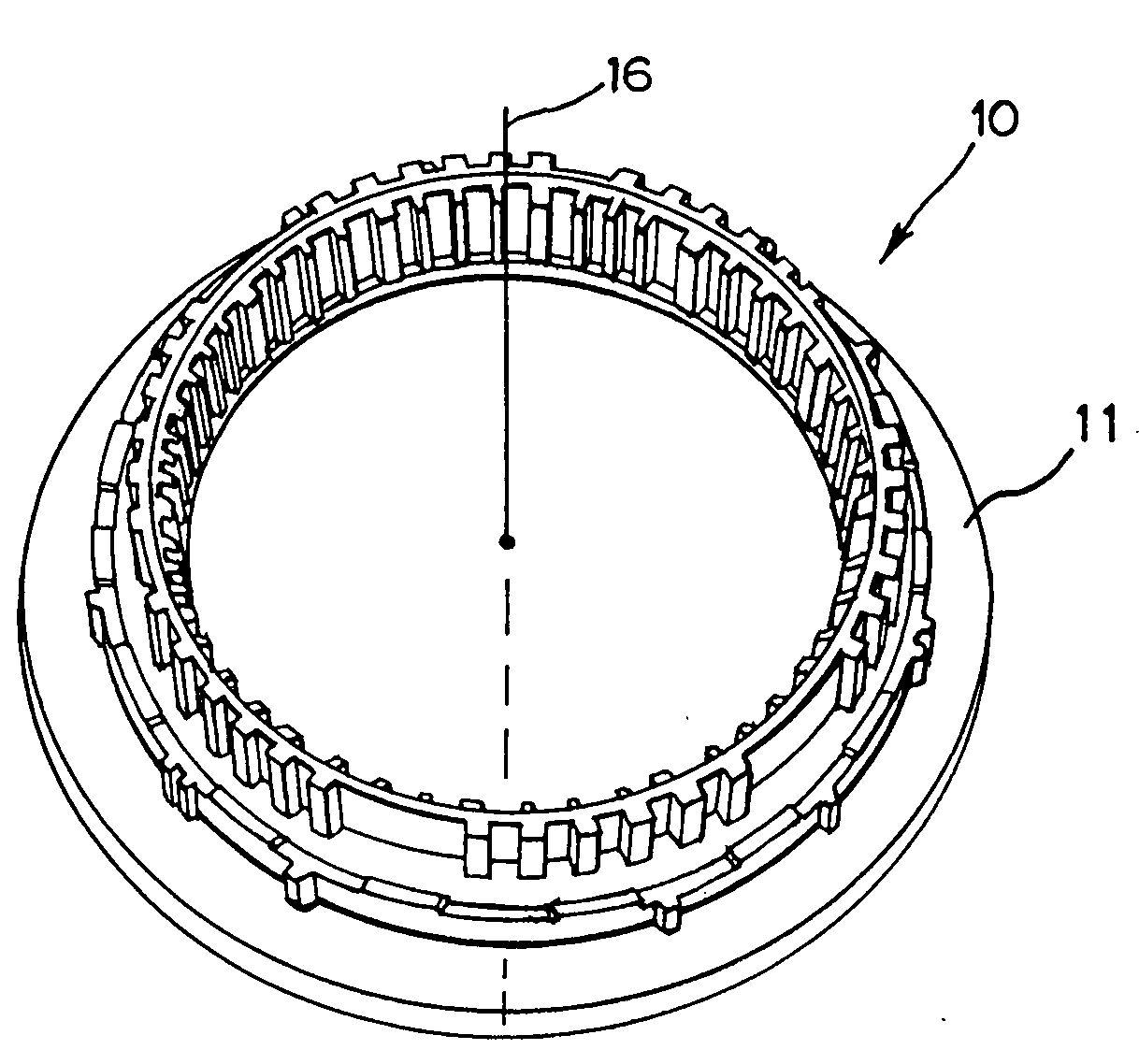
Figure 1 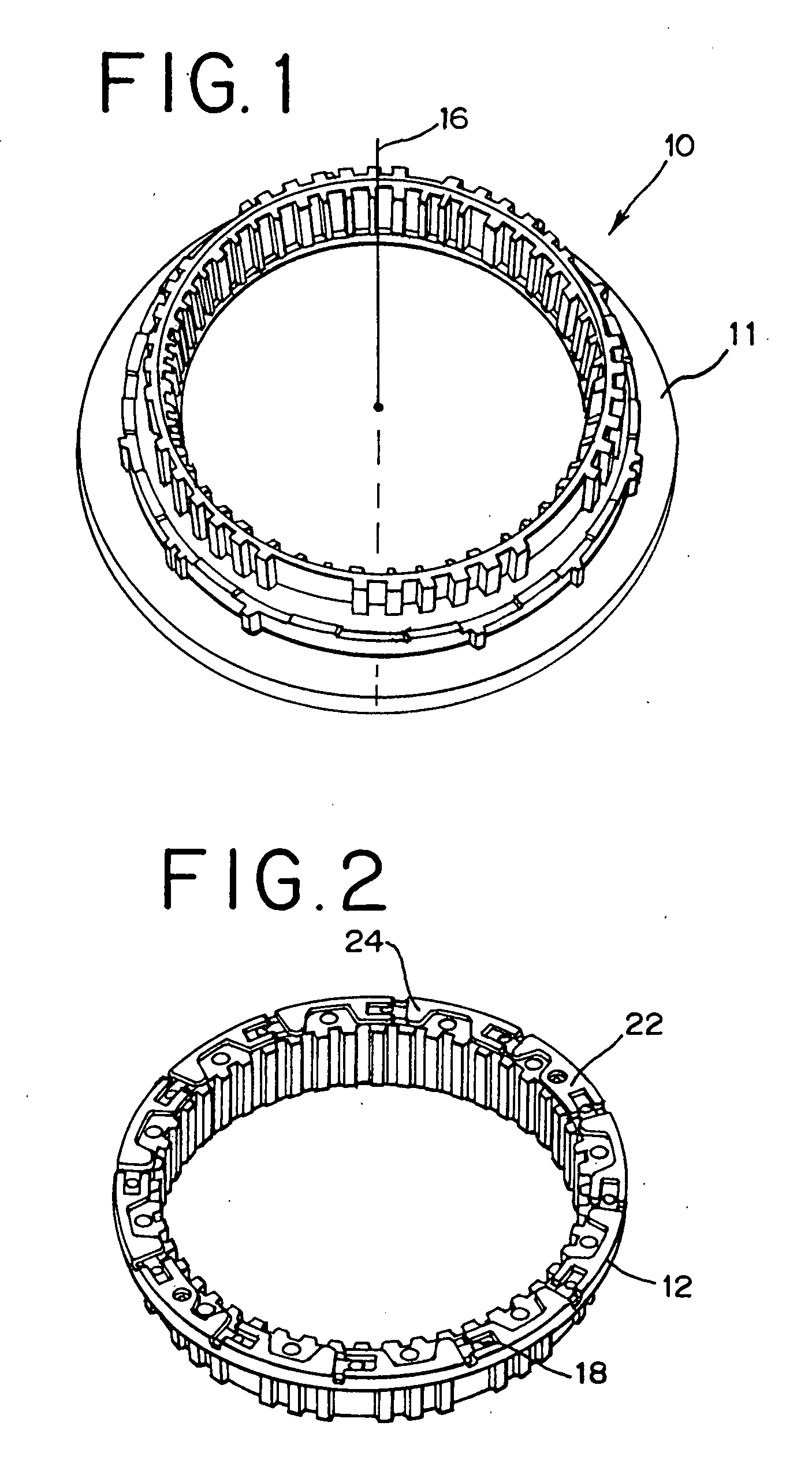
Figure 2 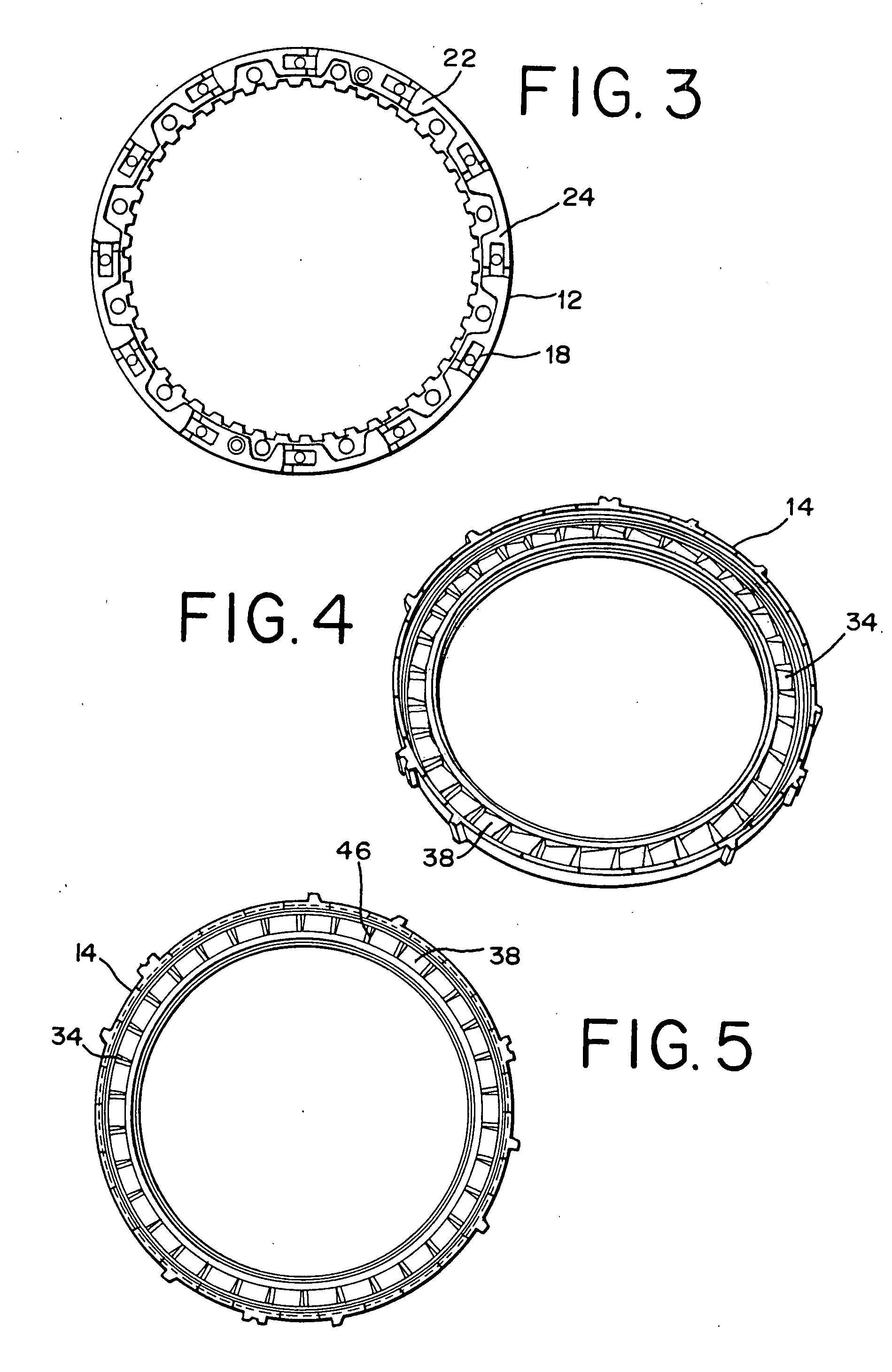
Figure 3
Abstract
Description
BACKGROUND OF THE INVENTION
[0001] The present invention relates to automotive clutch or transmission components and, more particularly, to so called one way clutches wherein one or more struts provide a mechanical coupling between opposed clutch faces and a pair of coaxially rotateable members, with a method for manufacturing and measuring such components.
[0002] As explained in U.S. Pat. No. 6,571,926, in such one way clutches, a driving member engages a driven member.
[0003] The manufacture of such automotive components is set forth in pending U.S. patent application Ser. No. 11 / 585,297 filed Oct. 23, 2006, and assigned to the assignee of the present application.
[0004] A thin flat strut is carried within each of the driving members' pockets such that a first longitudinal end may readily engage and bear against the shoulder defined by the corresponding recess in the driving member. The struts second, opposite longitudinal end is urged by spring force toward and against the driven member,...
Examples
example 1
[0033]In a method of manufacturing an automotive clutch component, an initial pre alloy metal powder of particle sizes between 250 and 1 micron was provided comprising, by weight, 0.45% nickel, 0.65% molybdenum, with the balance essentially iron.
[0034]An additional 0.7% graphite, and 1.75% copper metal powder of particle sizes between 150 and 1 micron, by weight, were admixed to form an admixed metal powder.
[0035]0.5% EBS was added as a lubricant to form a lubricated admixed metal powder.
[0036]The lubricated, admixed metal powder was compacted at a pressure of 45 tons per square inch.
[0037]The die compacted metal blank was then placed on a machined flat ceramic support and sintered at a temperature 2050° F. for 15 minutes.
[0038]The sintered metal blank was then quenched while on the ceramic support metal blank at a rate of 5.4° F. (3.00° C.) per second from an initial temperature of (2000° F.) (1090° C.) to a temperature of (500° F.) (260° C.) per use. The quenched was then tempered...
example 2
[0041]In a method of manufacturing an automotive clutch component, an initial pre alloy metal powder of particle sizes between 250 and 1 microns was provided comprising, by weight, 0.45% nickel, 0.65% molybdenum, with the balance essentially iron.
[0042]An additional 0.9% graphite, and 1.75% copper metal powder of particle size between 150 and 1 micron, by weight, were admixed to form an admixed metal powder.
[0043]0.5% EBS was added as a lubricant to form a lubricated admixed metal powder.
[0044]The lubricated, admixed metal powder was compacted at a pressure of 45 tons per square inch.
[0045]The die compacted metal blank was then placed on a ceramic support and sintered at a temperature 2050° F. for 15 minutes.
[0046]The sintered metal blank was then quenched while on the ceramic support at a rate of 1.9° F. (1.05° C.) per second from an initial temperature of (2000° F.) (1090° C.) to a temperature of (500° F.) (260° C.) per use. The quenched metal blank was then tempered at a temperat...
example 3
[0049]In a method of manufacturing an automotive clutch component, an initial pre alloy metal powder of particle size between 250 and 1 micron was provided comprising, by weight, 0.45% nickel, 0.65% molybdenum, with the balance essentially iron.
[0050]An additional 0.9% carbon, and 1.75% copper metal powder of particle size between 150 and 1 micron, by weight, were admixed to form an admixed metal powder.
[0051]0.5% EBS was added as a lubricant to form a lubricated admixed metal powder.
[0052]The lubricated, admixed metal powder was compacted at a pressure of 45 tons per square inch.
[0053]The die compacted metal blank was then placed on a machined flat ceramic support and sintered at a temperature 2050 for 15 minutes.
[0054]The sintered metal blank was then quenched while on the ceramic support at a rate of 1.9° F. (1.0° C.) per second from an initial temperature of (2000° F.) (1090° C.) to a temperature of (500 ° F.) (260° C.) per use. The quenched metal blank was then tempered at a te...