
Nickel-added high-polishing pre-hardened plastic mold steel plate and production method thereof
A technology of plastic mold and production method, applied in the field of plastic mold steel, can solve the problems of difficulty in meeting the hardness requirements of plastic mold steel, reduced polishing performance of mold steel, large difference in surface hardness, etc., and achieve excellent polishing performance of products and improve polishability. , the effect of hardness
Patent Information
- Authority / Receiving Office
- CN · China
- Patent Type
- Applications(China)
- Current Assignee / Owner
- Publication Date
- 2019-03-15
- Estimated Expiration
- Not applicable · inactive patent
Smart Images
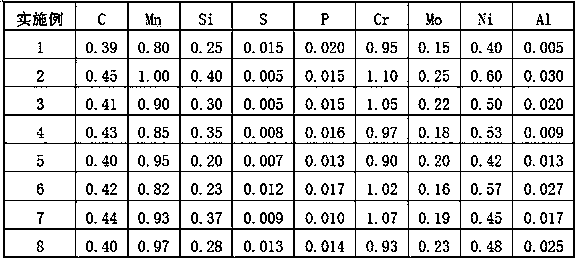
Figure 1
Abstract
Description
technical field
[0001] The invention belongs to the technical field of plastic mold steel, and in particular relates to a nickel-added high-polishing pre-hardened plastic mold steel plate and a production method thereof. Background technique
[0002] As an industrial raw material for the manufacture of plastic and rubber products, plastic mold steel is widely used in various industries such as household appliances, electronic communication equipment, living utensils, and vehicles. This type of die steel is generally delivered in a pre-hardened state, and the hardness is controlled between 28 and 36HRC. From the perspective of raw material cost, domestic 42CrMo, Japanese SCM440, American AISI 4140 and other brands are gradually introduced into the field of plastic mold steel due to their good economy. The mold steel plate standard YB / T 107 is low in SM3Cr2Mo, and its hardness is close to the use requirements of plastic mold steel.
[0003] Since the hardenability of plastic...
Examples
Embodiment 1
[0019] The thickness of the nickel-added high-polishing pre-hardened plastic mold steel plate in this embodiment is 80 mm, and its chemical composition and mass percentage are shown in Table 1.
[0020] The production method of nickel-added high-polish pre-hardened plastic mold steel plate in this embodiment includes converter smelting, LF furnace refining, RH vacuum refining, continuous casting slab, controlled rolling and controlled cooling, and high-temperature tempering heat treatment processes. The specific process steps are as follows. Said:
[0021] (1) Converter smelting process: the molten iron entering the converter has a sulfur content of 0.050%;
[0022] (2) LF furnace refining and RH vacuum refining process: after LF furnace refining and RH vacuum refining, qualified molten steel is obtained, with Ni element content of 0.40% and H content of 1.2ppm;
[0023] (3) Continuous casting slab process: the thickness of the continuous casting slab is 220mm, and the specif...
Embodiment 2
[0028] The thickness of the nickel-added high-polishing pre-hardened plastic mold steel plate in this embodiment is 150mm, and its chemical composition and mass percentage are shown in Table 1.
[0029] The production method of nickel-added high-polish pre-hardened plastic mold steel plate in this embodiment includes converter smelting, LF furnace refining, RH vacuum refining, continuous casting slab, controlled rolling and controlled cooling, and high-temperature tempering heat treatment processes. The specific process steps are as follows. Said:
[0030] (1) Converter smelting process: the molten iron entering the converter has a sulfur content of 0.042%;
[0031] (2) LF furnace refining and RH vacuum refining process: After LF furnace refining and RH vacuum refining, qualified molten steel is obtained, with Ni element content of 0.60% and H content of 1.5ppm;
[0032] (3) Continuous casting slab process: the thickness of the continuous casting slab is 400mm, and the specif...
Embodiment 3
[0037] In this embodiment, the nickel-added high-polish pre-hardened plastic mold steel plate has a thickness of 120mm, and its chemical composition and mass percentage are shown in Table 1.
[0038] The production method of nickel-added high-polish pre-hardened plastic mold steel plate in this embodiment includes converter smelting, LF furnace refining, RH vacuum refining, continuous casting slab, controlled rolling and controlled cooling, and high-temperature tempering heat treatment processes. The specific process steps are as follows. Said:
[0039] (1) Converter smelting process: the molten iron entering the converter has a sulfur content of 0.046%;
[0040] (2) LF furnace refining and RH vacuum refining process: After LF furnace refining and RH vacuum refining, qualified molten steel is obtained, with Ni element content of 0.50% and H content of 1.0ppm;
[0041] (3) Continuous casting slab process: the thickness of the continuous casting slab is 280mm, and the specifica...