
Control device for interleaved converters, a system of interleaved converters and related control method
Patent Information
- Authority / Receiving Office
- US · United States
- Current Assignee / Owner
- Publication Date
- 2009-10-15
Smart Images
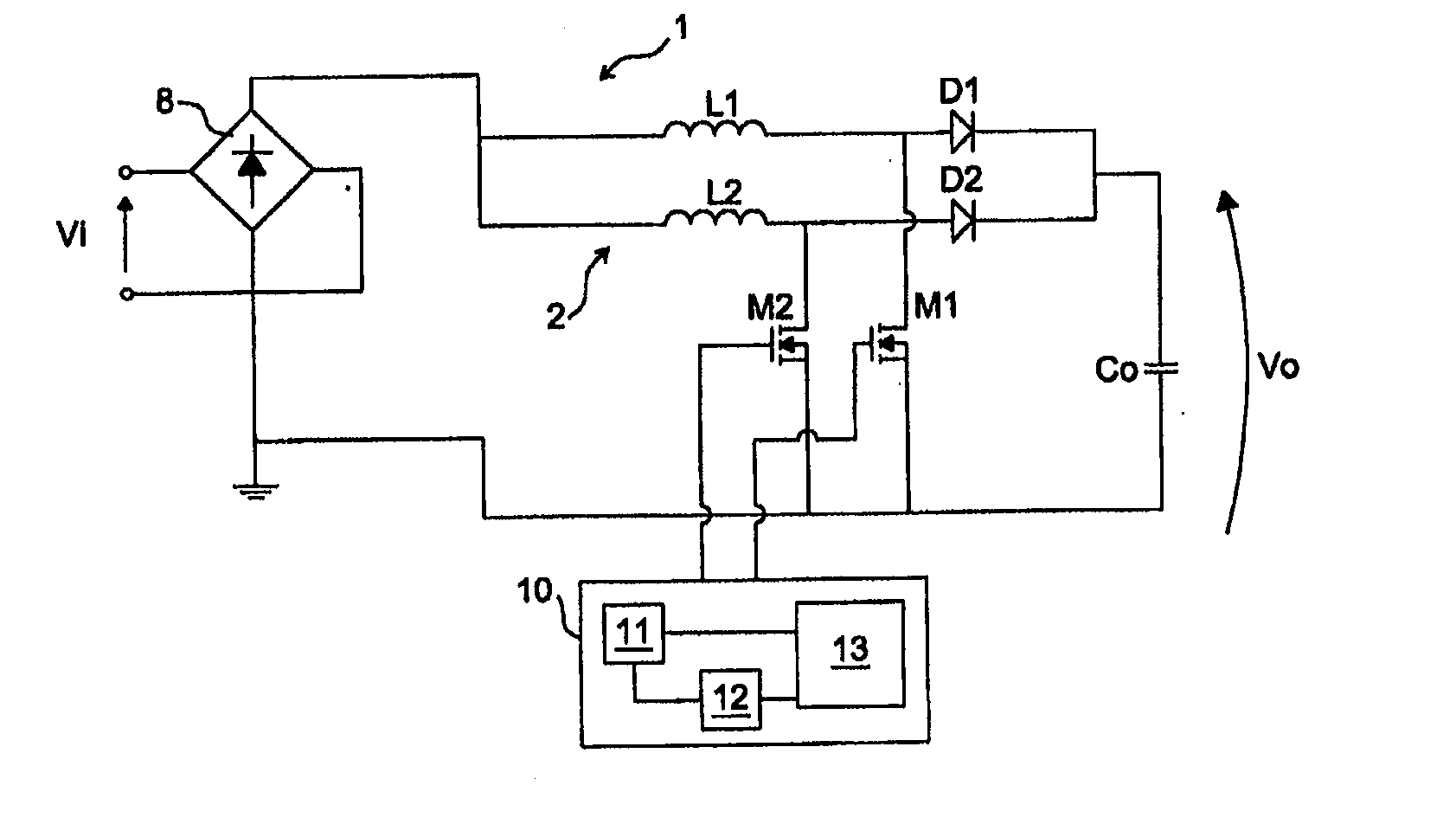
Figure 1 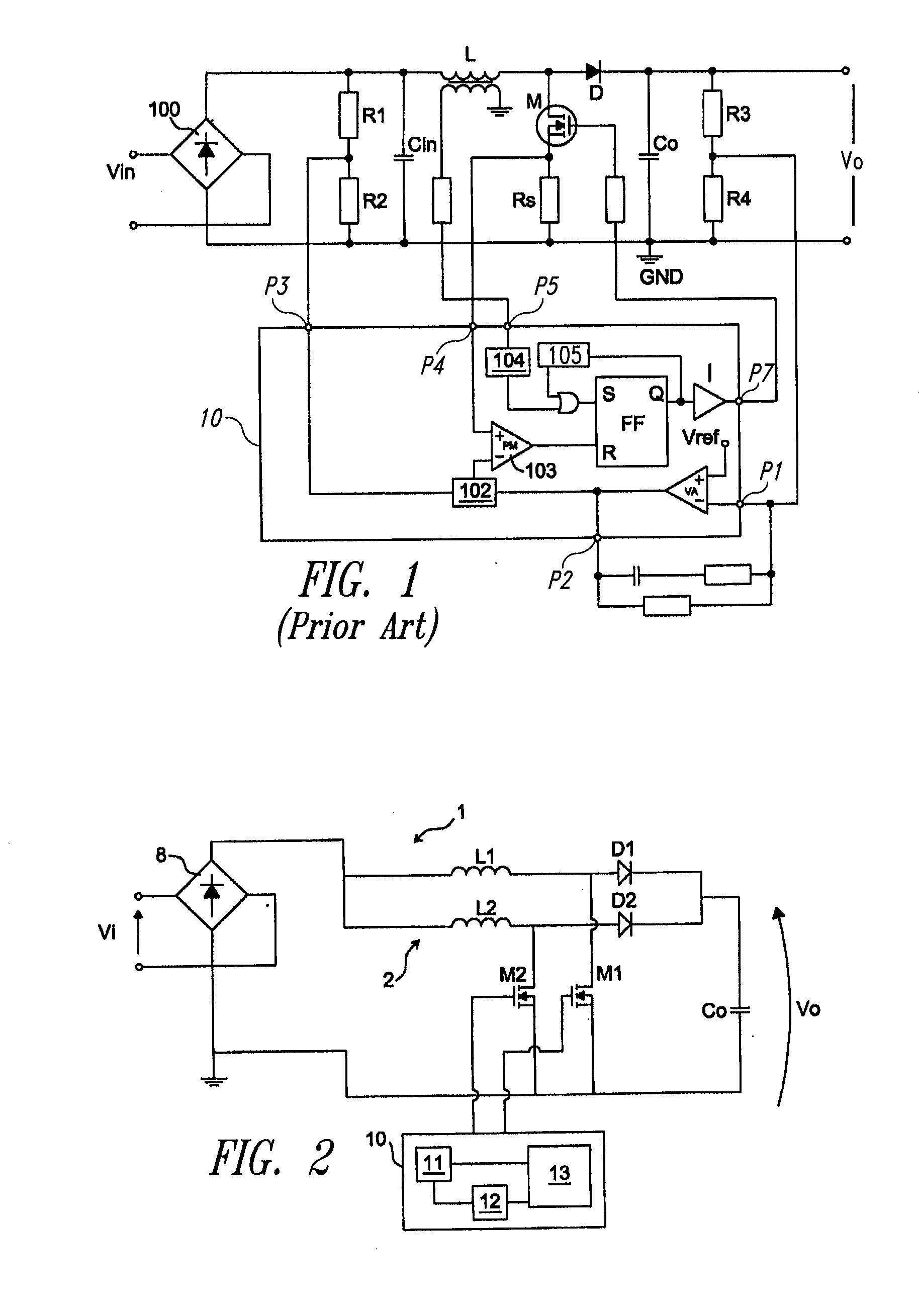
Figure 2 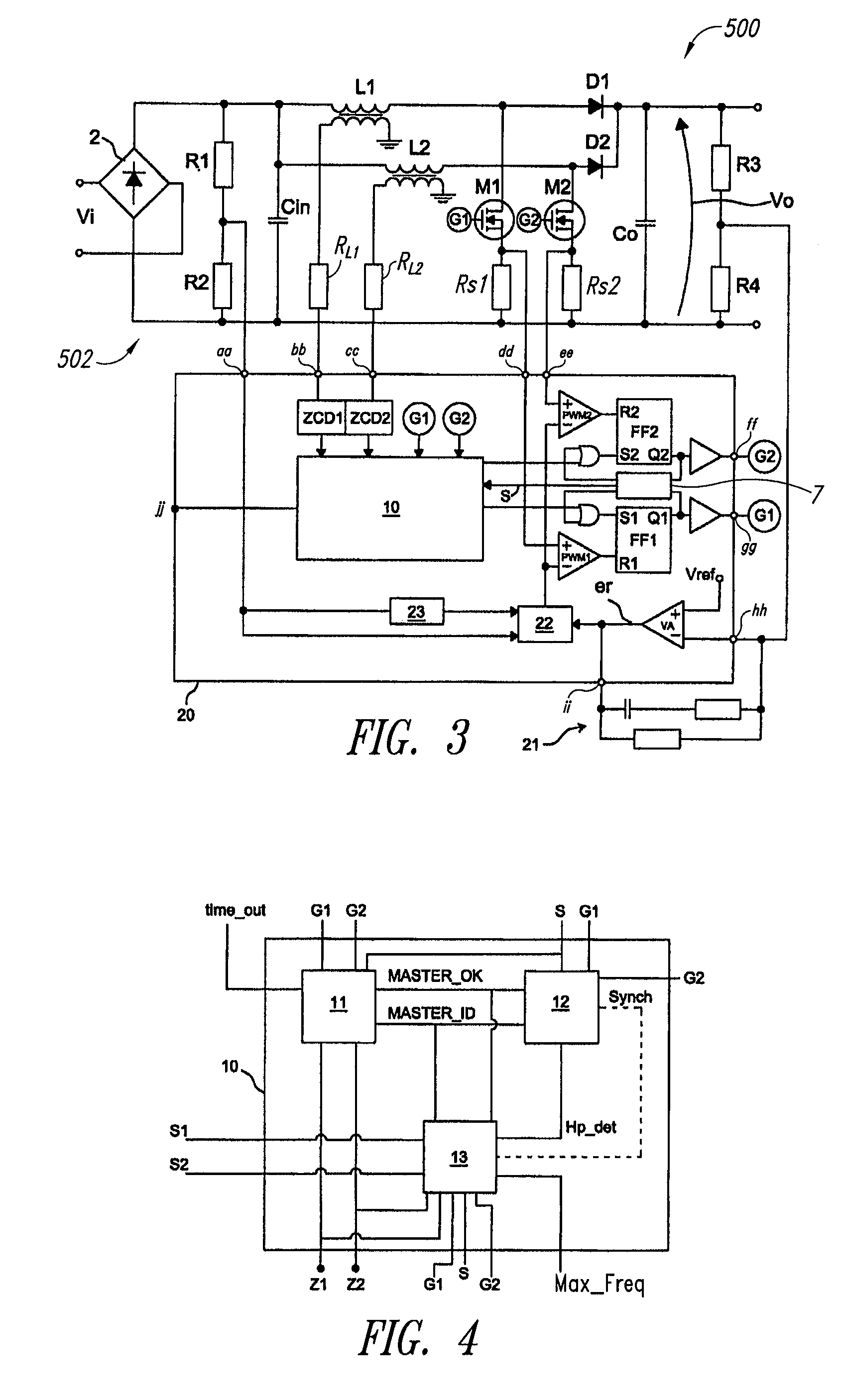
Figure 3
Abstract
Description
BACKGROUND
[0001] 1. Technical Field
[0002] The present disclosure refers to a control device for interleaved converters, to a system of interleaved converters and a related control method.
[0003] 2. Description of the Related Art
[0004] Switch-mode Power Supplies (SMPS) which operate off the public distribution power line, are known as “offline power supplies”. These often comprise switch-mode converters used for the active correction of the input power factor (Power Factor Correctors, PFC). The purpose of a PFC converter is to draw from the power line a current that is essentially sinusoidal and in-phase with the line voltage.
[0005] The typical front-end stage of a traditional offline SMPS, made up of a bridge rectifier that receives the ac line voltage at its input and a smoothing / reservoir capacitor connected right across the output of the bridge, produces a non-regulated dc voltage bus with some residual ac component superimposed (ripple). This dc bus will serve as the input for a dc-dc...
Examples
Embodiment Construction
[0048]To facilitate the use of TM PFC beyond the practical limits imposed by heavy filtering requirements it is possible to use multi-phase, or interleaved, converters. Note that the concept of interleaving converters is different from that of paralleling converters. Paralleled converters have in common the input and the output terminals but each of them is a complete, independent unit: separated input front-ends, separated controls, separated output sections; in addition, each converter may have even a different topology. In interleaved converters there is one input front-end, one control and one output section that are shared among all of the individual converters, or stages, which, in addition, have the same topology. Then, when considered all together they form a single entity capable of operating as a stand-alone unit.
[0049]If controlled with appropriate methodologies, such as properly displacing the phase of the PWM signals controlling each stage, an interleaved converter may ...