

Method for extracting nutrients from organic materials
Patent Information
- Authority / Receiving Office
- US · United States
- Current Assignee / Owner
- Publication Date
- 2014-10-30
- Estimated Expiration
- Not applicable · inactive patent
Smart Images
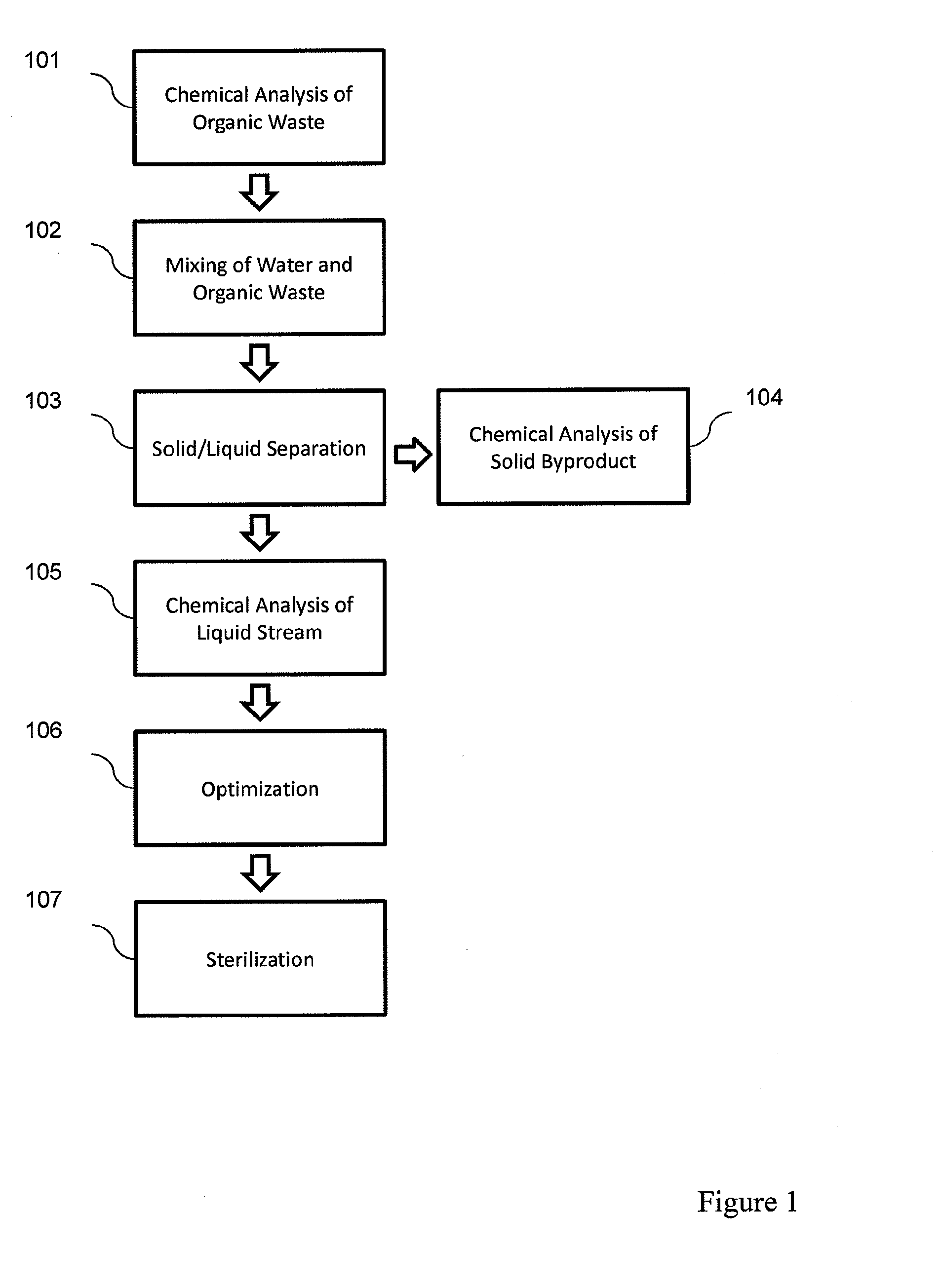
Figure 1 
Figure 2
Abstract
Description
CROSS-REFERENCE TO RELATED APPLICATIONS
[0001] This application claims the benefit of U.S. Provisional Application No. 61 / 567,538, filed Dec. 6, 2011, the content of which is incorporated by reference in its entirety.FIELD OF THE INVENTION
[0002] The present invention generally relates to processes for extracting and recovering nutrients from organic wastes and for converting these organic wastes into cell culture broth or growth media.BACKGROUND OF THE INVENTION
[0003] Currently, the majority of cell culture broths are produced in the following manner. Organic and inorganic sources of nutrients are obtained from various sources. These nutrients undergo analytical testing before being separated into organic and inorganic components. The inorganic components undergo weighing and either proceed to (a) mixing and grinding or (b) granulation and sieving to achieve the desired nutrient profile. The organic compounds are then separated into definite products, such as sugars, indicators, and inh...
Examples
##ic example 1
PROPHETIC EXAMPLE 1
Cell Culture Broth / Media from Livestock Manure
[0075]First, a sample of the source livestock manure may be analyzed to determine in what concentration it should be combined with water. Following this analysis, the determination of the proper water to manure ratio can be achieved. Because nitrate, phosphates, glucose, and peptides are present at a certain ratio, the manure will be mixed with water based on the limiting nutrient. For example, the amount of phosphate present in the manure may be at an about 20 to 1 ratio compared to the solubility limit in water. This would mean the operator would combine about 5000 liters of water and about ¼ ton of cow manure in a 10000-liter batch reactor based on the limiting nutrient composition. Next, the mixture may be agitated for about 30 to 60 minutes at about 150 to 200 rpm under turbulent conditions. The reactor may be maintained at room temperature. Optionally, it may be heated up to about 100 degrees C. in order to aid i...
##ic example 2
PROPHETIC EXAMPLE 2
Cell Culture Broth / Media from Chicken Manure
[0076]First, a sample of the source chicken manure may be analyzed to determine in what concentration it should be combined with water. Following this analysis, the determination of the proper water to manure ratio can be achieved. Based on the fact that nitrate, phosphates, glucose, and peptides are present at a certain ratio, the manure will be mixed with water based on the limiting nutrient. For example, the amount of phosphate present in the manure may be at an about 20 to 1 ratio compared to the solubility limit in water. This would mean the operator would combine 10000 liters of water and ½ ton of chicken manure in a 15000-liter batch reactor based on the limiting nutrient composition. Next, the mixture may be agitated for about 30 to 60 minutes at about 150 to 200 rpm under turbulent conditions. The reactor may be maintained at room temperature. Optionally, it may be heated up to about 100 degrees C. in order to a...
##ic example 3
PROPHETIC EXAMPLE 3
Cell Culture Broth / Media from Swine Manure
[0077]First, a sample of the source swine manure may be analyzed to determine in what concentration it should be combined with water. Following this analysis, the determination of the proper water to manure ratio can be achieved. Based on the fact that nitrate, phosphates, glucose, and peptides are present at a certain ratio, the manure will be mixed with water based on the limiting nutrient. For example, the amount of phosphate present in the manure may be at an about 20 to 1 ratio compared to the solubility limit in water. This would mean the operator would combine 5000 liters of water and about ¼ ton of chicken manure in a 10000-liter batch reactor based on the limiting nutrient composition. Next, the mixture may be agitated for about 30 to 60 minutes at about 150 to 200 rpm under turbulent conditions. The reactor may be maintained at room temperature. Optionally, it may be heated up to about 100 degrees C. in order to ...