
Shape-controlled ceramic fillers for enhanced piezoelectric properties of structured composites
Patent Information
- Authority / Receiving Office
- US · United States
- Current Assignee / Owner
- Publication Date
- 2018-03-22
Smart Images
Figure 1 
Figure 2 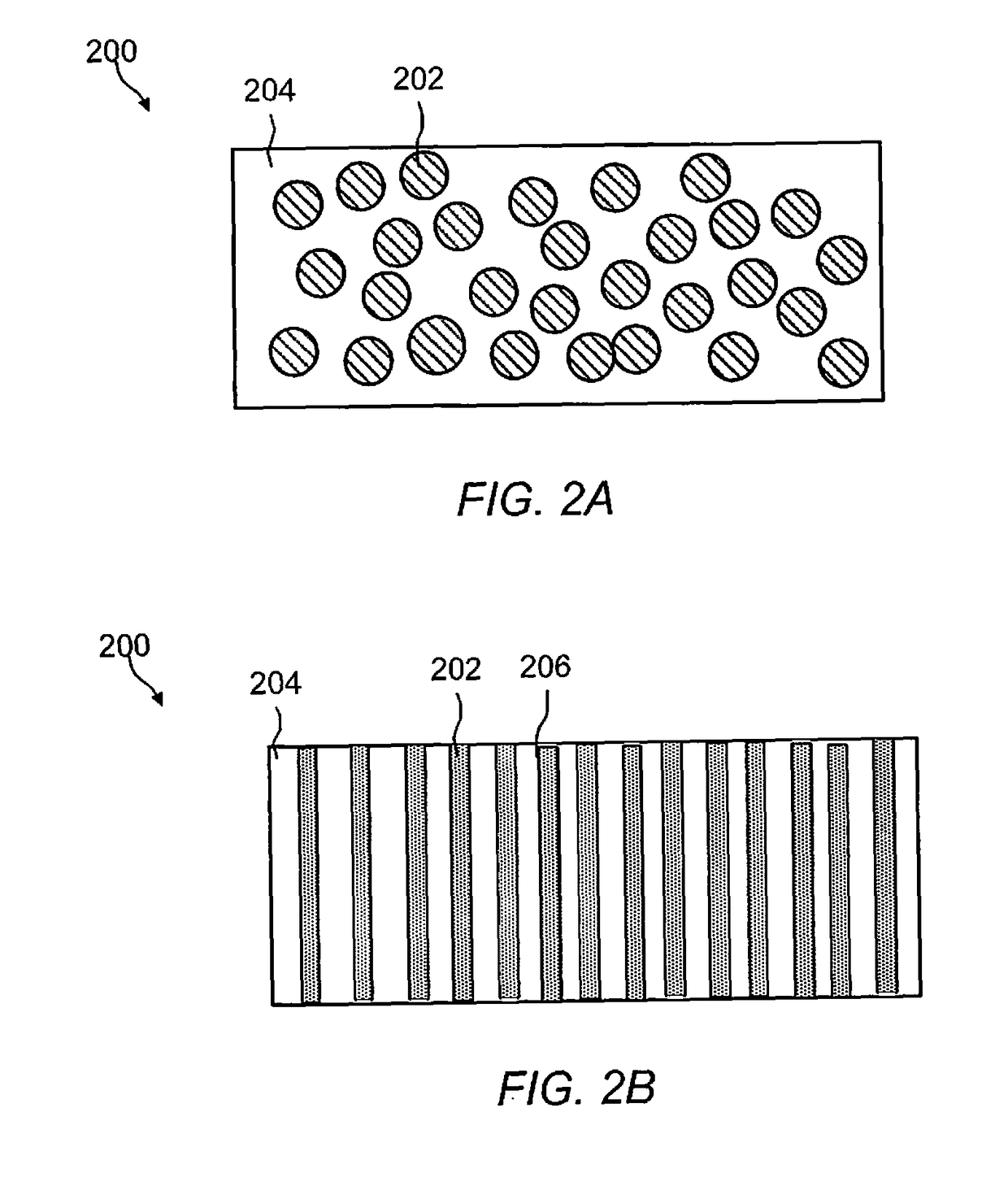
Figure 3
Abstract
Description
CROSS REFERENCE TO RELATED APPLICATIONS
[0001] This application claims the benefit of priority of U.S. Provisional Patent Application No. 62 / 141,513, filed Apr. 1, 2015, which is hereby incorporated by reference in its entirety.BACKGROUND OF THE INVENTION
[0002] A. Field of the Invention
[0003] The invention generally concerns lead-free lithium doped potassium sodium niobate piezoelectric particles that have a single crystalline phase. A two-staged calcination processes for making these single crystalline phase particles is also disclosed.
[0004] B. Description of Related Art
[0005] Piezoelectric materials are used in several components of medical diagnostic tools, industrial automation processes, and defense and communication systems. Such materials also find use in emerging fields such as micromotors, energy harvesting devices, magneto electric sensors and high power transformers.
[0006] Piezoelectrical properties can be found in several types of materials and engineered ceramics. For instanc...
Examples
example 1
Preparation of KNN Piezoelectric Precursors
[0062](K,Na)xLi1-xNbO3.
[0063]Stoichiometric proportions of K2CO3, Na2CO3, Li2CO3, and Nb2O5 (>99.9% purity) powders were mixed in a cyclohexane medium using polypropylene lined mixer using zirconia balls for 3 hours. The resulting slurry was dried in a hot air oven for 24 hours. The dried metal salt composition was divided into 6 samples (Samples 1-5 in Table 1) and calcined at different temperatures.
example 2
Calcination Procedure of LiKNN Piezoelectric Precursors
[0064]First Calcination.
[0065]The calcination of the dried metal salt composition was performed in a closed alumina crucible at a first calcination temperature by heating the samples at a rate of 5° C. / min until the first calcination temperature was reached, held at the first calcination temperature for 3 hours then cooled to ambient temperature. After the first calcination, the (K,Na)xLi1-xNbO3 powder was ball milled for 3 hours to refine the particle size. The calcination temperatures are listed in Table 1.
[0066]Second Calcination.
[0067]After ball milling, samples 4 and 5 were heated to a second calcination temperature at a rate of 5° C. / min until the second calcination temperature was reached, held at the calcination temperature for 10 hours, and then cooled to ambient temperature. The calcination temperatures are listed in Table 1. After calcination the powders were ultrasonicated for 1 hour in a cyclohexane medium, dried at...
example 3
Analysis of (K,Na)xLi1-xNbO3 Piezoelectric Ceramic Materials
[0068]The crystal structure and phase purity of the calcined powders were analyzed by X-Ray Diffraction (XRD) techniques (Brucker D8 diffractometer (GERMANY) having CoKα1 x-rays). FIG. 4 are XRD patterns of Samples 1-4 and 6. Data line 400 is Sample 1, data line 402 is Sample 2, data line 404 is Sample 3, data line 406 is sample 4 and data line 408 is Sample 6. From the XRD patterns, the samples have similar diffraction patterns except that Samples 3, 4 and 6 exhibited a defined secondary phase (peaks, 112 and 202) with sample 6 having the sharpest peaks. The XRD analysis confirmed the development of pervoskite phase (secondary phase) for powders calcined at 1000° C. for 6 hours (Sample 4), 1100° C. for 3 hours (Sample 3), and the double calcined sample (Sample 6). The particle size distribution and morphology of the (K,Na)xLi1-xNbO3 powders were analyzed using a particle size analyzer and scanning electron microscopy (SEM,...