
Method for diagnosis of metastatic cancer or taxane-based drug-resistant cancer by using lmcd1 protein and gene coding therefor
a technology of metastatic cancer and gene coding, which is applied in the direction of instruments, drug compositions, peptides, etc., can solve the problems of paclitaxel-resistant breast cancer patients who frequently experience recurrence and metastasis, and the therapeutic prognosis is deteriorated, and achieves convenient and convenient selection, unnecessary drug treatment, and enhanced cancer therapeutic efficiency
Patent Information
- Authority / Receiving Office
- US · United States
- Patent Type
- Applications(United States)
- Current Assignee / Owner
- Publication Date
- 2019-11-28
- Estimated Expiration
- Not applicable · inactive patent
Smart Images
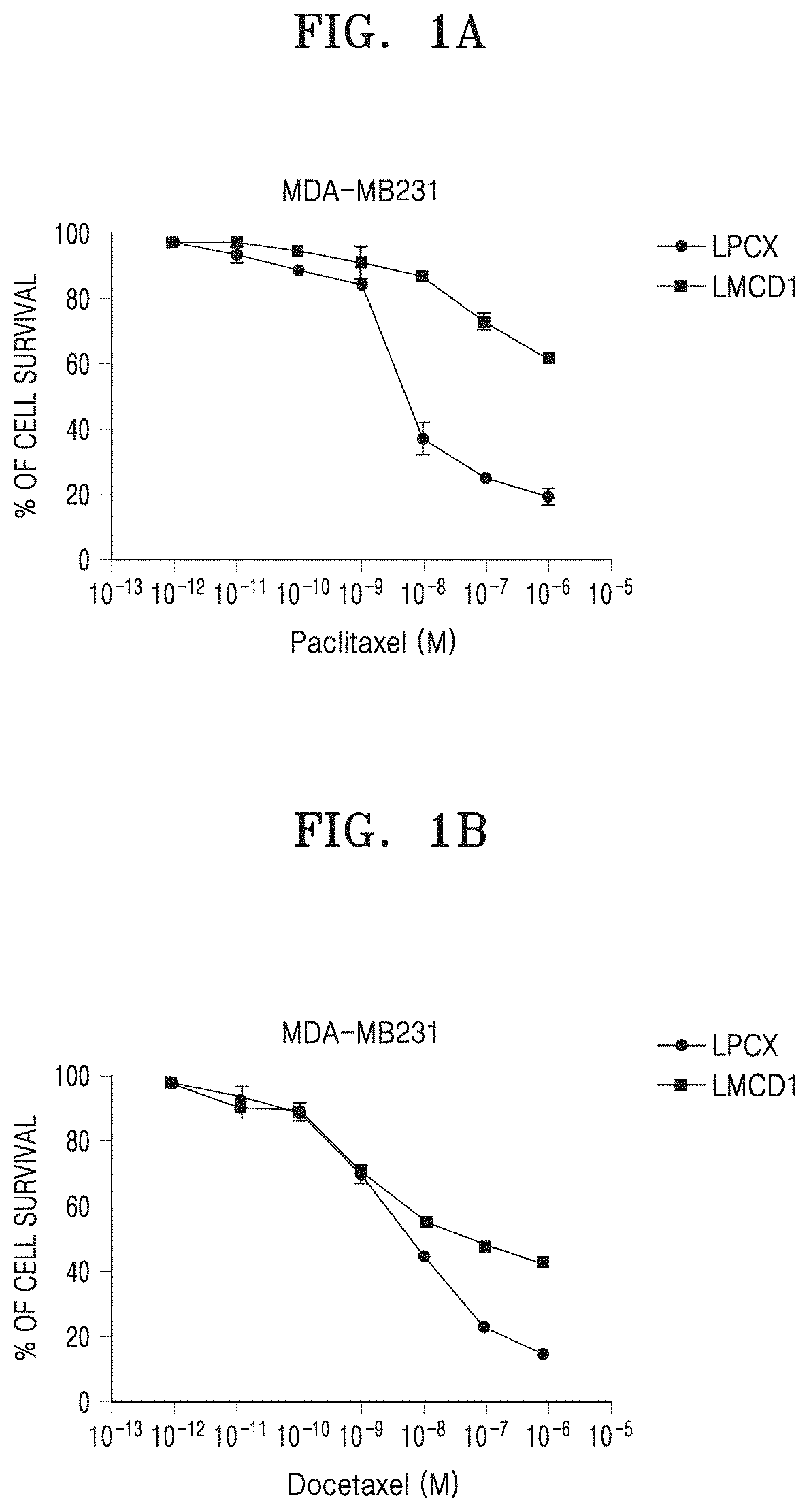
Figure 1 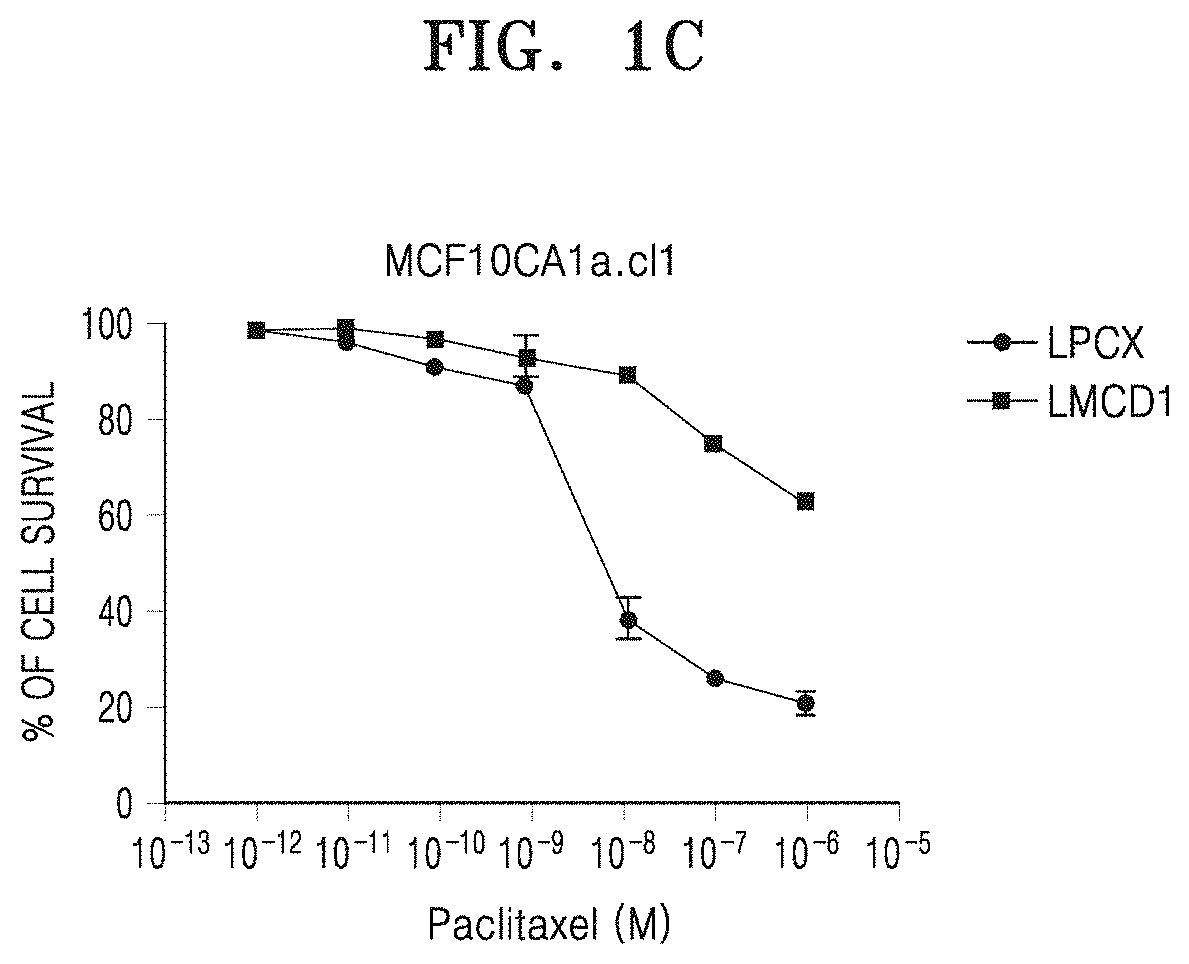
Figure 2 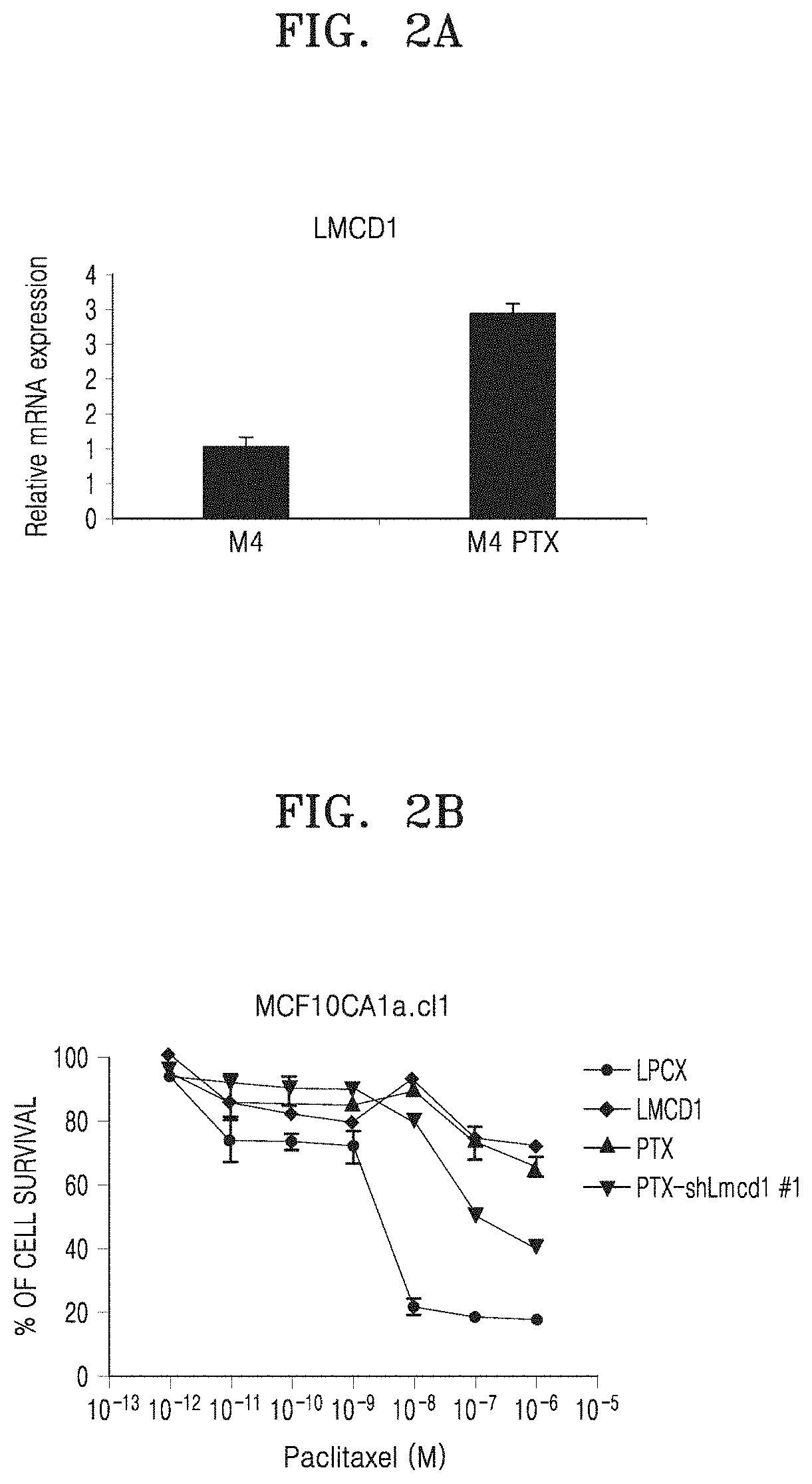
Figure 3
Abstract
Description
RELATED APPLICATIONS
[0001] The present application is a continuation-in-part of PCT Application No. PCT / KR2016 / 013828 filed Nov. 29, 2016, which claims priority to Korean Application No. 10-2016-0152231, filed Nov. 15, 2016, all of which are hereby incorporated in their entirety by reference as set forth herein.TECHNICAL FIELD
[0002] The present disclosure relates to a method and composition for diagnosing metastatic cancer or taxane-based drug-resistant cancer by using the degree of Smad3 protein phosphorylation and LMCD1 induced thereby as biomarkers.REFERENCE TO SEQUENCE LISTING
[0003] The present application contains a Sequence Listing that was filed as an ASCII text file via EFS-Web on May 15, 2019. The ASCII text file is entitled “AIY0001IA-Sequence_Listings.txt,” was created on Nov. 15, 2016 and is 23,000 bytes in size.BACKGROUND ART
[0004] Smad3 is a vital messenger of the TGF-β1 signaling pathway and mediates cell function by regulating the expression of active genes by transmissi...
Examples
example 1
ion of Resistance to Taxane-Based Anticancer Agent in LMCD1-Overexpressing Cells Through MTT Assay
[0063]To investigate whether LMCD1 protein-overexpressing breast cancer cells have resistance to a taxane-based anticancer agent, an MTT assay, which is used to evaluate cell viability, was performed on MCF-10CA1a.cl1, which are human MCF-10A-based breast cancer cell lines, and MDA-MB231. The MCF-10CA1a.cl1 and MDA-MB231 cell lines are characterized as malignant breast cancer cell lines with high metastasis.
[0064]In particular, human MCF-10A-based breast cancer cell lines, i.e., MCF-10CA1a.cl1 and MDA-MB231, were maintained in a DMEM culture solution containing 10% fetal bovine serum and 1% penicillin / streptomycin (WeIGENE) in a CO2 incubator at 37° C.
[0065]To overexpress the LMCD1 protein in cells, LMCD1 was cloned into retroviral vector pLPCX, and LMCD1 retrovirus was obtained using Plat-GP cells. The metastatic breast cancer cells were infected with the LMCD1 retrovirus, LMCD1 protei...
example 2
n of LMCD1 Overexpression in Cells with Resistance to Taxane-Based Anticancer Agent
[0068]2-1. Production of Cells with Resistance to Taxane-Based Anticancer Agent
[0069]To evaluate whether the LMCD1 protein is overexpressed in cells having resistance to a taxane-based anticancer agent, cells having resistance to a taxane-based anticancer agent were produced.
[0070]In particular, parental cells were treated with paclitaxel at a small concentration of 0.5 nM, and alive cells were repeated treated with paclitaxel three or four times while being passaged. After the repeated paclitaxel treatment processes, alive cells were treated with paclitaxel with an increment of 0.5 nM, and then passaging of alive cells was further repeated, thereby producing cells having resistance to paclitaxel that did not die even at an IC50 value of 50 nM.
[0071]2.2. Evaluation of LMCD1 Expression Level in Cells with Resistance to Taxane-Based Anticancer Agent
[0072]An expression level of LMCD1 in taxane-based anti...
example 3
ion of LMCD1 Overexpression and the Effect of Different Smad3 Protein Phosphorylation in Paclitaxel-Resistant Cells
[0080]3-1. Production of Smad3 Phosphorylation Inhibition Model
[0081]To verify whether LMCD1 overexpression and Smad3 linker phosphorylation inhibition are exhibited in paclitaxel-resistant cells, as illustrated in FIGS. 3A-3C, phosphorylation inhibition models according to Smad3 phosphorylation site were produced. GFP, Smad3 wild-type, C-terminal phosphorylation-inhibiting mutant (3SA), Smad3 linker phosphorylation-activating mutant (STD), and a Smad3 linker phosphorylation-inhibiting mutant (EPSM) adenovirus were supplied from Dr. Sushil G. Rane (NIDDK, NIH, Bethesda, Md.). To measure transduction efficiency, GFP adenovirus was used as a control. The cells were transfected with 75 to 100 virus particles / cell in a cell solution, and each transfection procedure was repeated three times.
[0082]3-2. Evaluation of LMCD1 Expression Level and Smad3 Protein Phosphorylation in ...