
Pressure sensitive ink jet media for digital printing
a technology of pressure sensitive ink jets and digital printing, applied in printing, transportation and packaging, coatings, etc., can solve the problems of easy smear, low color saturation, bleed, etc., and achieve the effect of easy application, excellent physical properties, and high absorption efficiency
Patent Information
- Authority / Receiving Office
- US · United States
- Patent Type
- Patents(United States)
- Current Assignee / Owner
- Publication Date
- 2002-08-13
- Estimated Expiration
- Not applicable · inactive patent
Smart Images
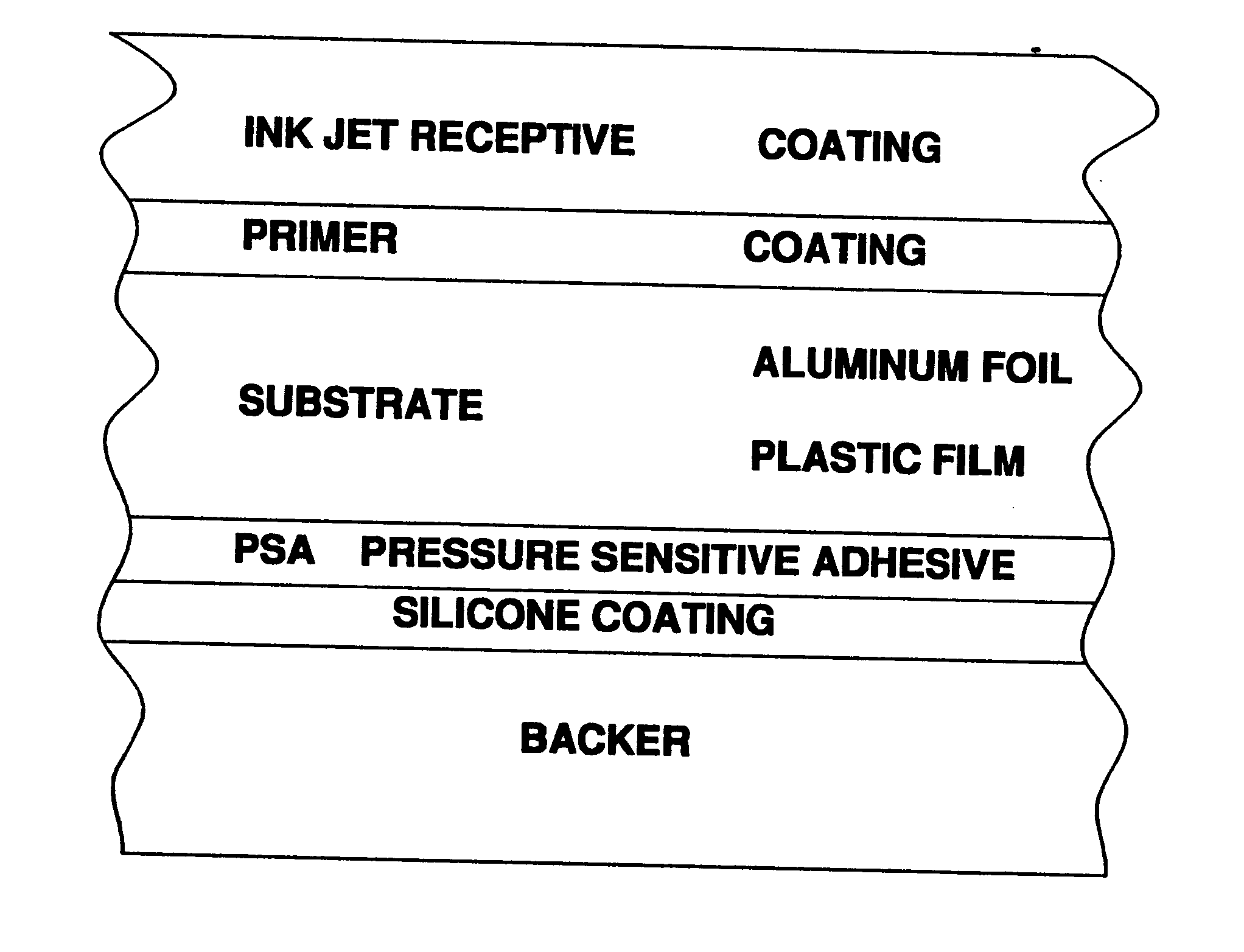
Figure 1 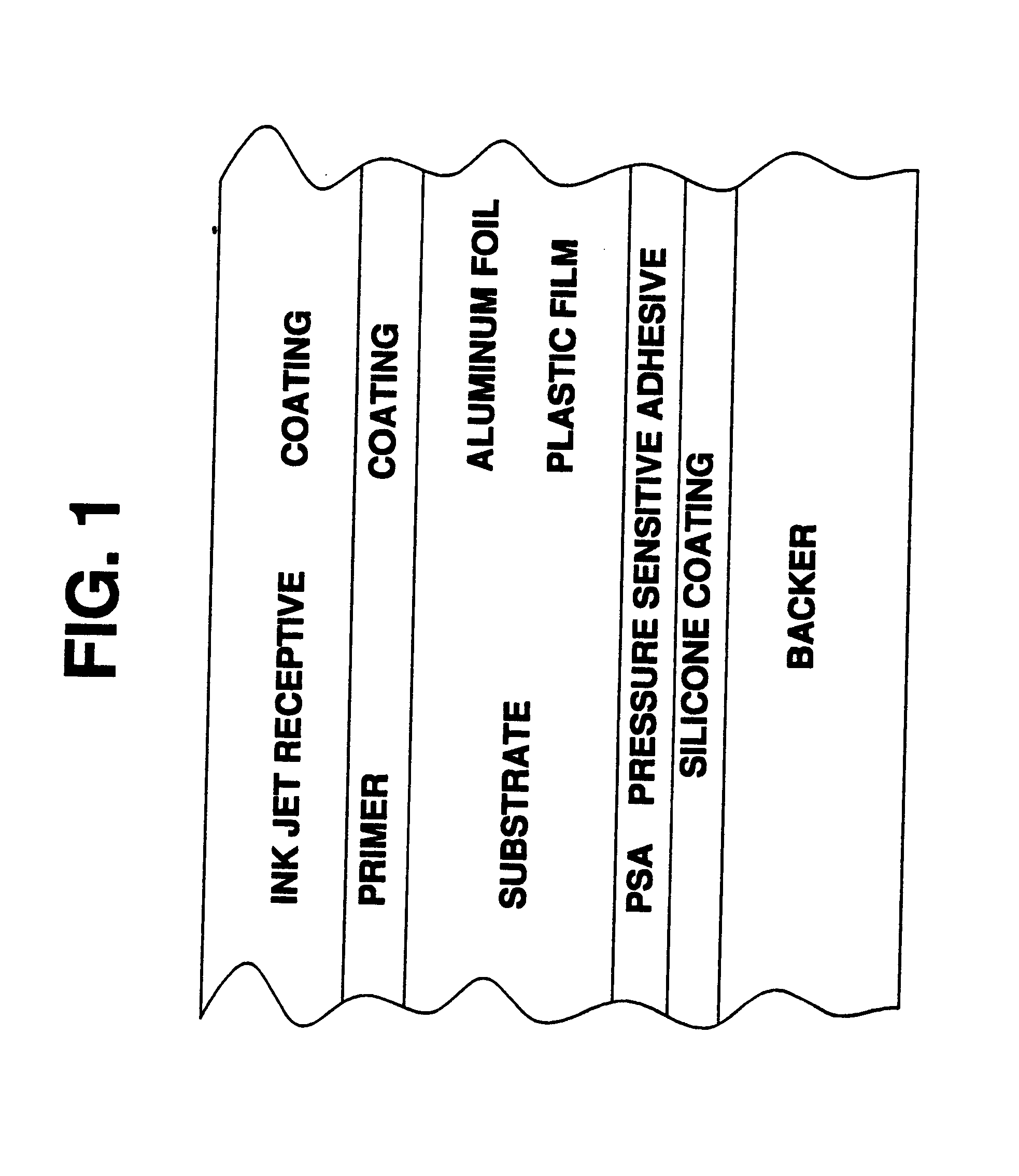
Figure 2
Abstract
Description
The existing pressure sensitive ink jet media for various commercial ink jet printers and inks, such as sold by Apple, Hewlett Packard, Canon, Epson and the like, work under the mechanism in which the ink absorption relies principally or partially on the absorption of the ink into voids of substrate fiber and / or silica gel pigment particles, and / or heavy coating thickness. It dries slowly. The print feathers, bleeds, and has low color saturation and poor resolution. The print smears readily, smudges easily, and requires immediate interleaving. The print also has a high water sensitivity and will be washed off upon contact with water such as under outdoor display conditions where it is subject to rain.The current market does not offer waterproof aluminum foil / plastic film self-adhesive ink jet media. Due to the fact that these substrates are absolutely non-porous, non-absorbing, non-penetrating to ink jet inks, normal approaches are to increase the coating thickness (e.g., 17 g / m2), ...
Examples
example 1
The following components were mixed at room temperature to form the ink jet receptive composition. 1 gram of slurry or aqueous dispersed silica gel, average size at 0.3 micron with a positive zeta potential, (commercially available from Grace Division), was added to 6 grams of OF-280, a cationic co-polymer, dimethyl-diallyl-ammonium chloride / acrylic acrylic with 80 / 20 ratio and 35% activity molecular weight 250-400K, (commercially available from Calgon Company), under agitation. 32 grams of IJ-2, positively charged polyurethane (commercially available from Esprit Company) were then added and well mixed. 35 grams of tap water were added. 8 grams of 10% aqueous solution of Daxad 11, Sodium napthalenesulfonate-formaldehyde dispersants (commercially available from Hampshire Corporation) were added afterwards.
Two grams of Lucidene 901 polyethylene acrylic acid (commercially available from Morton Corporation) were then added to the mixture. 2.2 grams of Carboset GA-33, acrylic dispersion ...
example 2
Part A: 600 grams of poly (diallyldimethylammonium chloride), commercially available from Aldrich, 20% by weight in water, average molecular weight 400-500K, under vigorous agitation were mixed with 3200 grams of IJ-2 (commercially available from Esprit Company), 3500 grams of distilled water were then added after 800 grams of 10% by weight aqueous solution of Triton X-100, Polyoxyethylene-polyoxypropylene glycol, a wetting agent, (commercially available from Rohm & Haas Company), were added afterwards. 20 grams of Pruronic L-61, Octylphenoxypolyethoxyethanol nonionic surfactant, a defoamer, (commercially available from BASF Corporation), were added to the mixture. 200 grams of Carboset CR-761 (commercially available from BF Goodrich Company), were added to the mixture 20 grams of CR-5L, an aliphatic epoxy compound (commercially available from Esprit), were added.
Part B: 600 grams of pigskin pharmaceutical grade gelatin, 11337 Type 56, (commercially available from SKW Biosystems), w...