
2-alkoxyestradiol analogs with antiproliferative and antimitotic activity
a technology of which is applied in the field of new alkoxy estradiols with antiproliferative and antimitotic activity, can solve the problems of frequent apoptosis and mitotic arrest, and achieve the effects of inhibiting angiogenesis, inhibiting microtubule formation and function, and inhibiting cell proliferation
Patent Information
- Authority / Receiving Office
- US · United States
- Patent Type
- Patents(United States)
- Current Assignee / Owner
- Publication Date
- 2005-02-08
- Estimated Expiration
- Not applicable · inactive patent
Smart Images
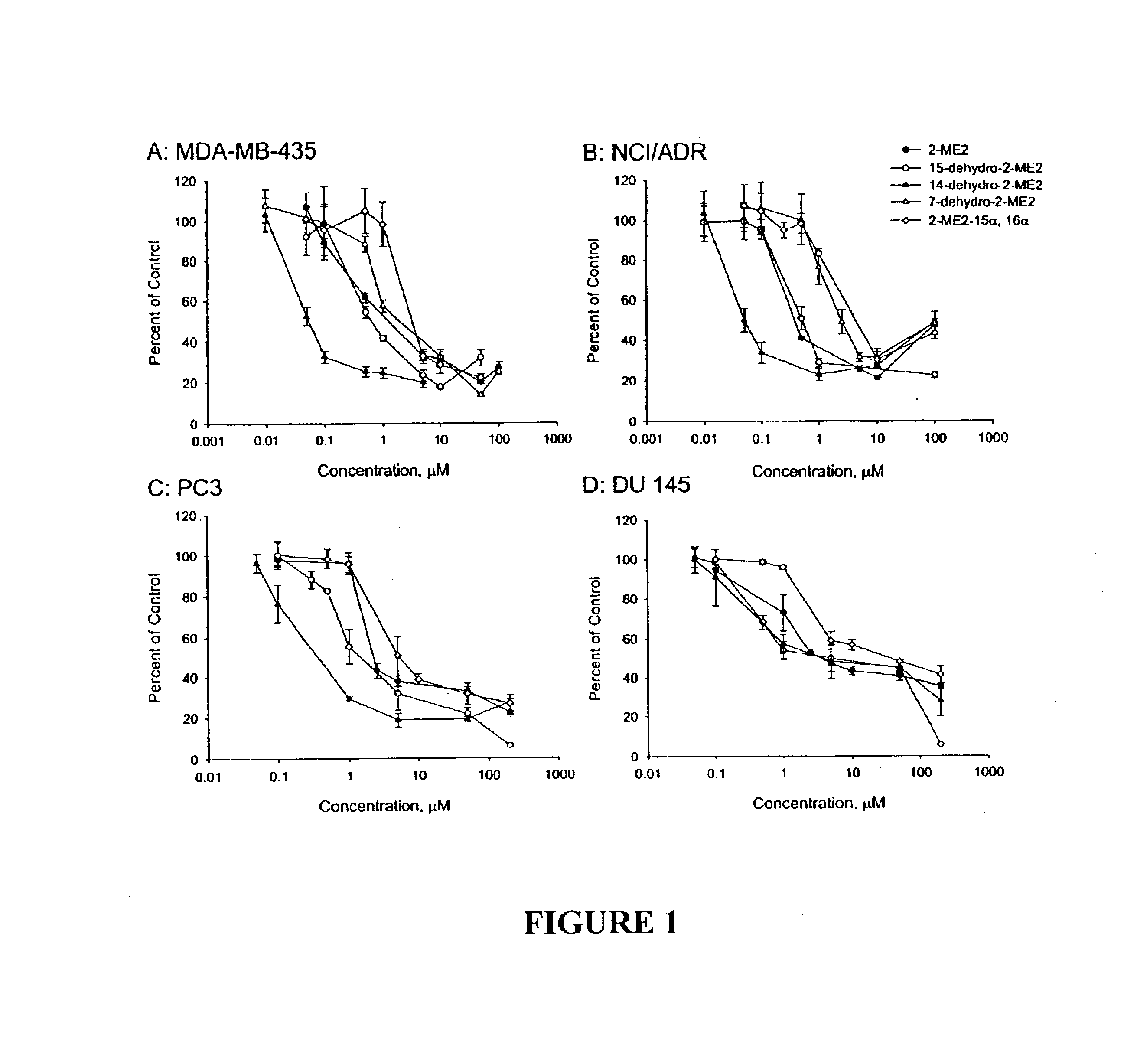
Figure 1 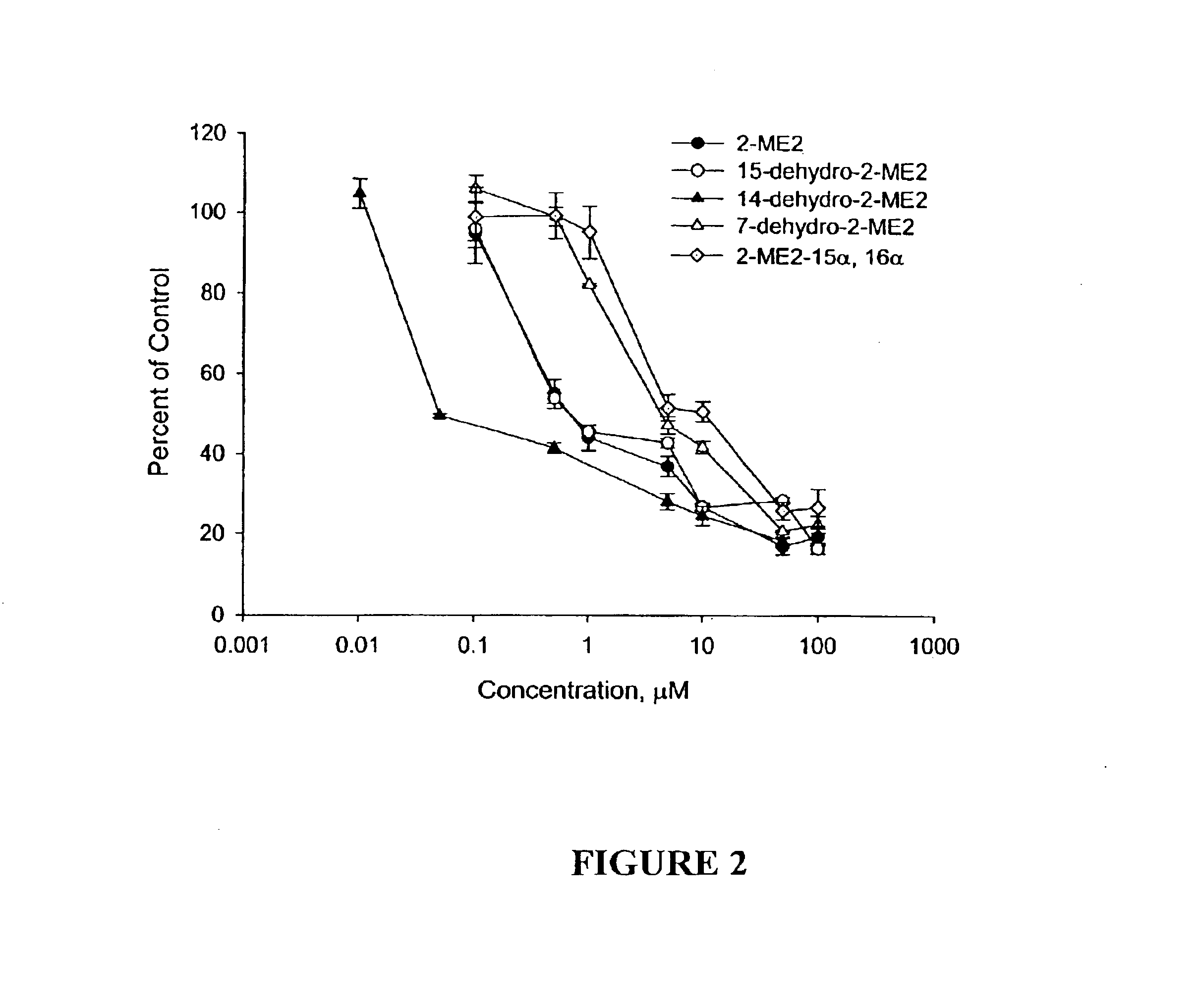
Figure 2 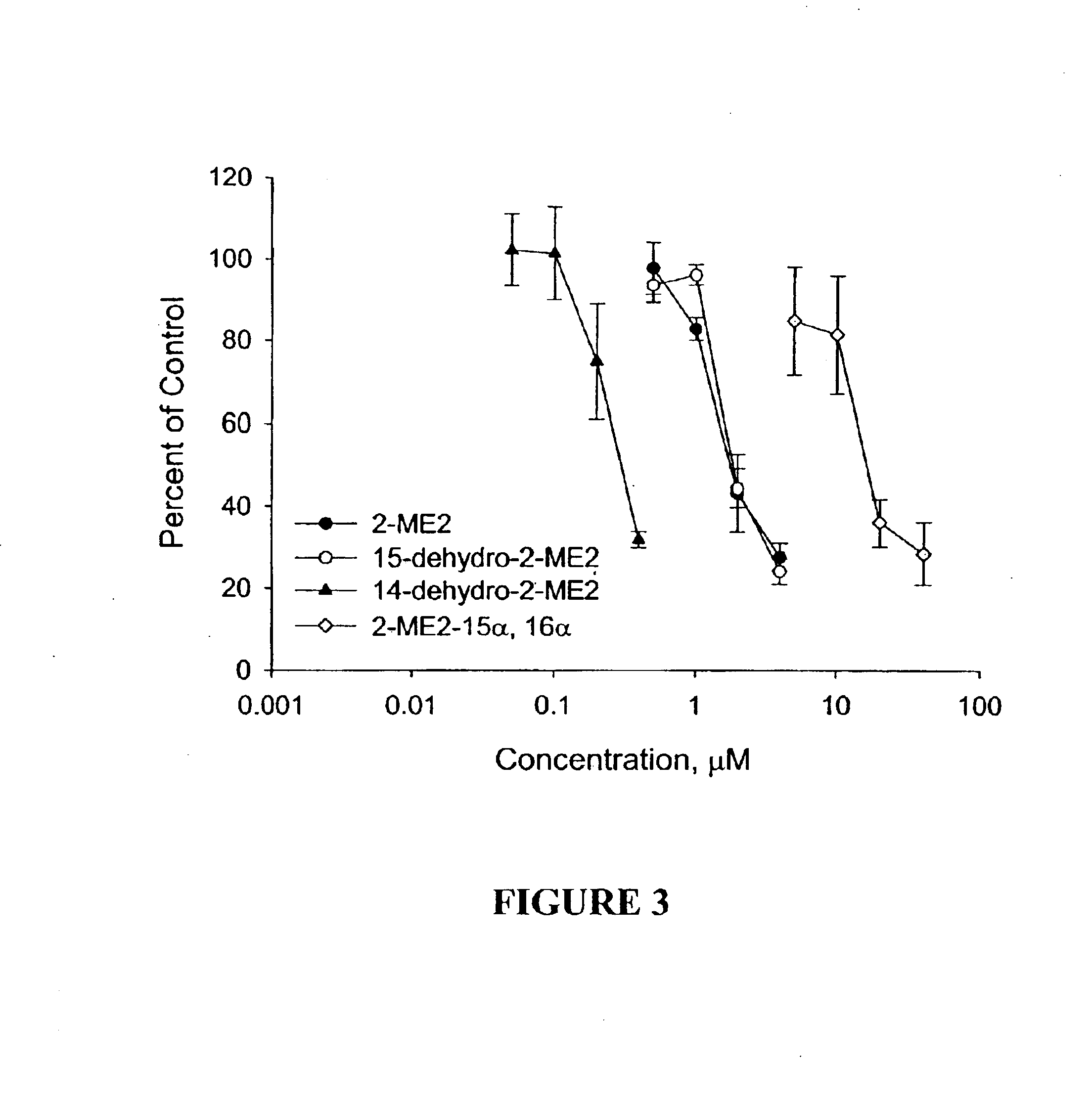
Figure 3
Abstract
Description
BACKGROUND OF THE INVENTION1. Field of InventionThe present invention relates, in general, to chemical compounds having antiproliferative and antimitotic activity. More specifically, the present invention is directed to novel 2-alkoxy estradiols having antiproliferative and antimitotic activity and to methods of preparing and using these novel compounds.2. Description of the Related ArtCertain 2-alkoxy estradiols have been discovered to have antitumor activity (U.S. Pat. No. 6,136,992; U.S. Pat. No. 6,054,598; U.S. Pat. No. 6,051,726; U.S. Pat. No. 5,892,069; U.S. Pat. No. 5,661,143; U.S. Pat. No. 5,504,074; WO 95 / 04535) (all patents cited throughout this specification are incorporated herein by reference). 2-Methoxyestradiol (2-ME2) is one such 2-alkoxy estradiol exhibiting antitumor activity (U.S. Pat. No. 5,892,069; U.S. Pat. No. 5,661,143; U.S. Pat. No. 5,504,074; WO 95 / 04535) 2-Methoxyestradiol is an endogenous mammalian metabolite formed by the sequential biochemical hydroxyla...
Examples
example 1
Properties of the Compounds
Four novel derivatives of 2-ME2 were designed, synthesized and tested for antiproliferative activity against breast, prostate, cervical and ovarian cancer cells. These analogs are shown above in Table 1. As set forth in more detail below, one analog is 3-to 25 times more potent than 2-ME2 and another is approximately equal in potency, while two others were slightly less potent against 6 human tumor cell lines. All 4 analogs disrupt interphase and mitotic microtubules, consistent with the current state of knowledge of the mechanism of action of 2-ME2.
The antiangiogenic activity of 2-ME2 is of key importance in its antitumor effects. The effects of the 4 analogs on the proliferation of endothelial cells, an indicator of antiangiogenic activity, were evaluated. All 4 analogs inhibited endothelial cell proliferation. These data are consistent with the known effects of antiangiogenic compounds.
The 2-ME2 analogs were also tested for effectiveness against a multi...
example 2
Methods of Synthesizing 2-Methoxyestradiol and 2-Methoxy-7α-Methylestradiol
The method according to the present invention of synthesizing 2-Methoxyestradiols (8a, 8b) is illustrated in FIG. 5 and is described in particularity below.
1. Estradiol Diacetate (2a)
Under nitrogen, acetic anhydride (50 mL, 264.5 mmol) was added to a solution of estradiol (1a) (20.0 g, 73.43 mmol) in dry pyridine (200 mL). The reaction mixture was stirred at room temperature overnight (16 h). The next morning, analysis by tlc (5% acetone / CH2Cl2) indicated a complete reaction. The mixture was cooled in an ice bath and the excess acetic anhydride quenched by addition of methanol (25 mL). The mixture was stirred at 0° C. for one hour and then allowed to warm to room temperature. The solvents were removed in vacuo and the solid residue crystallized from hot methanol to give the pure diacetate (2a) (24.87 g, 95%).
mp=127-128° C.
FTIR (KBr, diffuse reflectance) νmax 2924, 2874, 1765 and 1734 cm−1.
NMR (300 MHz, CDCl3)...
example 3
Methods of Synthesizing 2-Methoxyestra-1,3,5(10),15-tetraen-3,17β-diol (16)(15-dehydro-2-ME2)
The method according to the present invention of synthesizing 2-Methoxyestra-1,3,5(10),15-tetraen-3,17β-diol (16) (15-dehydro-2-ME2) is illustrated in FIG. 6 and is described in particularity below.
1. 2-Methoxyestrone 3-benzyl Ether (9)
A solution of the 17-alcohol (7a) (8.1 g, 20.64 mmol) in acetone (300 mL) was cooled to 0° C. in an ice bath and treated dropwise with Jones reagent with stirring until a yellow color persisted. At that point, the reaction mixture was stirred at 0° C. for another 5 m. and then was treated dropwise with isopropanol until a green color persisted. The resulting green suspension was diluted with water (500 mL) and extracted with methylene chloride (3×). The organic fractions were washed with water (1×), saturated sodium bicarbonate solution (1×) and brine (1×). The organic fractions were filtered through anhydrous sodium sulfate, combined and concentrated in vacuo...