
Method and apparatus for multiplexing plural ion beams to a mass spectrometer
a mass spectrometer and multiplexing technology, applied in the field of mass spectrometers, can solve the problems of inefficient use of ions created by direct coupling of continuously operating ion sources to time-of-flight mass spectrometers, uncompromised chemical data, and high overall sample throughput, so as to achieve high throughput and high resolution. , the effect of fast detection
Patent Information
- Authority / Receiving Office
- US · United States
- Patent Type
- Patents(United States)
- Current Assignee / Owner
- Publication Date
- 2007-05-15
Smart Images
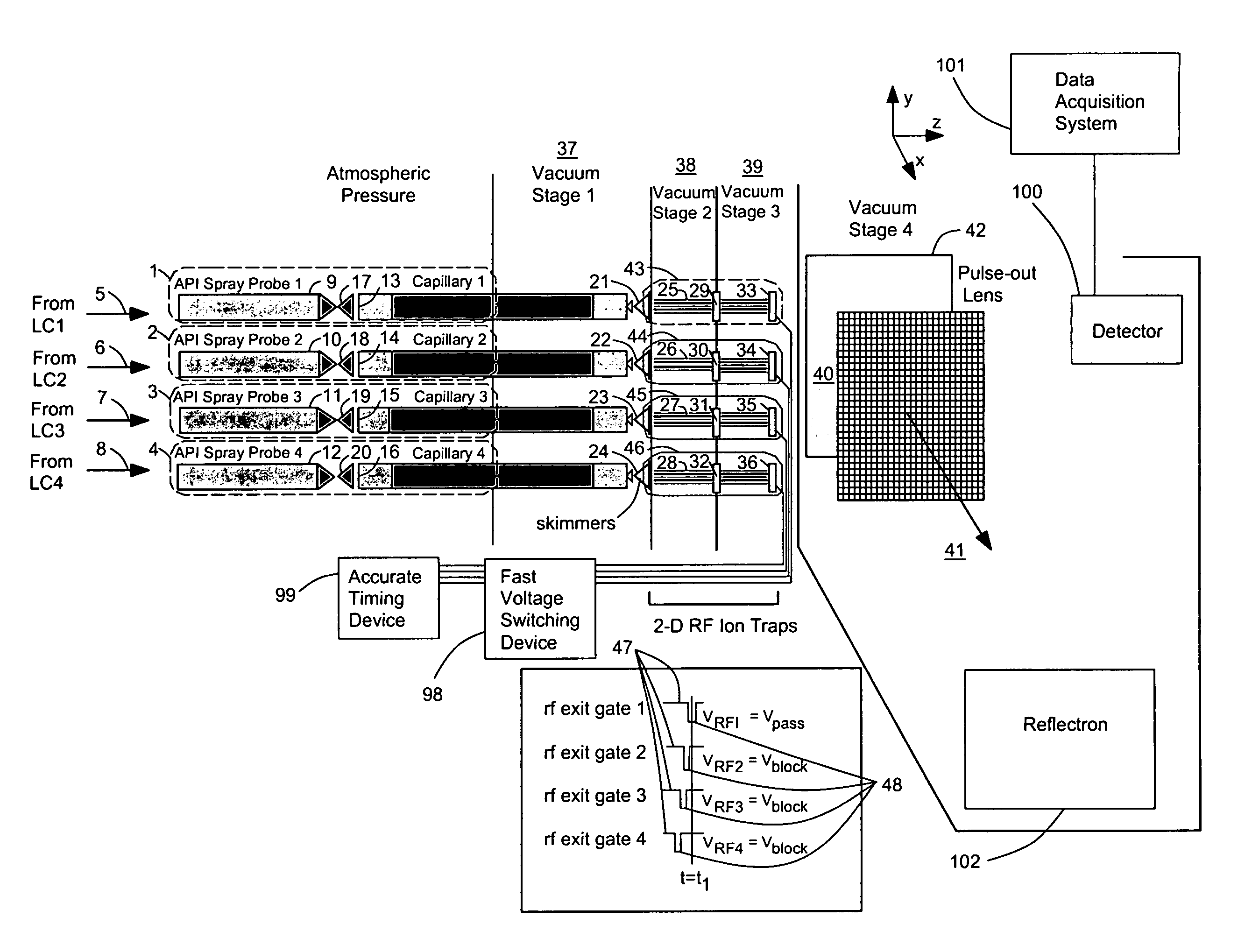
Figure 1 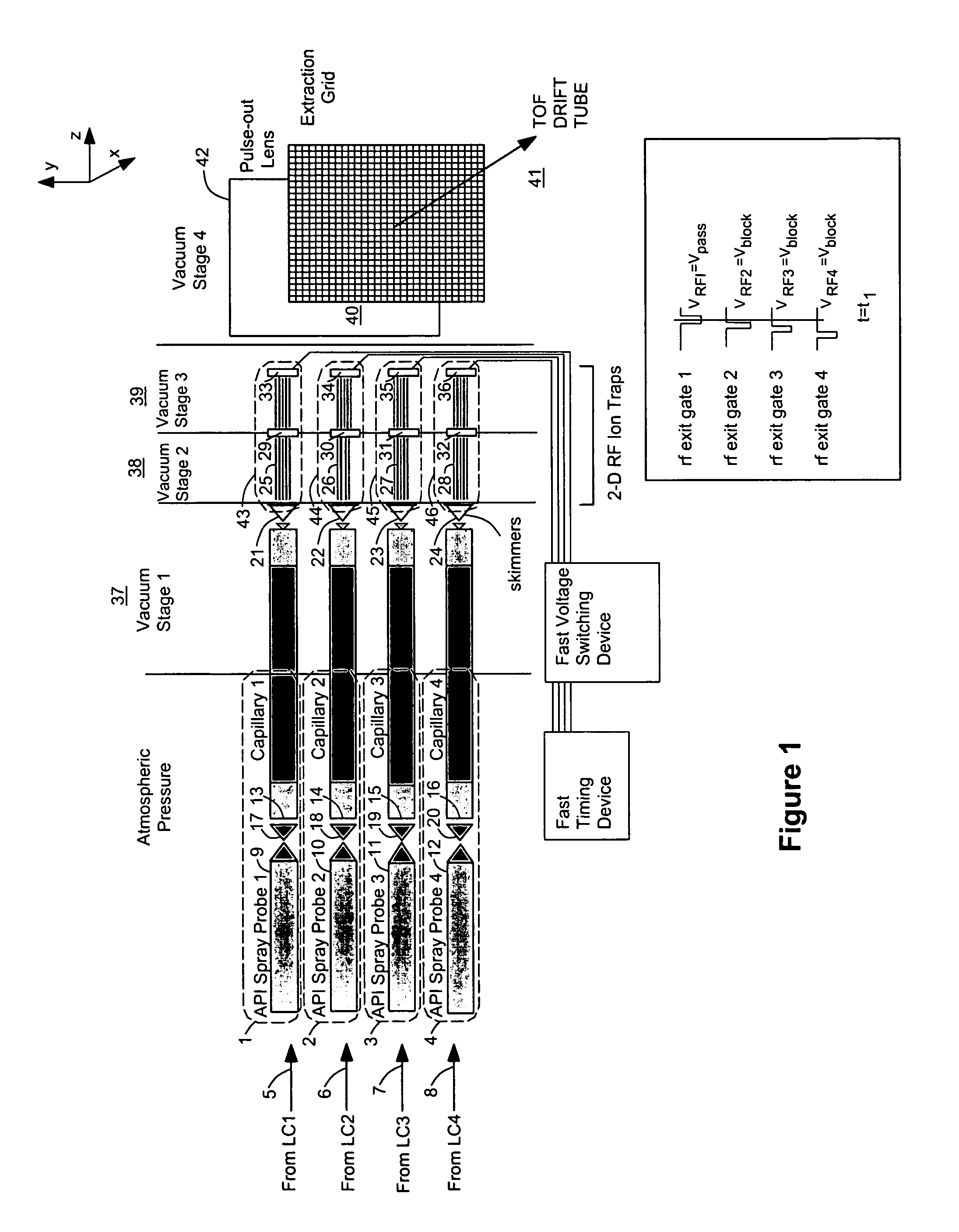
Figure 2 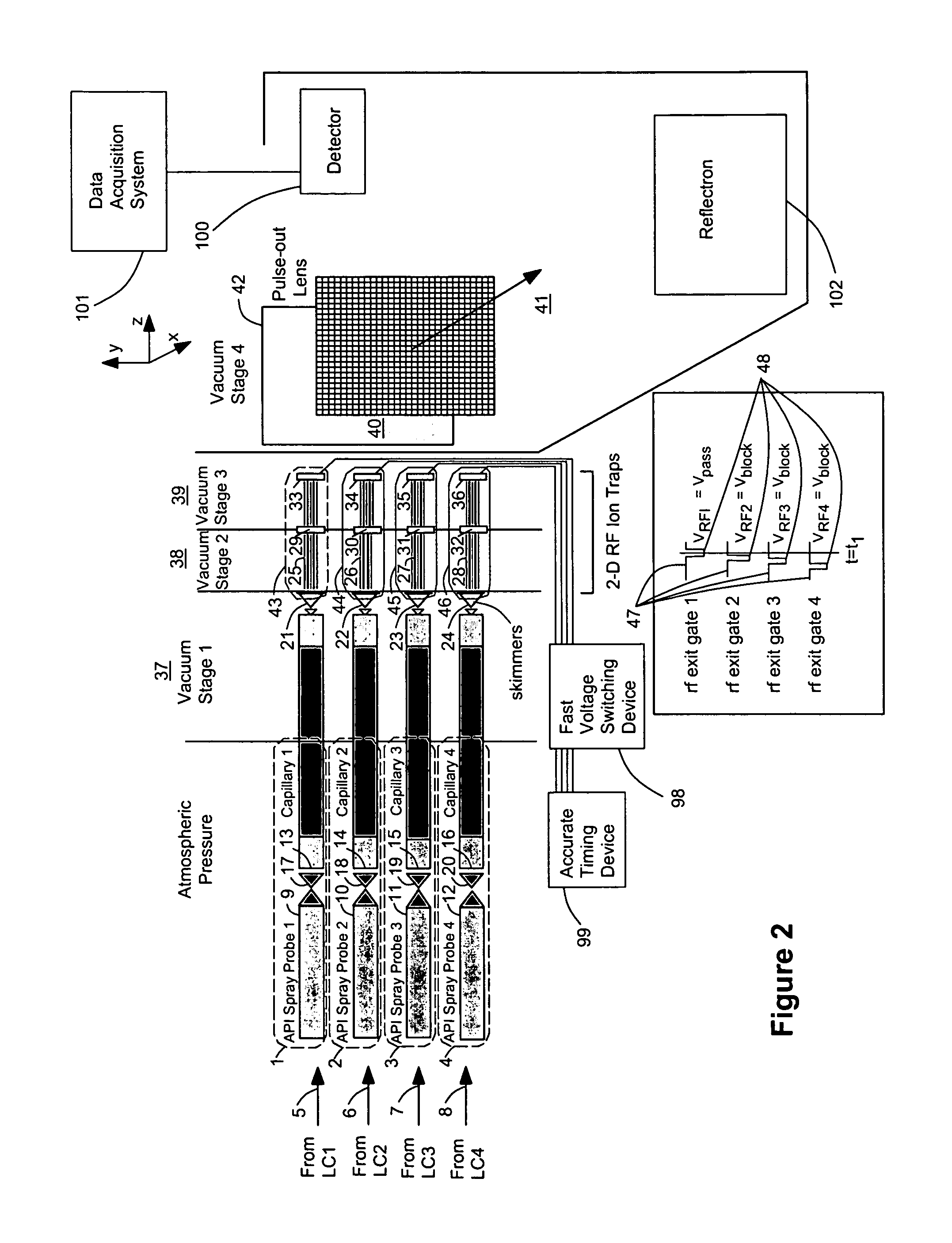
Figure 3
Abstract
Description
[0001] References CitedU.S. Patent Documents3,740,551June 1973Green250 / 41.9 ME3,831,026August 1974Powers250 / 2964,507,555March 1985Chang250 / 2815,179,278January 1993Douglas250 / 2905,331,158July 1994Dowell250 / 2825,420,425May 1995Bier250 / 2925,652,427July 1997Whitehouse et. al.250 / 2885,689,111November 1997Dresch et. al.250 / 2875,763,878June 1998Franzen250 / 2925,811,800September 1998Franzen et. al.250 / 288OTHER PUBLICATIONS
[0002] Ooms, B. Temperature Control in High Performance Liquid Chromatography, LC-GC (Asia Pacific), vol. 1, No. 1, p. 27–35 (1998).
[0003] Lin H. Y., Voyksner R. D., Analysis of Neuropeptides by Perfusion Liquid Chromatography / Electrospray Ion-trap Mass Spectrometry, Rapid Communications in Mass Spectrometry, vol. 8, p. 333–338 (1994).
[0004] Chien, B. M., Michael, S. M., Lubman, D. M., Plasma Source Atmospheric Pressure Ionization Detection of Liquid Injection Using an Ion Trap Storage / Reflectron Time-of-Flight Mass Spectrometer, Analytical Chemistry, vol. 65, p. 1916–1924 (199...
Examples
Embodiment Construction
[0058]FIG. 1 shows an arrangement for conducting mass spectrometric analysis on multiple ion sources 1, 2, 3, 4 using a preferred embodiment of the invention. In this case a number of samples are simultaneously injected onto the same number of liquid chromatography columns for separation of their individual constituents. Each of these sample streams 5, 6, 7, 8 elute and are transferred in line to its own atmospheric pressure ionization source 1, 2, 3, 4. These API ion sources 1, 2, 3, 4 are oriented to allow high transfer efficiency of ions between each ionization probe 9, 10, 11, 12 and its respective vacuum orifice 13, 14, 15, 16. Likewise, each of these sprayer-orifice pairs 9&13, 10&14, 11&15, 12&16 is set a suitable distance apart to prevent the migration of ions from, for example, probe A 9, e.g. towards orifice B 14, e.g., which would lead to erroneous mass spectral data in mass spectrum B by falsely indicating the presence of a compound from chromatograph A. Each of the API ...