
Methods for detecting cancer cells by using nucleic acid encoding for IGF-1 receptor interacting proteins
Patent Information
- Authority / Receiving Office
- US · United States
- Current Assignee / Owner
- Publication Date
- 2008-03-25
- Estimated Expiration
- Not applicable · inactive patent
Smart Images
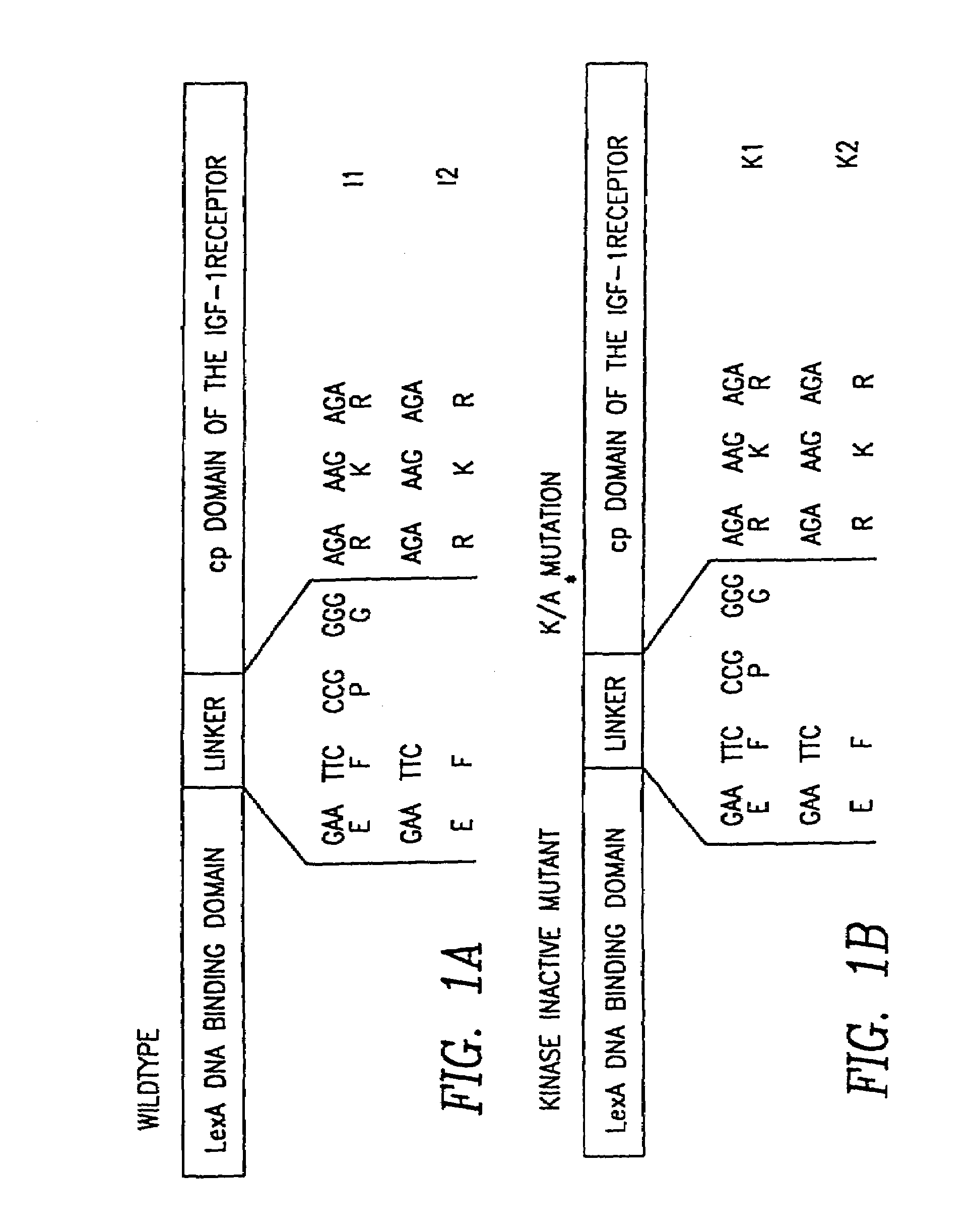
Figure 1 
Figure 2 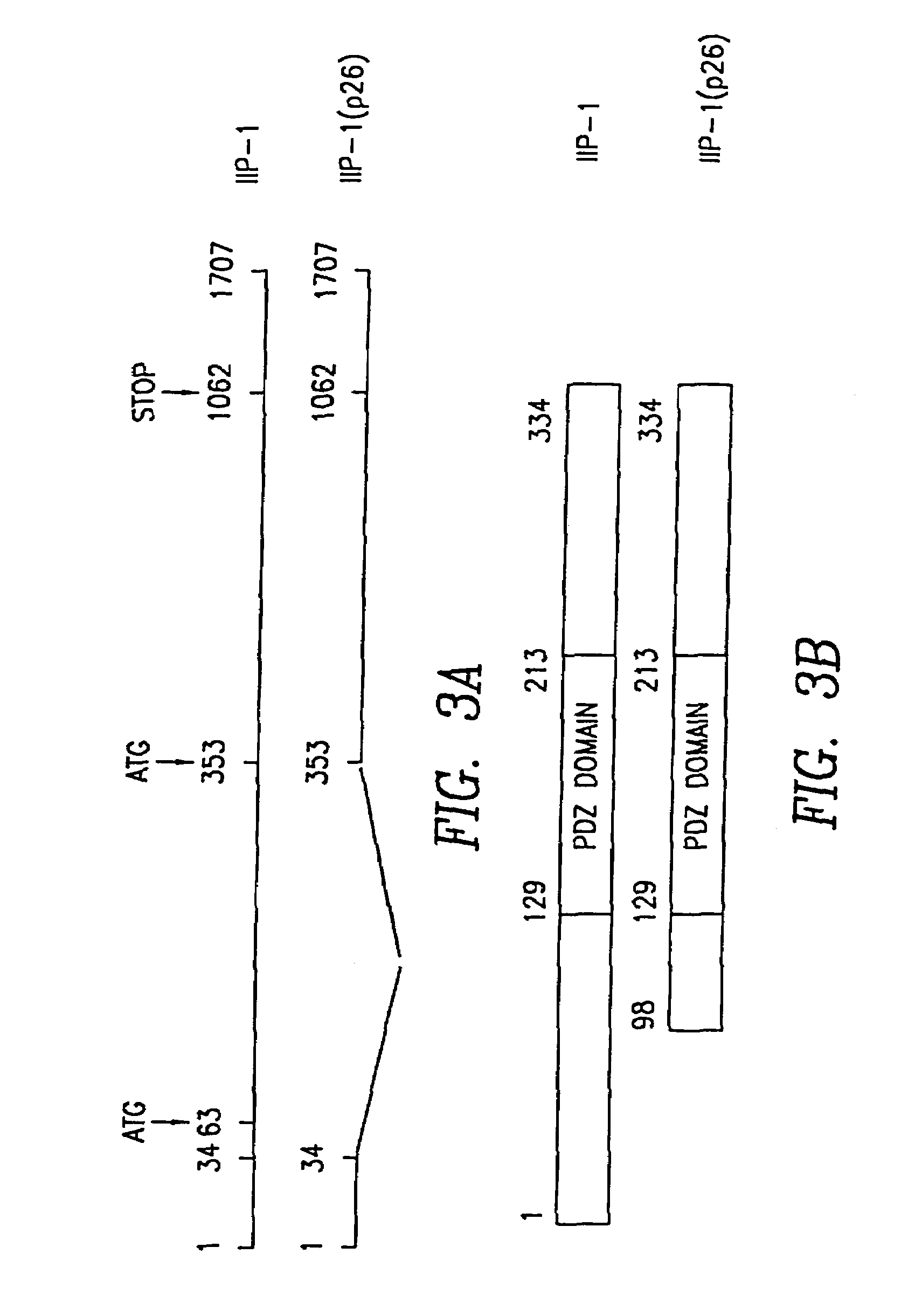
Figure 3
Abstract
Description
PRIORITY TO RELATED APPLICATIONS
[0001] This application is a Divisional of Ser. No. 10 / 013,056, filed Oct. 30, 2001 which is now abandoned, which is a continuation-in-part application of Ser. No. 09 / 453,195, filed Dec. 2, 1999, now U.S. Pat. No. 6,368,826.BACKGROUND OF THE INVENTION
[0002] The IGF-1 receptor signaling system plays an important role in tumor proliferation and survival and is implicated in inhibition of tumor apoptosis. In addition and independent of its mitogenic properties, IGF-1R activation can protect against or at least retard programmed cell death in vitro and in vivo (Harrington et al., EMBO J. 13 (1994) 3286-3295; Sell et al., Cancer Res. 55 (1995) 303-305; Singleton et al., Cancer Res. 56 (1996) 4522-4529). A decrease in the level of IGF-1R below wild type levels was also shown to cause massive apoptosis of tumor cells in vivo (Resnicoff et al., Cancer Res. 55 (1995) 2463-2469; Resnicoff et al., Cancer Res. 55 (1995) 3739-3741). Overexpression of either ligand ...
Examples
example 1
Isolation and Characterization of IGF-1R Binding Proteins
[0100]The yeast two-hybrid system (Fields, S., and Song, O., Nature 340 (1989) 245-246) was used to isolate unknown cytosolic IGF-1 receptor binding proteins. For screening a modified version of the yeast two-hybrid system was used which allows interchain tyrosylphosphorylation of the receptors in yeast.
[0101]The yeast two-hybrid bait plasmid (BTM116-cpIGF-1 receptor) was constructed by fusing the cytoplasmic domain of the β-subunit of the IGF-1 receptor (nt 2923 to 4154) (Ullrich, A., et al., EMBO J. 5 (1986) 2503-2512) to the LexA DNA-binding domain which forms dimers and mimics the situation of the activated wildtype receptor (cf. Weidner, M., et al., Nature 384 (1996) 173-176). By introducing a proline-glycine spacer between the LexA DNA-binding domain and the receptor domain the ability of the bait to bind known substrates of the IGF-1 receptor was remarkably increased in comparison to other spacer amino acids (FIG. 1).
[0...
example 2
Assay Systems:
A) In-Vitro / Biochemical Assays:
[0106]1 ELISA-Based Assay / Homogenous Assay
[0107]IGF-1R and the binding proteins (IIPs) are expressed with or without Tag-epitopes in E. coli or eucaryotic cells and purified to homogeneity. Interaction of IGF-1R and the respective binding proteins are analyzed in the presence or absence of drugs. Compounds which either inhibit or promote binding of IGF-1R and the respective binding proteins are selected. In the case of the ELISA system antibodies specific for the two binding partners are used for detection of the complexes. In the case of the homogenous assay at least one binding partner is labeled with fluorophores which allows analysis of the complexes. Alternatively, anti-Tag-antibodies are used to monitor interaction.
B) Cellular Assays:
[0108]Tumor cells or cells transfected with expression constructs of the IGF-1R and the respective binding proteins are treated with or without drugs and complex formation between the two components is ...
example 3
cDNA Cloning of IIP-1 and IIP-10 (and RT-PCR-Assay)
[0109]The nucleotide sequence of full length IIP-1 was determined by sequencing of the partial cDNA clones of IIP-1 and (IIP-1a, IIP-1b) and by using database information (ESTs). cDNA cloning of full length IIP-1 was performed by RT PCR on total RNA isolated from a MCF7ADRbreast cell line. PT PCR with two oligonucleotide primers: TIP2c-s (SEQ ID NO:7) and TIP2b-r (SEQ ID NO:8) resulted in amplification of two DNA fragments of 1.0 kb (IIP-1) and 0.7 kb (IIP-1(p26)).
[0110]The nucleotide sequence of full length IIP-10 was determined by sequencing of the partial cDNA clone of IIP-10 and by using database information (ESTs). cDNA cloning of IIP-10 was performed on total RNA isolated from the colon cancer cell line SW480. RT PCR with two oligonucleotide primers: Hcthy-s (SEQ ID NO:9) and Hcthy-r (SEQ ID NO:10) resulted in amplification of a cDNA fragment of 676bp (IIP-10).
[0111]DNA sequencing was performed using the dideoxynucleotide chai...