
Benzamide derivatives as oxytocin agonists and vasopressin antagonists
a technology of benzamide derivatives and vasopressins, which is applied in the direction of drug compositions, metabolic disorders, extracellular fluid disorders, etc., and can solve problems such as not being likely to be bioavailabl
Patent Information
- Authority / Receiving Office
- US · United States
- Patent Type
- Patents(United States)
- Current Assignee / Owner
- Publication Date
- 2008-08-05
- Estimated Expiration
- Not applicable · inactive patent
Smart Images
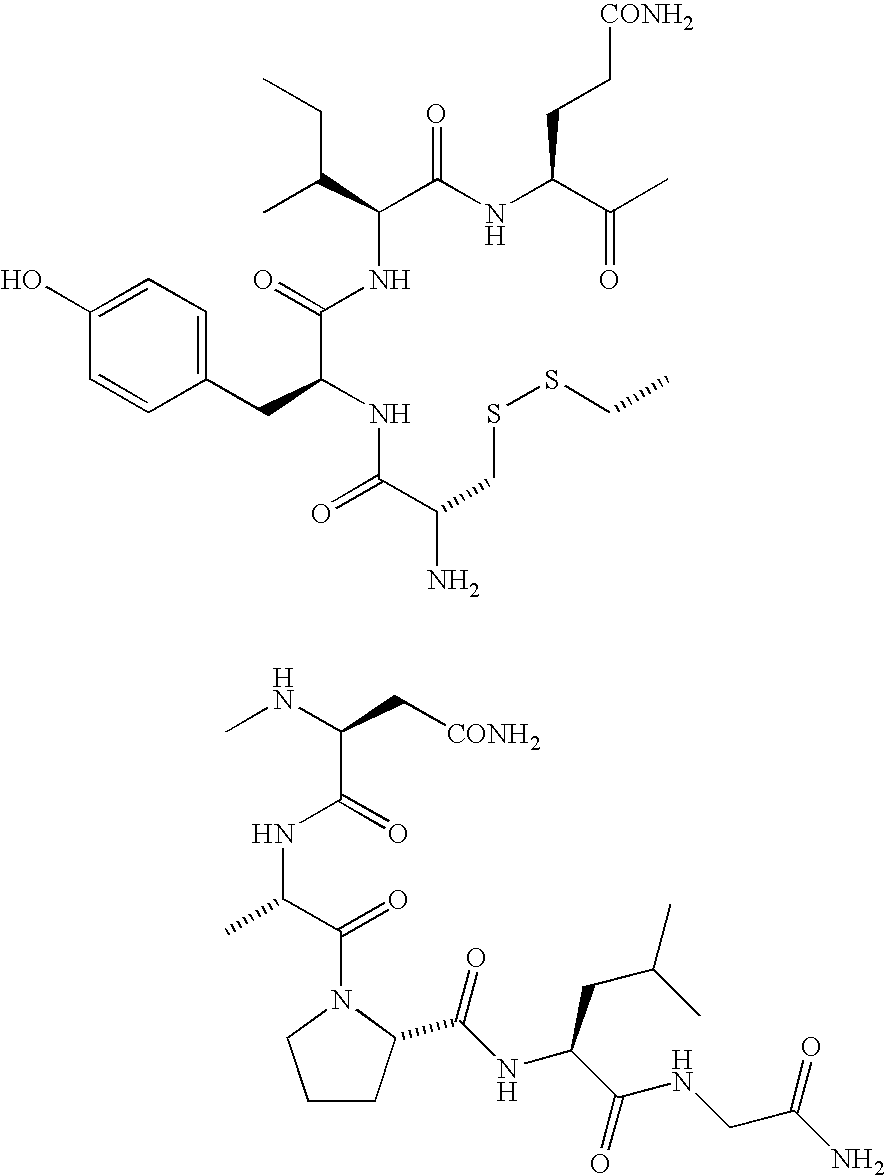
Figure 1 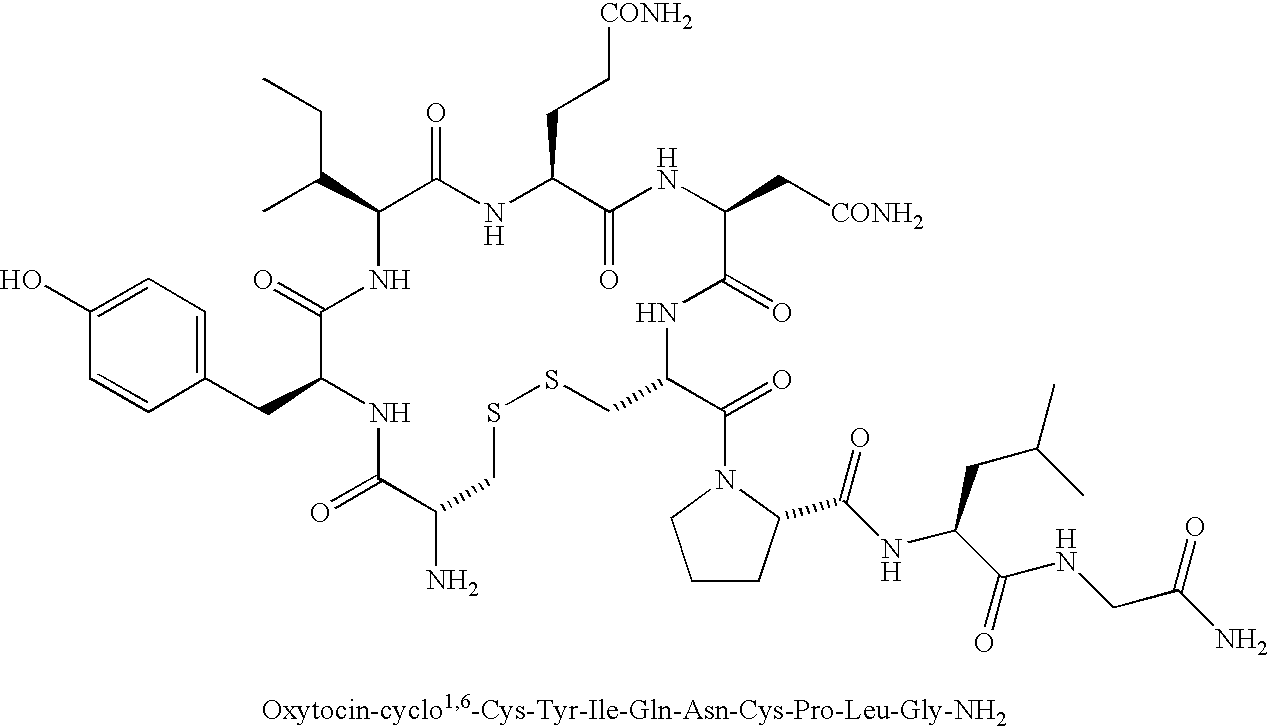
Figure 2 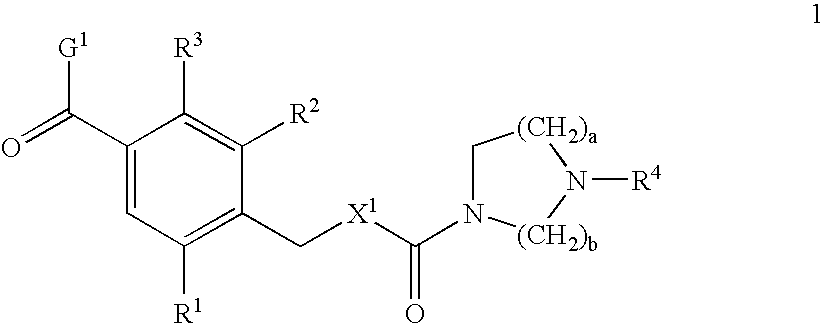
Figure 3
Abstract
Description
FIELD OF THE INVENTION
[0001] The present invention relates to novel non-peptide oxytocin agonists and to pharmaceutical compositions comprising such compounds. The present invention also relates to the use of non-peptide oxytocin agonists for the treatment of certain physiological disorders, such as erectile dysfunction and primary dysmenorrhoea.BACKGROUNDNeurophyseal Hormones
[0002] The neurophyseal hormones oxytocin (OT) and vasopressin (VP) are cyclic nonapeptides secreted by the posterior pituitary gland. The structure of oxytocin is shown below.
[0003]
[0004] Vasopressin differs from oxytocin in that it has phenylalanine at position 3 in place of isoleucine and arginine at position 8 in place of leucine. Both hormones are synthesised in vivo as larger precursors, neurophysins, which are subject to post-translational processing to release the mature peptides. OT and VP act through a family of heptahelical receptors. Only one OT receptor has so far been well characterised, while three ...
Examples
example 1
1-Benzyl-4,10-dihydropyrazolo[5,4-b][1,5]benzodiazepine
[0179]
1A: Ethyl 5-amino-1-benzylpyrazole-4-carboxylate
[0180]Benzylhydrazine dihydrochloride (4.29 g, 22 mmol) was added to a solution of ethyl (ethoxymethylene)cyanoacetate (3.38 g, 20 mmol) and triethylamine (6.15 ml, 44 mmol, 2 eq) in ethanol (40 ml) and the mixture was heated at reflux for 18 h. The solvent was removed in vacuo and the residue was purified by flash chromatography on silica gel (eluant 60% pet. ether / 40% ethyl acetate) to yield a pale yellow solid identified as ethyl 5-amino-1-benzylpyrazole-4-carboxylate (4.3 g, 88%).
1B: Ethyl 1-benzyl-5-(2′-nitrophenylamino)pyrazole-4-carboxylate
[0181]Sodium hydride (60% dispersion in oil, 520 mg, 13 mmol) was added portionwise to a suspension of ethyl 5-amino-1-benzylpyrazole-4-carboxylate (2.2 g, 9 mmol) in anhydrous THP (30 ml) at 0° C. The mixture was allowed to warm to room temperature and stirred for 2 h then 1-fluoro-2-nitrobenzene (1.26 g, 9 mmol) was added and the r...
example 2
1-Methyl-4,10-dihydropyrazolo[4,5-c]pyrido[2,3-b][1,4]diazepine
[0189]
2A: Ethyl 1-methyl-2-3′-nitro-2′-pyridylamino)pyrazole-4-carboxylate
[0190]Sodium hydride (60% dispersion in oil, 600 mg, 15 mmol) was added portionwise to a suspension of ethyl 5-amino-1-methylpyrazole-4-carboxylate (1.69 g, 10 mmol) in anhydrous THF (15 ml) at 0° C. The mixture was stirred for 2 h at room temperature then 2-chloro-3-nitropyridine (1.58 g, 10 mmol) was added and the resulting deep red suspension was stirred at room temperature for 18 h. 1 M KHSO4 was added to quench the reaction and the solvent was removed in vacuo. The residue was dissolved in ethyl acetate and the solution was washed with 0.3 M KHSO4, sat NaHCO3 and brine, dried over Na2SO4 and concentrated in vacuo. The residue was purified by flash chromatography on silica gel (eluant 30% pet. ether / 70% ethyl acetate) to give ethyl 1-methyl-2-(3′-nitro-2′-pyridylamino)pyrazole-4-carboxylate (1.95 g, 67%).
[0191]MS [M+H]+ 292.0
2B: Ethyl 2-(3′-ami...
example 3
tert-Butyl 4-aminomethyl-3-chlorobenzoate
[0196]
3A: tert-Butyl 3-chloro-4-methylbenzoate
[0197]Thionyl chloride (11 ml, 150 mmol) was added to a suspension of 3-chloro-4-methylbenzoic acid (5.12 g, 30 mmol) in toluene (25 ml) and the mixture was heated at reflux for 2 h. The solvent was removed in vacuo and the residue was azeotroped with toluene three times, then dissolved in anhydrous THF (40 ml) and cooled to 0° C. Lithium tert-butoxide (2.4 g, 30 mmol) was added and the mixture was stirred at room temperature for 3 days. Water (5 ml) was added and the solvent was removed in vacuo. The residue was dissolved in ethyl acetate. The solution was washed with 0.3M KHSO4, sat. NaHCO3 and brine, dried over Na2SO4 and concentrated in vacuo to give a pale yellow gum identified as tert-butyl 3-chloro-4-methylbenzoate (5.4 g, 79%).
3B: tert-Butyl 4-bromomethyl-3-chlorobenzoate
[0198]N-Bromosuccinimide (4.27 g, 24 mmol) and 2,2′-azo-bis(2-methylpropionitrile) (394 mg, 2.4 mmol) were added to a so...