
Fluorinated polyoxyalkylene glycol diester surfactants
a technology of polyoxyalkylene glycol and surfactants, which is applied in the field of surfactants, can solve the problems of reducing the performance effect of altering surface behavior, using fluorinated surfactants containing longer perfluoroalkyl chains, and tetrafluoroethylene is a hazardous and expensive intermediate with limited availability
Patent Information
- Authority / Receiving Office
- US · United States
- Patent Type
- Patents(United States)
- Current Assignee / Owner
- Publication Date
- 2011-09-20
- Estimated Expiration
- Not applicable · inactive patent
Smart Images
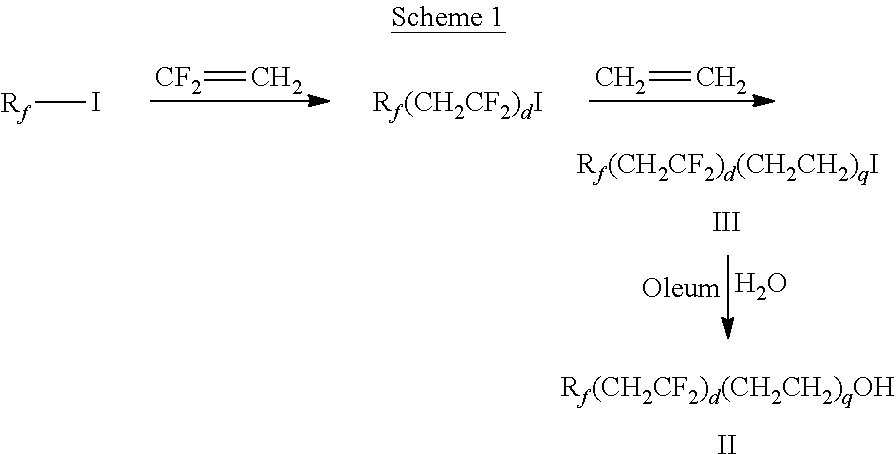
Figure 1 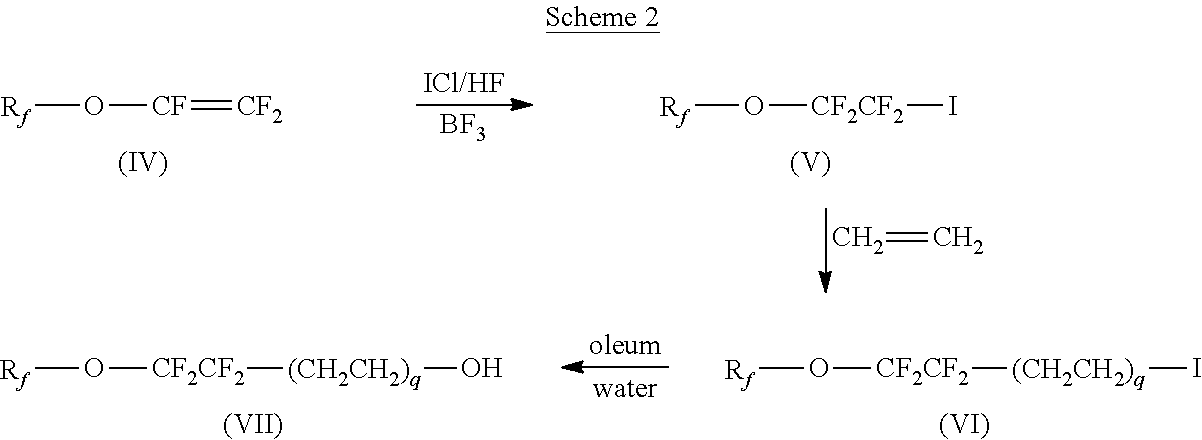
Figure 2 
Figure 3
Abstract
Description
FIELD OF THE INVENTION
[0001] This invention relates to a fluorinated polyoxyalkylene glycol diester and use thereof as a surfactant.BACKGROUND OF THE INVENTION
[0002] Most commercially available fluorinated surfactants are produced through electrochemical fluorination or telomerization. Electrochemical fluorination utilizes anhydrous hydrofluoric acid as the fluorine source. However, industrially produced hydrofluoric acid contains impurities; which requires use of further complicated processes to remove these impurities.
[0003] Telomerization processes use tetrafluoroethylene as the starting material. However, tetrafluoroethylene is a hazardous and expensive intermediate with limited availability. The telomerization products contain a mixture of homologs which contain a distribution of different carbon chain lengths, typically containing chain lengths of from about 4 to about 20 carbons. Therefore, in order to produce fluorinated surfactants which contain a fluorinated carbon chain of f...
Examples
example 1
[0108]A mixture of ethanolamine (13 g, 28 mmol) and ether (30 mL) was cooled to 15° C. Perfluoro-2-methyl-3-oxahexanoyl fluoride (33 g in ether 50 mL) was added dropwise to keep the reaction temperature below 25° C. After the addition, the reaction mixture was stirred at room temperature for one hour. The solid was removed by filtration and the filtrate was washed with hydrochloric acid (0.5N, 30 mL), water (2 times 30 mL), sodium hydrogen carbonate solution (0.5N, 20 mL), water (30 mL), and sodium chloride solution (saturated, 20 mL). It was then concentrated and dried in vacuum over night at room temperature to give N-(perfluoro-2-methyl-3-oxahexanoyl)-2-aminoethanol as a white solid 35 g, yield 95%. mp. 69-72° C. 1H NMR (CDCl3) δ 1.67 (bs, 1H), 3.57 (m, 2H), 3.80 (t, J=5 Hz, 2H), 6.91 (bs, 1H).
[0109]A 3-neck flask equipped with an air condenser, stopper and septa kept under nitrogen flush was charged with dry dichloromethane (100 mL). The flask was cooled to 15° C. and poly(ethyl...
example 2
[0110]A similar procedure as described in Example 1 was followed using poly(ethylene glycol) bis(carboxymethyl) ether (Mw ˜1000, average n=19-20, 1.1 g) and C3F7OCFCF3CONH(CH2)2OH (0.903 g) prepared as in Example 1. The reaction mixture was warmed to room temperature and allowed to stir overnight. GC-analysis showed the complete conversion of fluorinated alcohol to the ester. The resulting clear solution was transferred to a separatory funnel and washed with 2% HCl (2×50 mL), saturated NaHCO3 solution (2×50 mL) and brine (1×50 mL). The organic layer was dried (anhydrous MgSO4), concentrated and dried under vacuum to provide fluorinated polyoxyalkylene glycol-diester (1.72 g) as a colorless oil. IR, neat, 3291 cm−1, N—H stretch, 1754 cm−1, C═O stretch of ester, 1716 cm−1 C═O stretch of amide. 1H NMR (CDCl3): δ 4.31 (t, J=4.8 Hz, 4H, OCH2), 4.18 (s, 4H, COCH2O), 3.71 (q, J=5.2 Hz, 4H, N—CH2), 3.64 (bs, polyoxyalkylene glycol OCH2s), 3.0 (bs, 2H, NH): 19F NMR (CDCl3): δ−81.3 (dm, J=147...
example 3
[0111]Ethylene (25 g) was introduced to an autoclave charged with C4F9CH2CF2I (217 g) and d-(+)-limonene (1 g), and the reactor heated at 240° C. for 12 hours. The product was isolated by vacuum distillation to provide C4F9CH2CF2CH2CH2I. Fuming sulfuric acid (70 mL) was added slowly to 50 g of C4F9CH2CF2CH2CH2I and mixture was stirred at 60° C. for 1.5 hours. The reaction was quenched with ice-cold 1.5% by weight Na2SO3 aqueous solution and heated at 95° C. for 0.5 hours. The bottom layer was separated and washed with 10% by weight aqueous sodium acetate and distilled to provide C4F9CH2CF2CH2CH2OH: bp 54-57° C. at 2 mmHg (267 Pa).
[0112]A 4-neck flask with condenser, Dean-Stark trap, magnetic stirrer, thermocouple, and heating mantle was charged with poly(ethylene glycol) bis(carboxymethyl) ether (Mw ˜600, average n=10-11, 10.0 grams), C4F9CH2CF2CH2CH2OH (10.9 grams), p-toluene sulfonic acid (0.22 grams), and toluene (100 grams). After refluxing for 15 hours, GC analysis confirmed fo...