
Folding hopping robot
A robotic and foldable technology, applied in motor vehicles, transportation and packaging, etc., can solve the problems of low bouncing height, single movement form, inability to adjust the take-off direction and angle, and achieve the effect of saving electricity
- Summary
- Abstract
- Description
- Claims
- Application Information
AI Technical Summary
Problems solved by technology
Method used
Image

Examples
Embodiment Construction
[0021] The working principle and working process of the present invention will be further described in detail below in conjunction with the accompanying drawings and embodiments.
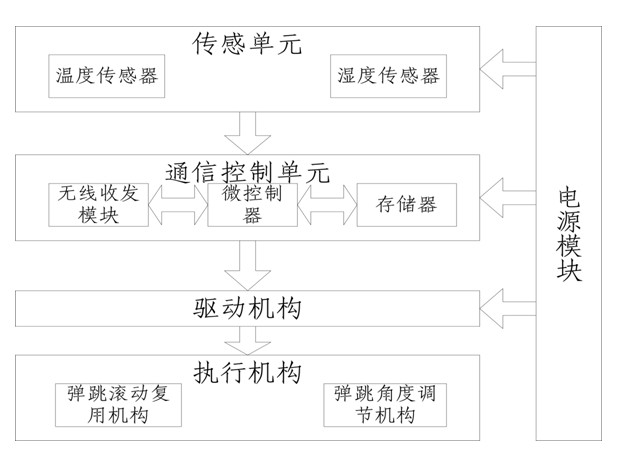
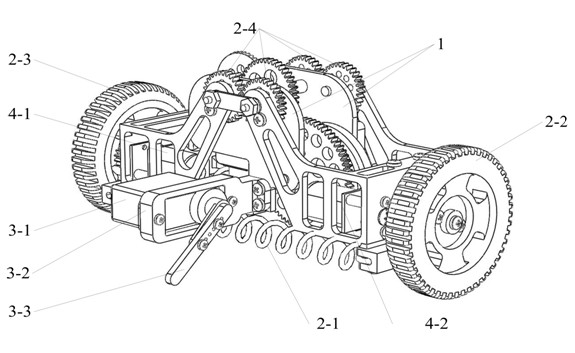
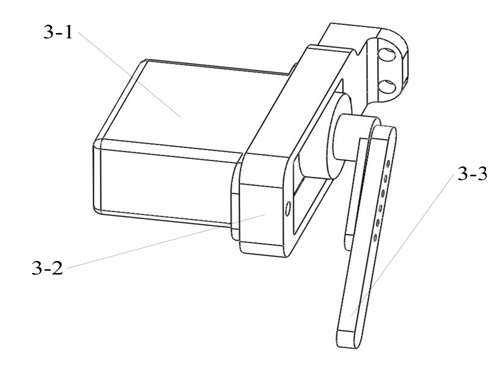
[0022] refer to figure 1 , the folding bouncing robot consists of a frame ( figure 2 shown in 1), bouncing and rolling multiplexing mechanism, take-off angle adjustment mechanism, driving mechanism, sensing unit, communication control unit and power supply module, the features are: the frame is used to fix the mechanical structures; ( figure 2 ) to complete the bouncing and rolling functions of the robot; the take-off angle adjustment mechanism ( image 3 ) to complete the function of adjusting the take-off angle; the driving mechanism is divided into a bouncing driving mechanism ( Figure 5 ) and the scroll drive mechanism ( Figure 6 ) two parts, which provide driving force for the robot's bouncing, rolling and take-off angle adjustment; the sensor unit is used to collect environmental info...
PUM
 Login to View More
 Abstract
Description
Claims
Application Information
 Login to View More