Method and system for improving single-user peak rate and throughput of TDD (Time Division Duplex) CDMA (Code Division Multiple Access) system

A peak rate, single-user technology, applied in network traffic/resource management, error prevention/detection using return channels, electrical components, etc. question

CN102223217AInactive Publication Date: 2011-10-19TD TECH COMM TECH LTD
1 Cites 13 Cited by

Patent Information

Authority / Receiving Office
CN · China
Current Assignee / Owner
Publication Date
2011-10-19
Estimated Expiration
Not applicable · inactive patent

Smart Images

  • Figure 1
    Figure 1
  • Figure 2
    Figure 2
  • Figure 3
    Figure 3
Patent Text Reader

Abstract

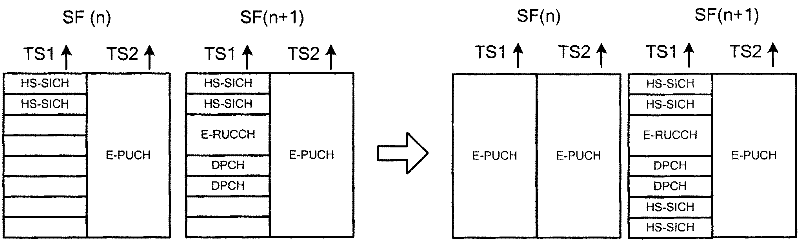
The invention provides a method and a system for improving single-user peak rate and throughput of a time-division duplexing code division multiple-access (TDD (Time Division Duplex) CDMA (Code Division Multiple Access)) system. A plurality of HS-SICH channels originally corresponding to independent hybrid automatic repeat request (HARQ) process on different subframes are tied on the time slot ofone subframe by a time delaying method so as to be sent, thus separating a plurality of unoccupied uplink time slots in the uplink time slots originally occupied by the HS-SICH. The separated unoccupied uplink time slots are combined with the original E-PUCH time slots to form a greater E-PUCH resource pond, thus being used for improving the uplink peak rate of the single user or the uplink throughput of the base station.
Need to check novelty before this filing date? Find Prior Art

Description

technical field

[0001] The invention relates to mobile communication technology, in particular to a method and a system for improving the peak rate and throughput of a single user in a Time Division Duplex Code Division Multiplexing (TDDCDMA) system. Background technique

[0002] In the existing Time Division Synchronous Code Division Multiplexing (TD-SCDMA) High Speed ​​Packet Access (HSPA) system, when the downlink control signaling High Speed ​​Shared Control Channel (HS-SCCH) schedules the High Speed ​​Downlink Shared Channel (HS-DSCH) For users, there is a definite timing relationship between HS-SCCH and HS-DSCH. After the user equipment (UE) demodulates the HS-DSCH, and feeds back the HS-DSCH reception confirmation / non-acknowledgment message (ACK / NACK) to the base station (NodeB) on the uplink high-speed shared information channel (HS-SICH), the HS - The timing relationship between the SICH and the HS-SCCH is also determined, and the HS-SICH channel not only carries A...

Examples

Embodiment 1

[0085] Embodiment 1 Taking an application scenario in which four consecutive HS-SCCHs correspond to one HS-SICH feedback time as an example, the solution of the present invention is further described in detail.

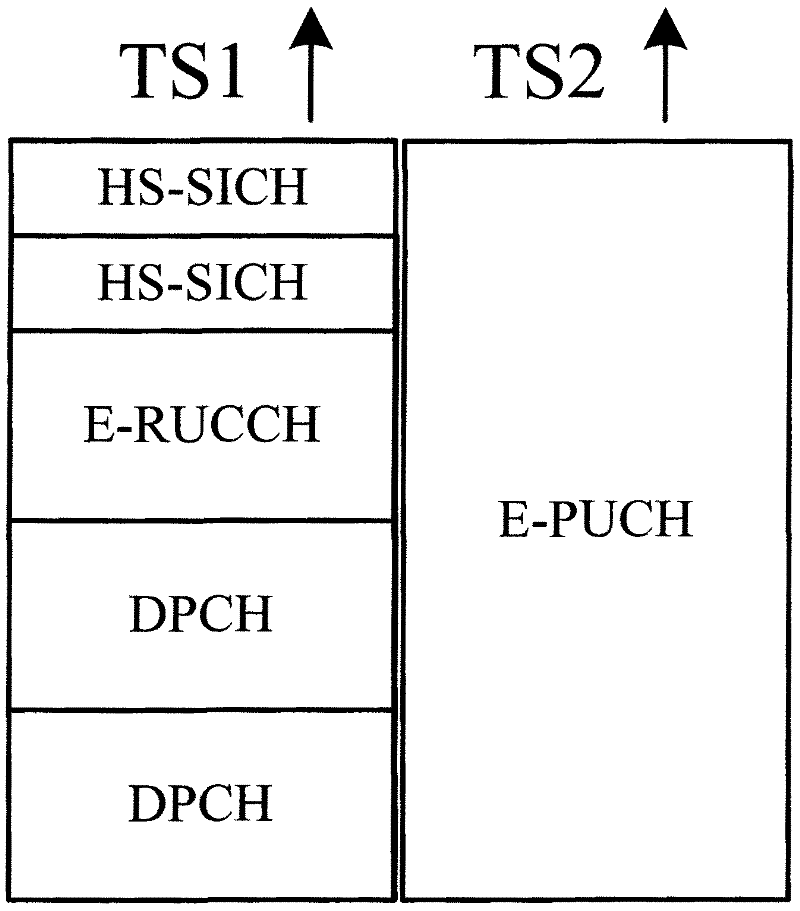
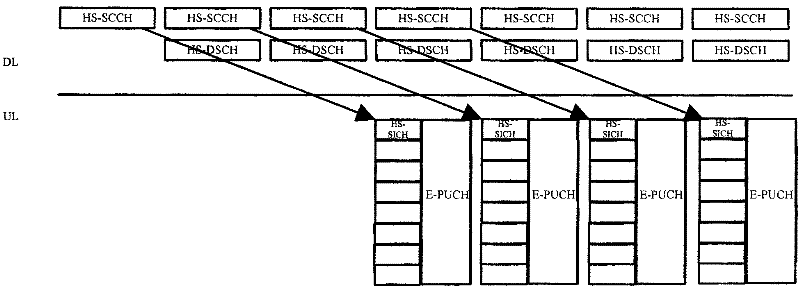
[0086] Figure 5 Shown in Embodiment 1 of the present invention are two examples in which four HS-SICHs are bound and sent on one uplink time slot. Two consecutive 10ms time slots are the window length of the binding window, and each binding window Both can support one or more users to schedule at the same time. Figure 5 In , the HS-SCCH of 20ms (that is, 4 downlink time slots) in a row corresponds to the 4 HS-SICHs in the third uplink time slot after the last HS-SCCH time slot, and the corresponding relationship is indicated by the downward arrow express. The two instances can be implemented independently or in cooperation with each other, that is, one NodeB maintains two binding scheduling windows.

[0087] Image 6 It is a schematic diagram of the mapping rela...