No-reference Stereo Image Quality Evaluation Method Based on Dictionary Learning and Machine Learning

A stereoscopic image and dictionary learning technology, applied in image enhancement, image analysis, image data processing, etc., to achieve the effect of improving correlation

CN105488792BActive Publication Date: 2017-11-28广州方维知识产权运营有限公司
9 Cites 0 Cited by

Patent Information

Authority / Receiving Office
CN · China
Patent Type
Patents(China)
Current Assignee / Owner
Publication Date
2017-11-28

Smart Images

  • Figure 1
    Figure 1
  • Figure 2
    Figure 2
Patent Text Reader

Abstract

The invention discloses a no-reference stereo image quality evaluation method based on dictionary learning and machine learning. The method comprises the following steps of: firstly, performing log-Gabor filtering for left and right viewpoint images, obtaining respective amplitude and phase information, then, performing local binarization operation for the amplitude and the phase information, and obtaining a local binarization mode feature image of the left and right viewpoint images; secondly, using a binocular energy model to fuse the amplitude and the phase information of the left and right viewpoint images, obtaining binocular energy information, and acquiring a local binarization mode feature image of the binocular energy information; then, using a coordination representation algorithm to perform dictionary learning for the local binarization mode feature images of the left and right viewpoint images and the binocular energy information, obtaining binocular visual perception sparse feature information, and finally, obtaining an objective quality evaluation predicted value of a to-be-evaluated distorted stereo image. The method has the advantages of being capable of fully considering stereo visual perception characteristics, and being capable of effectively improving correlation between objective evaluation result and subjective perception.
Need to check novelty before this filing date? Find Prior Art

Description

technical field

[0001] The invention relates to an objective evaluation method of stereoscopic image quality, in particular to a no-reference stereoscopic image quality evaluation method based on dictionary learning and machine learning. Background technique

[0002] Since entering the 21st century, with the maturity of stereoscopic image / video system processing technology and the rapid development of computer network and communication technology, people have a strong demand for stereoscopic image / video system. Compared with the traditional single-viewpoint image / video system, the stereoscopic image / video system is more and more popular because it can provide depth information to enhance the visual reality and give users an immersive new visual experience. It is considered to be the main development direction of the next-generation media, and has aroused widespread concern in the academic and industrial circles. However, in order to obtain better stereoscopic presence and v...

Examples

Embodiment Construction

[0039] The present invention will be further described in detail below in conjunction with the accompanying drawings and embodiments.

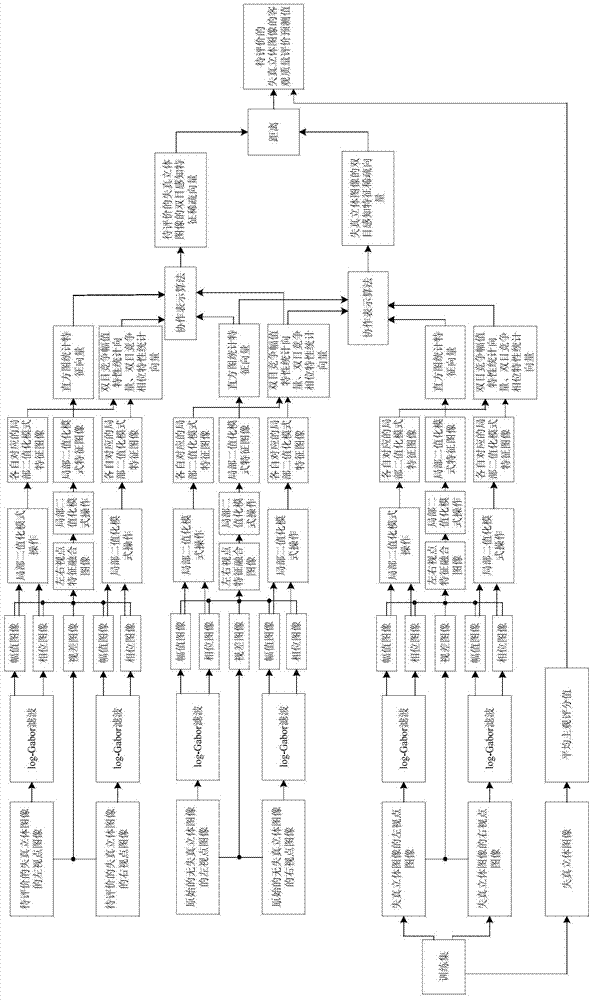
[0040] A no-reference stereoscopic image quality evaluation method based on dictionary learning and machine learning proposed by the present invention, its overall realization block diagram is as follows figure 1 As shown in Fig. 1, log-Gabor filtering is first performed on the left and right viewpoint images of the distorted stereo image to obtain the amplitude information and phase information of the left and right viewpoint images, and then the local binarization operation is performed on the amplitude information and phase information to obtain The local binarization mode feature images of the left and right viewpoint images; secondly, the binocular energy model is used to fuse the amplitude information and phase information of the left and right viewpoint images to obtain the binocular energy information, and the local binarization operati...