
An energy-saving strip coverage relay station deployment method
A relay station and strip technology, which is applied in the field of energy-saving strip coverage relay station deployment, can solve the problems of long-band area coverage and few people have studied it, achieve the dynamic balance of spectrum efficiency and energy efficiency, and ensure the effect of spectrum efficiency
- Summary
- Abstract
- Description
- Claims
- Application Information
AI Technical Summary
Problems solved by technology
Method used
Image

Examples
Embodiment Construction
[0043] The present invention will be described in further detail below in conjunction with the accompanying drawings and embodiments. It should be understood that the specific embodiments described here are only used to explain the present invention, not to limit the present invention.
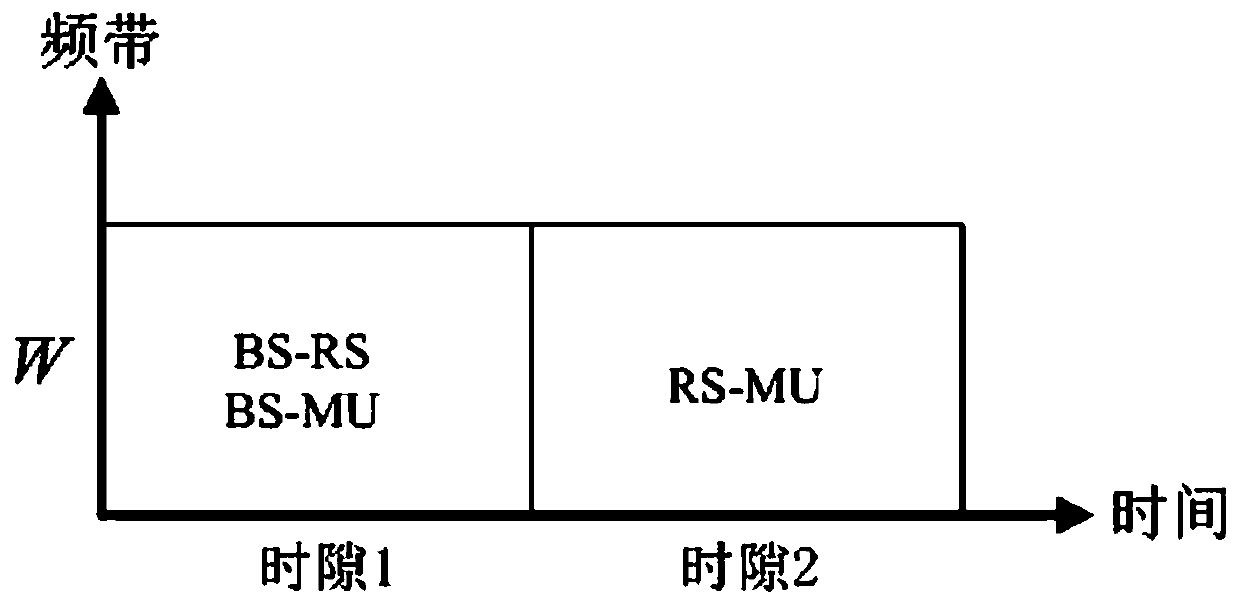
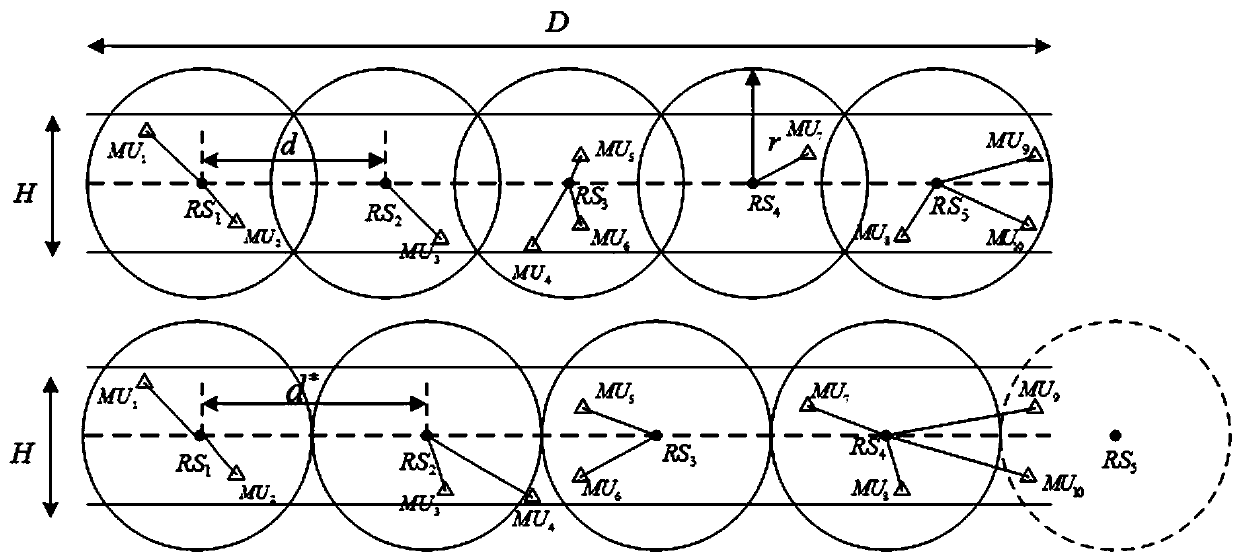
[0044] Assuming that there are multiple cells in the cellular network, adjacent cells use different frequency bands, and non-adjacent cells may consider frequency reuse, so that the relay station deployment method described above can be extended to multi-cell relay station deployment. In each cell, the base station BS is configured with multiple antennas, and multiple relay stations RS configured with multiple antennas are deployed in a strip-shaped area. The coverage of the relay stations is a circle with a radius of r. A large number of user MUs are randomly distributed in the cell, and users can access base stations or relay stations as required. In addition, we only discuss the case of tw...
PUM
 Login to View More
 Abstract
Description
Claims
Application Information
 Login to View More