Alternating rejuvenating pruning method for controlling number of large branches and managing small branches of castanea mollissima

A technology of alternately updating and pruning methods, applied in horticultural methods, botanical equipment and methods, horticulture, etc., can solve the problems of high fertilizer and water management conditions, unsafe operation, low yield, etc., to achieve controllable canopy size, convenient and safe management , the effect of strong tree

CN110558140AActive Publication Date: 2019-12-13赵玉亮
5 Cites 1 Cited by

Patent Information

Authority / Receiving Office
CN · China
Patent Type
Applications(China)
Current Assignee / Owner
Publication Date
2019-12-13

Smart Images

  • Figure 1
    Figure 1
  • Figure 2
    Figure 2
  • Figure 3
    Figure 3
Patent Text Reader

Abstract

The invention discloses an alternating rejuvenating pruning method for controlling the number of large branches and managing small branches of castanea mollissima, and belongs to the field of pruningof castanea mollissima trees. The disclosed pruning method comprises the steps that the number of the large branches is controlled, vigorous branches at the top end are removed, relatively healthy andstrong fruiting mother branches are retained for fruiting, and thin and delicate redundant useless branches are removed; two parallel healthy and strong fruiting mother branches are retained from front-end branch groups for fruiting, a renewal stake of 2-4 centimeters is retained on the adjacent position, and developmental branches of the renewed stake are promoted to grow for fruiting in the next year; through continuous fruiting and cultivation for three years, the overlong front-end branch groups are cut to retain stakes, and developmental branches of the stakes are promoted to grow for fruiting in the next year. The alternating rejuvenating pruning method can save nutrients, rejuvenate the trees, and can achieve free stretch and retraction of crowns, and the insides and outsides of the crowns are pervious to light and have fruiting mother branches, thereby achieving the purpose of three-dimensional fruiting.
Need to check novelty before this filing date? Find Prior Art

Description

technical field

[0001] The invention belongs to the field of chestnut tree pruning, and in particular relates to a method for alternately renewing and rejuvenating chestnuts by controlling large tubes and small tubes. Background technique

[0002] Chestnut is one of the main woody food tree species in my country. However, due to its biological characteristics such as light-loving, apical dominance, and strong branching power, it is easy to make the canopy closed, resulting in insufficient light and ventilation inside the canopy, resulting in the fruiting of the canopy. The phenomenon of outward migration reduces fruit yield and quality, resulting in economic losses. Pruning in winter can adjust the structure of the tree, adjust the internal light of the canopy, and adjust the distribution of nutrients among various organs, etc. The ventilation and light transmission conditions in the canopy with different pruning intensities are different, resulting in differences in temperat...

Examples

Embodiment 1

[0033] A chestnut control large tube small alternate update rejuvenation pruning method, the specific steps are as follows:

[0034] 1. After the chestnut tree is grafted into a cultivated variety, remove invalid large branches: according to the requirements of plastic surgery, select and retain the main branch, side branch and fruiting branch group, and control the reasonable tree height.

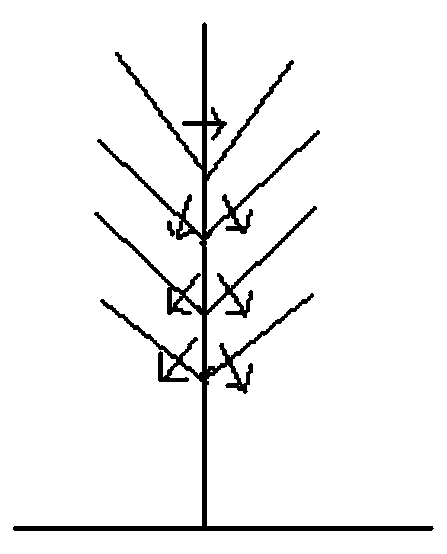
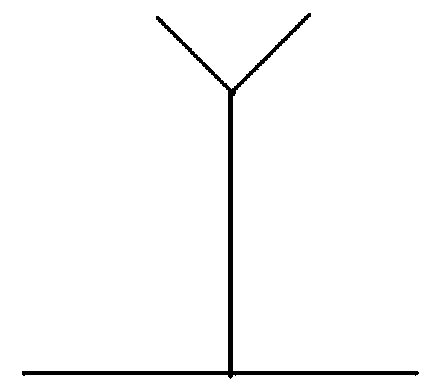
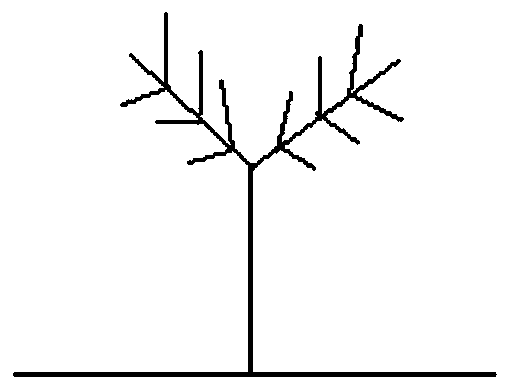
[0035] 2. When pruning in the first year, remove the strong branches at the top, keep 2 strong branches in the horizontal direction for fruiting in the same year, and remove all the weak branches below, that is, the so-called control of large and small, specific pruning methods see Figure 1a-1b .

[0036] 3. When pruning in the second year, remove the strong branches at the top of the two fruit-bearing branch groups, keep the two strong branches in the horizontal direction, and remove all the weak branches below; The other one retains 2-4cm at the base and keeps the prongs, which can pr...