
Method for evaluating temperature and humidity states of growing environment of nursery pig individual based on relative abundance of nasal cavity prokaryotic microorganisms
A prokaryotic microorganism and relative abundance technology, applied in the field of pig breeding environment assessment, can solve the problems that the temperature and humidity index is difficult to evaluate the temperature and humidity state of pigs, and the temperature and humidity environment state cannot be accurately evaluated.
- Summary
- Abstract
- Description
- Claims
- Application Information
AI Technical Summary
Problems solved by technology
Method used
Image

Examples
Embodiment Construction
[0032] Unless otherwise specified, the experimental methods, materials and reagents used in the following examples are conventional methods, materials and reagents, all of which can be obtained from commercial sources.
[0033] 1. Test animals
[0034] Select 40 Large White-Landrace binary nursery pigs with no significant difference in body weight and divide them into 5 groups at random, with 8 heads in each group (n=8). Provide enough drinking water, provide the same reference NRC standard configuration feed, and eat freely.
[0035] 2. Test procedure and sample collection
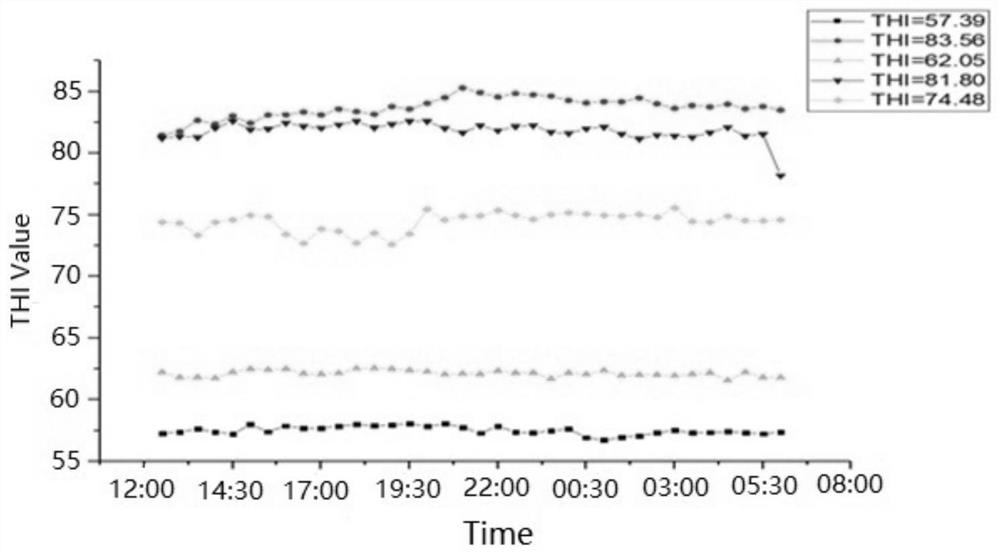
[0036]The temperature and humidity environment of the nursery pigs in the control test in the respiration calorimetry cabin is the same for each group. In this test, the temperature and humidity environment is controlled by air conditioning. After later calculation, the environmental temperature and humidity indexes of the five groups of test pigs during the test period were 57.5, 62.1, 74.4, 81.8, and ...
PUM
 Login to View More
 Abstract
Description
Claims
Application Information
 Login to View More