
Interval intuitionistic fuzzy multi-attribute group decision supplier selection method
A technology of fuzzy intuition and group decision-making, which is applied in data processing applications, special data processing applications, complex mathematical operations, etc. It can solve the problems of not using hesitation information, not considering comprehensively, and not fully considering the definition of interval intuition fuzzy numbers.
- Summary
- Abstract
- Description
- Claims
- Application Information
AI Technical Summary
Problems solved by technology
Method used
Image



Examples
Embodiment Construction
[0061] The present invention will be further described in detail below in conjunction with the accompanying drawings and specific embodiments: taking this as an example to further describe and illustrate the present application.
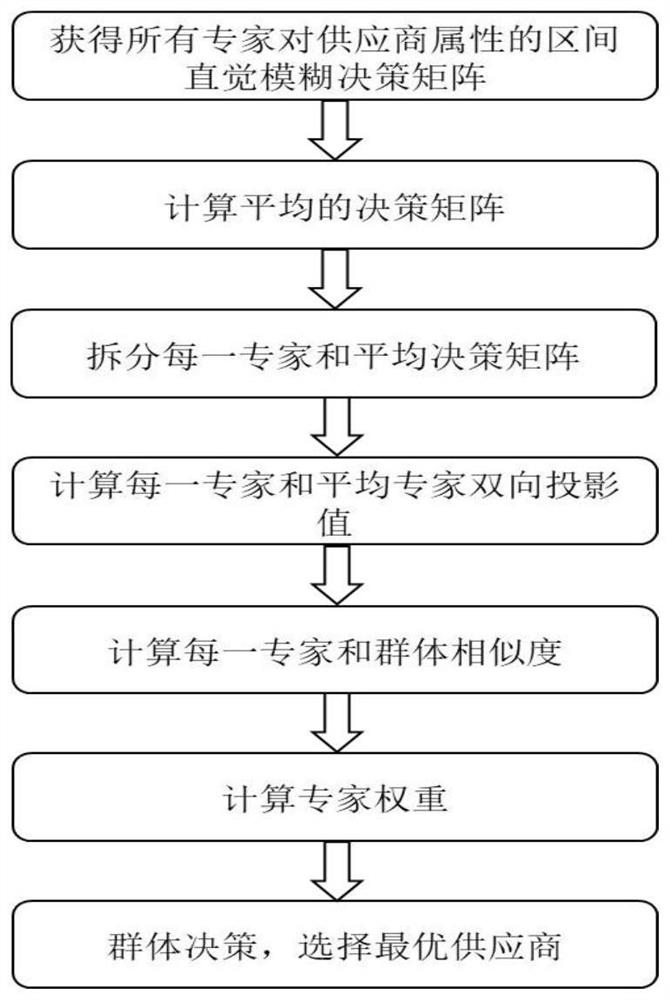
[0062] Aiming at the problem of supplier selection in which experts evaluate supplier attributes as interval intuitionistic fuzzy numbers, under the premise that the expert weight is completely unknown, the more similar the expert is to the group, the greater the weight should be, and a weighted interval is designed for this purpose. The two-way projection formula of the number matrix is used to determine the weight of the experts. The content of the present invention is to first use the existing operator to assemble the decision matrix of each expert to form an average decision matrix, and use the decision matrix of each expert to split into a membership degree matrix, a non-membership degree matrix and a value hesitation matrix , and use the impr...
PUM
 Login to View More
 Abstract
Description
Claims
Application Information
 Login to View More