
Natural language generation through character-based recurrent neural networks with finite-state prior knowledge
- Summary
- Abstract
- Description
- Claims
- Application Information
AI Technical Summary
Benefits of technology
Problems solved by technology
Method used
Image


Examples
examples
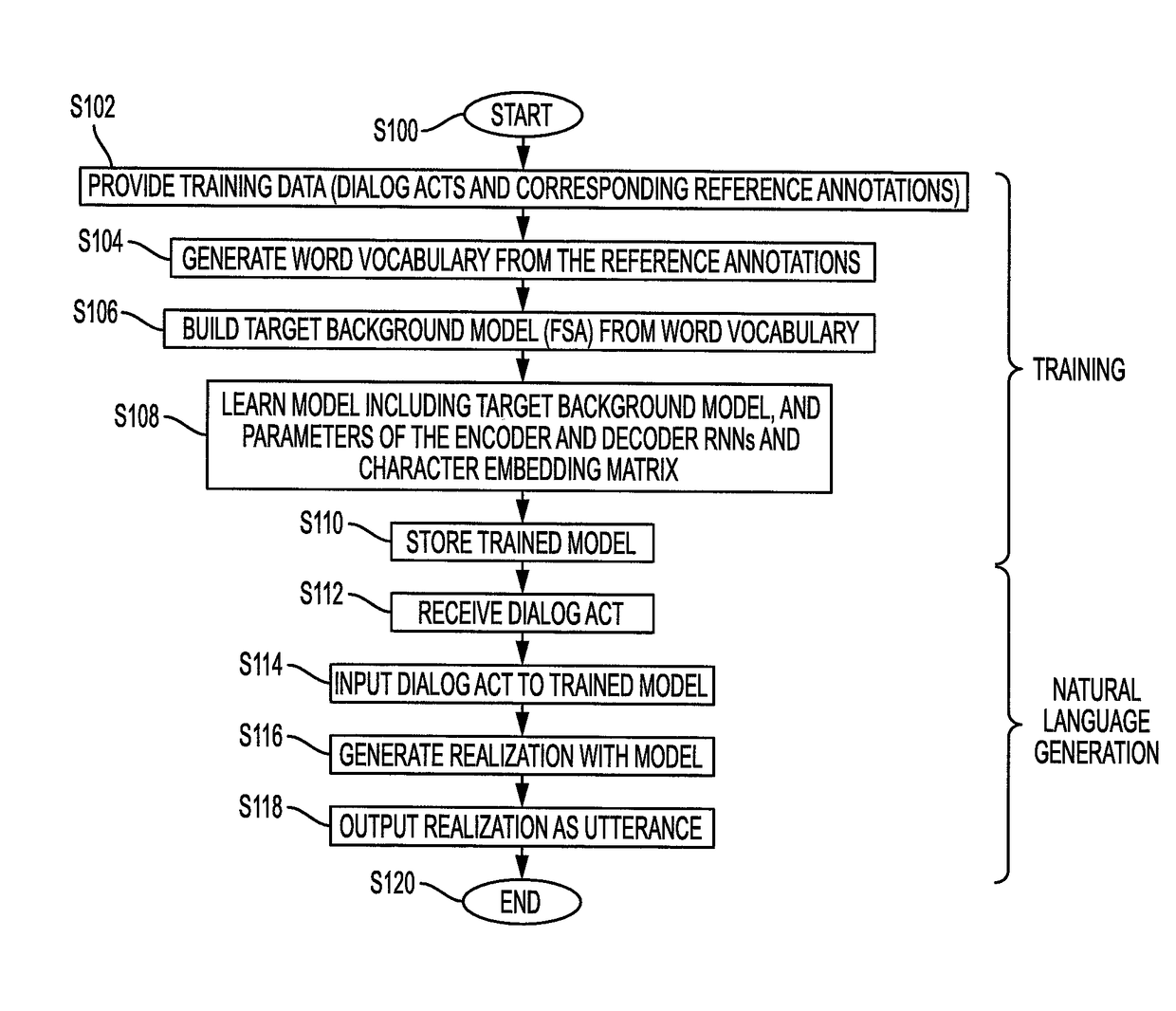
[0138]Experiments were performed using the character-based attention encoder-decoder framework detailed above. For decoding, a greedy approach is used to sample from the conditional probability distribution by taking the most probable character at each step.
[0139]The following are the notations used for example samples below:
[0140]1. [D-ACT]: Dialog Act or the source sentence,
[0141]2. [REFERENCE]: True reference utterance,
[0142]3. [PREDICTION]: Utterance generated by the model.
[0143]Dataset
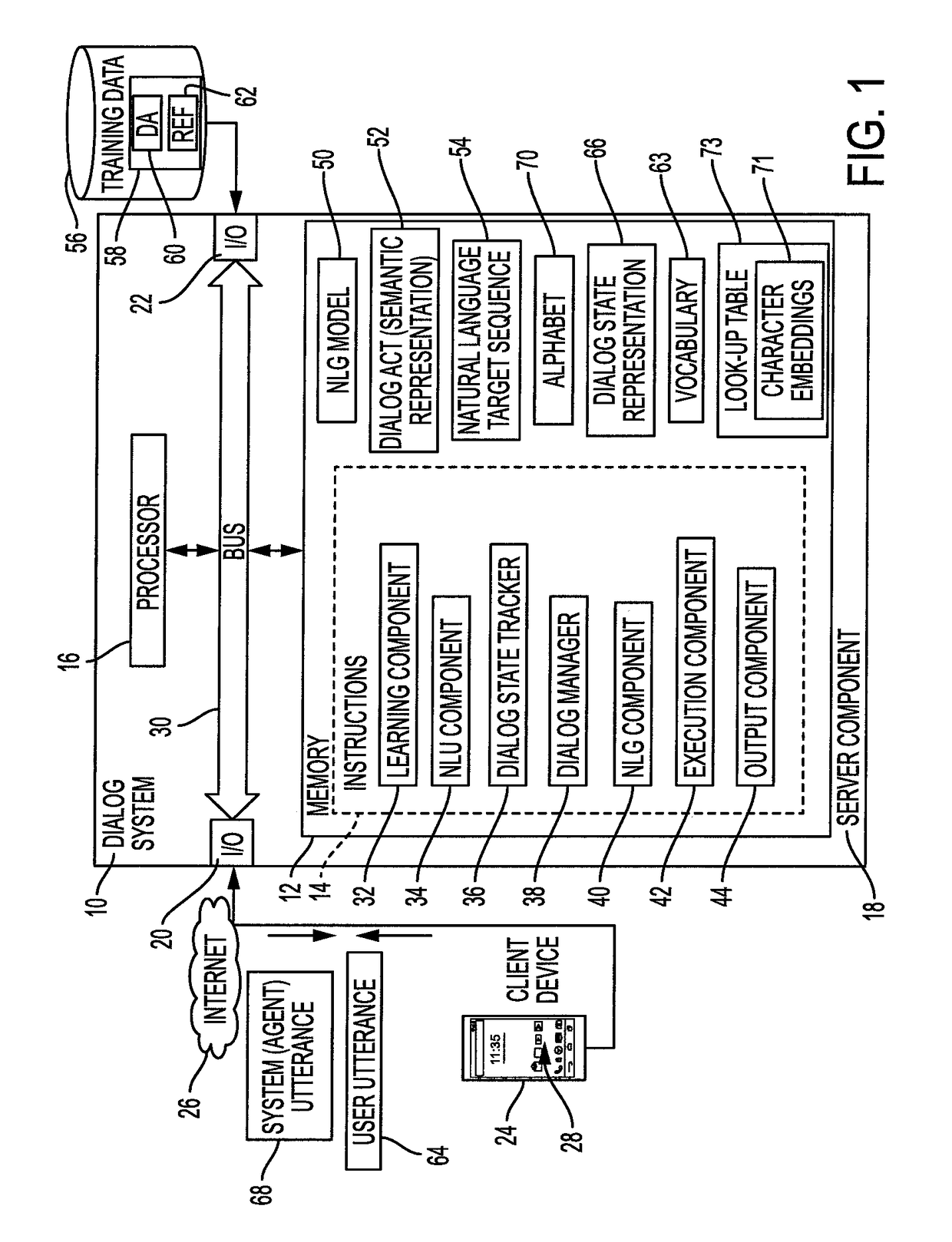
[0144]The dataset used for the following experiments was collected by Wen 2015 using crowdsourcing. It includes two domains, hotel and restaurant. Each domain includes dialogue acts 60 along with their corresponding natural language realizations 62. Each dialogue act is a combination of slot-value pairs of the information to be conveyed. There are eight dialogue act types such as inform, request, reject etc., and twelve slots such as name, pricerange, phone, etc.
[0145]Experiments were performed on...
PUM
 Login to View More
 Abstract
Description
Claims
Application Information
 Login to View More